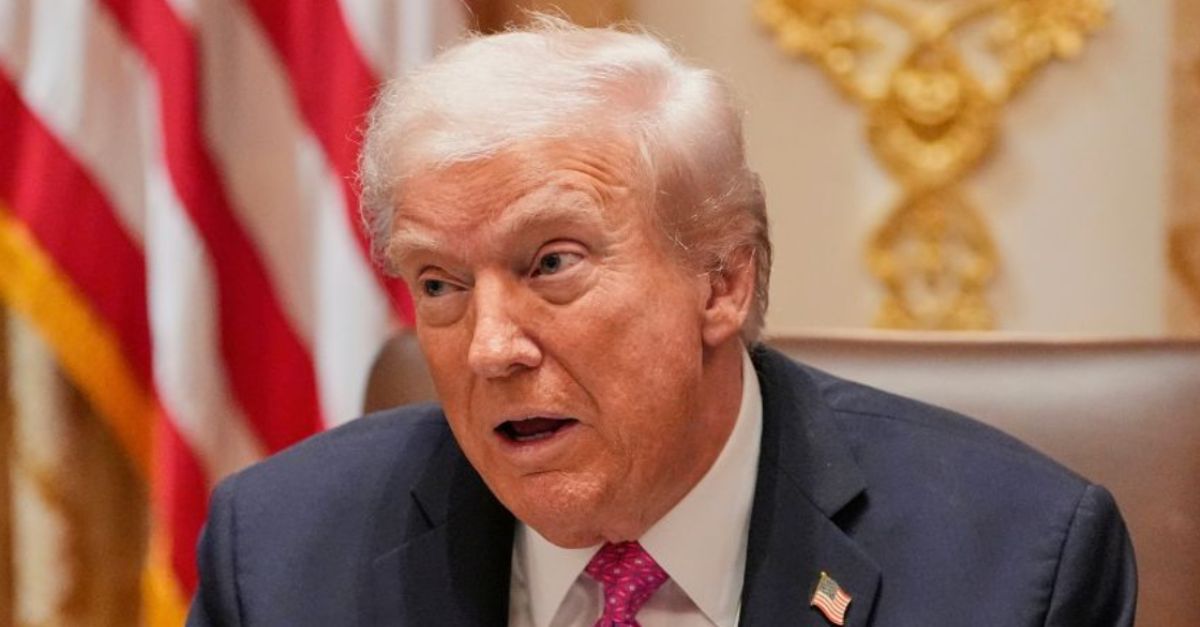

President Donald Trump speaks in the Cabinet Room of the White House, Friday, Oct. 17, 2025, in Washington (AP Photo/Alex Brandon).
The Trump administration is once more facing legal challenges over its implementation of a “broad” tariff policy, which allegedly raises tax burdens on states, companies, and consumers, according to a lawsuit filed on Thursday.
Just recently, the U.S. Supreme Court determined that President Donald Trump exceeded his authority by imposing tariffs under the International Emergency Economic Powers Act (IEEPA).
However, undeterred by this ruling, Trump swiftly enacted new tariffs using Section 122 of the Trade Act of 1974. In his statement, Trump asserted that these tariffs had “already been approved” and dismissed the need for congressional approval.
In response, a 35-page lawsuit spearheaded by New York Attorney General Letitia James, along with several states, claims that Trump “lacks inherent authority to impose tariffs,” as the power to levy such tariffs is constitutionally vested in Congress.
According to the cited statute, tariffs of up to 15% can be enacted under specific conditions but are restricted to a five-month period unless extended by Congress.
The lawsuit argues that the statute only grants “limited” powers to tackle “fundamental international payments problems,” necessitating “special import measures to restrict imports” to manage “large and serious balance-of-payments deficits.”
To hear the states tell it, the “balance-of-payments” language in the statute refers to something entirely different from Trump”s cited intention to balance the United States’ trade deficit.
“[T]he Section 122 Proclamation focuses on trade deficits,” the lawsuit reads. “Contrary to the Section 122 Proclamation, a trade deficit is not a balance of payments deficit. Indeed, Section 122 expressly differentiates between ‘balance of payments’ and ‘balance of trade.’”
The lawsuit goes on to characterize Trump’s “purported justification” as a “fatally flawed” effort at “redefining” the definition “contrary to its meaning and cherry-picking only the negative components that make up the balance of payments.” The definition used by the president ignores “the huge net positive financial inflow components that also make up the” commonly understood – and statutory “balance of payments,” the plaintiffs say.
In other words, the lawsuit says the term “balance of payments” used in Section 122 is a complicated concept involving multiple financial considerations which Trump has attempted to completely redefine in order to refer to the trade deficit.
The filing explains, at length:
A balance of payments deficit is a term of art incorporating into law a settled meaning from international financial accounting—it includes the balance of trade as only one element, but it also includes the balance of capital and financial transactions. A trade deficit does not qualify, either as a matter of economics or of law, as a balance of payments deficit.
The lawsuit goes on to needle and chastise Trump over the novel use of both the IEEPA and Trade Act statutes.
“That statute had, unsurprisingly, never been used to attempt anything of the sort,” the lawsuit reads. “Having lost the battle on IEEPA, the President now dusts off a separate statute…which is another statute that has never been used to impose tariffs. Indeed, it has never been used at all.”
Trump is even violating the plain language of the statute by giving tariff exceptions to several countries in North and South America, the lawsuit claims. Under Section 122, all tariffs are to “be applied consistently with the principle of nondiscriminatory treatment.”
“Altogether, the President’s goal is clear—he wishes to exercise carte blanche authority when tariffing the world based on any statutory reed he can find,” the filing goes on.
The lawsuit also alleges the president has acted in clear violation of his authority under the U.S. Constitution which only gives Congress the “Power To lay and collect Taxes, Duties, Imposts and Excises.”
In a dovetailing cause of action, the plaintiffs say Trump is acting in defiance of the Constitution’s separation of powers.
“Because the power to tariff rests with Congress, the President lacks inherent authority to impose tariffs, and the President has usurped Congress’s authority by imposing tariffs that violate Section 122,” the lawsuit goes on. “The Section 122 Proclamation is an exercise of Congressional authority in violation of separation of powers.”
The plaintiff states are seeking a court order that Section 122 cannot be used to impose tariffs. The lawsuit also asks a judge to issue refunds to companies that have already paid Section 122 tariffs.
Again the lawsuit at length:
Contrary to the purpose and limited delegation of Section 122, President Trump has invoked this statute to impose immense and ever-changing tariffs on whatever goods entering the United States he chooses and for whatever reasons he finds convenient. As with his unlawful use of IEEPA, the President has once again exercised tariff authority that he does not have—involving a statute that does not authorize the tariffs he has imposed—to upend the constitutional order and bring chaos to the global economy.
“Once again, President Trump is ignoring the law and the Constitution to effectively raise taxes on consumers and small businesses,” James said in a statement announcing the litigation. “After the Supreme Court rejected his first attempt to impose sweeping tariffs, the president is causing more economic chaos and expecting Americans to foot the bill. These tariffs will only drive up the cost of living, and I will continue to uphold the rule of law.”