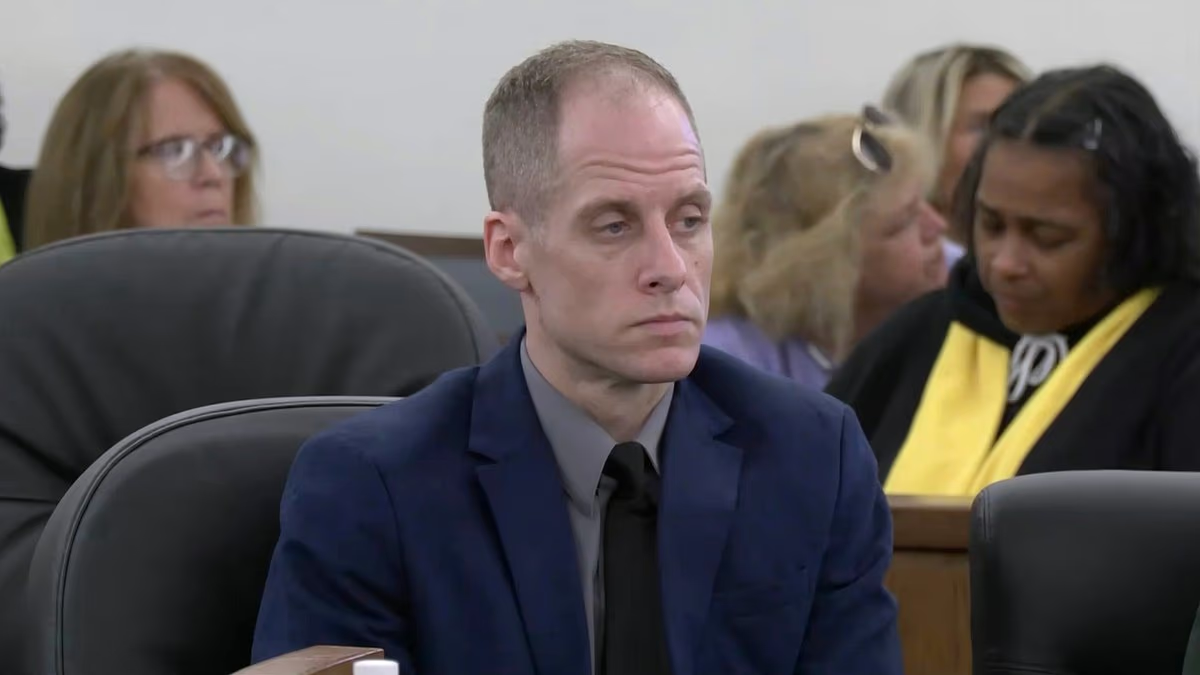
Man identified as Guy Wesley Reffitt
Jurors considering the debut trial related to the Jan. 6 attack can hear testimony from a law enforcement officer about a holster an accused militia member was wearing, a federal judge ruled on Thursday. The testimony could prove key to determining whether the man brought a gun to the U.S. Capitol.
U.S. District Judge Dabney Friedrich, a Donald Trump appointee, ruled that prosecutors could call a special agent to testify about the holster that Guy Reffitt was seen carrying at the Capitol.
Reffitt, a Texas man who has been linked to the Three Percenters militia group, memorably told his kids in the days after Jan. 6 that “traitors get shot.” The militia group gets its name from the historically inaccurate believe that only three percent of colonists participated in the American Revolution.
His son, Jackson Reffitt, had previously flagged his father to the FBI with concerns about his increasingly violent rhetoric. When the FBI called him to ask if his father was at the Capitol on Jan. 6, Jackson—notwithstanding Reffitt’s threat—said yes.
Reffitt never made it inside the Capitol building that day, but he’s accused of multiple felonies nonetheless. Reffitt allegedly led a group that charged at police officers trying to control the crowd at the Capitol as the mob of Donald Trump supporters sought to stop the certification of Joe Biden‘s win in the 2020 presidential election.
Prosecutors say Reffitt was armed at the time. Charges against him include obstruction of an official proceeding of Congress, obstruction of justice through physical force or threat of physical force, and entering or remaining in a restricted building or grounds with a deadly or dangerous weapon.
Reffitt’s trial is scheduled to start on Feb. 28. It will be the first case in the government’s sprawling prosecution of the Jan. 6 defendants.
The issue was whether the law enforcement agent whom the government has described as a “gun enthusiast” could testify as a lay witness about the holster Reffitt allegedly had on him at the Capitol. At the time, Friedrich thought the special agent’s testimony could potentially be prejudicial because the jury may give it a disproportionate amount of deference. Friedrich considered whether the agent should instead testify as an expert witness, which the government opposed.
At Thursday’s hearing, Friedrich said that she ultimately agreed with prosecutors’ arguments.
“I do agree with the government that [the agent’s testimony] falls on the lay rather than the expert side of the line,” Friedrich said. “I do think he could qualify as a firearms expert, but I don’t think it’s necessary to do so given the nature of his testimony.”
Friedrich said that the agent’s testimony would ostensibly be “helpful to determining a fact at issue, namely whether Mr. Reffitt was carrying a gun at the Capitol.”
Friedrich also took up the issue of jury instructions at Thursday’s hearing, and specifically addressed language proposed by the defense about the federal obstruction charge against Reffitt.
Friedrich was the first to rule on the propriety of the obstruction charge in Jan. 6 cases, as multiple defendants tried to get the charge dismissed. She ruled in the case of Ronald Sandlin that the charge could stand, and at least six judges have since followed in Friedrich’s footsteps in finding that the certification of Electoral College votes was an “official proceeding” for purposes of the statute and that the language of the statute wasn’t unconstitutionally vague.
But Welch, it seemed, was trying to push for jury instructions that didn’t exactly follow Friedrich’s ruling.
“Mr. Welch, your proposal, much of it conflicts with this Court’s decision in Sandlin, which you’re aware of,” she told defense lawyer William Welch.
“Your objections to the track this Court is on are well noted, and you’re not waiving them,” Friedrich said. She told Welch that it’s “not helpful to propose language inconsistent with” her previous rulings.
Welch also raised the issue of a jury instruction about testimony from someone he described as an “informant.” Prosecutors said this designation wasn’t necessary.
“We don’t believe the witness Mr. Welch is referring to would be classified as an informant,” Assistant U.S. Attorney Jeffrey Nestler said. “‘Informant’ has a specific definition in the law and no one was acting as an informant at the time these recordings were made.”
Friedrich said that she would rule on the issues raised about jury instructions at a later date.
Friedrich and the attorneys also discussed the jury selection process. Welch expressed concern that potential jurors’ own opinions about the Capitol attack may not be able to be impartial, an argument that other Jan. 6 defense attorneys have also raised.
Welch said that a proposed juror questionnaire asks whether a potential juror has “such strong feelings about Jan. 6 that would make it difficult to be a fair juror in this case.”
“I just can’t take a yes answer to that without drilling down,” Friedrich replied. “Do they just not want to serve, or do they really think they can’t be fair and impartial? That would be fleshed out in the individualized voir dire.”
“I can’t imagine any ‘yes’ answer leads us to disqualify a whole group en masse,” she added.
The next pretrial conference in Reffitt’s case is set for Feb. 18.
[Image via FBI.]
Have a tip we should know? [email protected]
Source: This post first appeared on