
Share this @internewscast.com
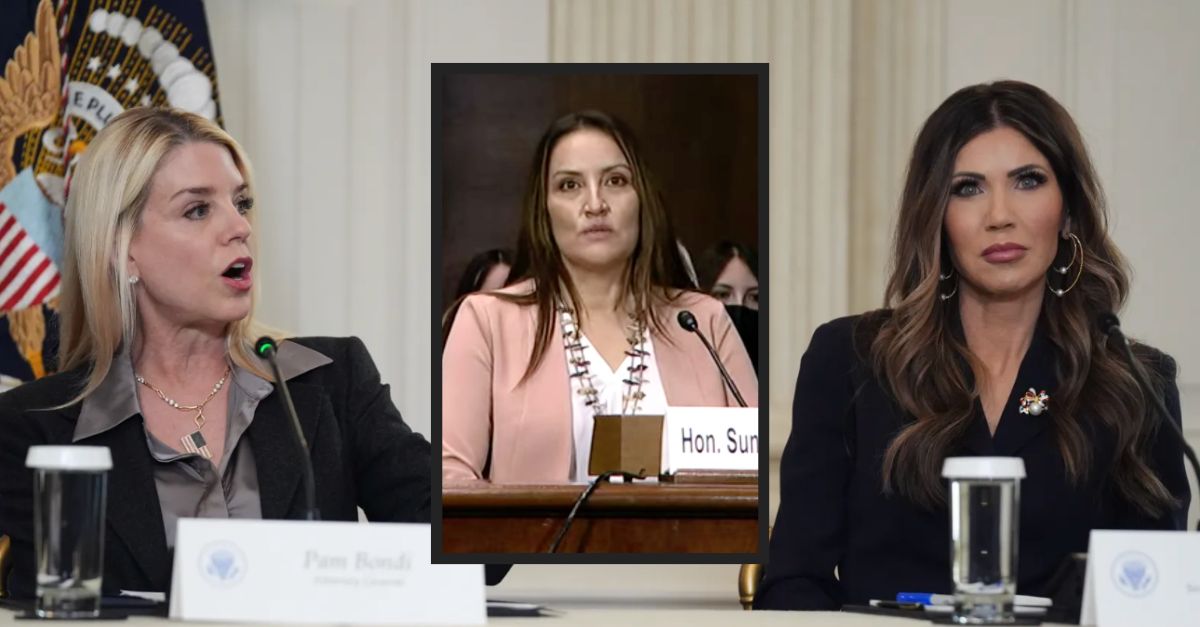
Main: Attorney General Pam Bondi speaks during a roundtable on criminal cartels with President Donald Trump in the State Dining Room of the White House, Thursday, Oct. 23, 2025, in Washington, as Homeland Security Secretary Kristi Noem listens (AP Photo/Evan Vucci). Inset: Judge Sunshine Sykes, pictured at a Senate Judiciary Hearing in 2022 (Forbes/YouTube).
A federal judge has voiced her frustration with the Trump administration’s handling of certain immigration policies, criticizing what she describes as “frivolous arguments” and “indefinite detentions.” Siding with noncitizens in a class action lawsuit, she issued a detailed order that took aim at the government’s practices.
U.S. District Judge Sunshine Sykes, who made history as California’s first Native American federal judge following her 2022 appointment by President Joe Biden, wasted no time in expressing her disapproval. In her ruling on Wednesday, she challenged the Trump administration’s depiction of their immigration enforcement efforts, particularly the characterization of deporting the “worst of the worst,” which she labeled as misleading for the majority of those impacted by the Department of Homeland Security (DHS) and Immigration and Customs Enforcement (ICE) operations.
The case of Lazaro Maldonado Bautista exemplifies the type of situations Judge Sykes scrutinized. Bautista, who has no criminal history and had been residing and working in Los Angeles for about four years near his U.S. citizen relatives, was arrested by ICE in June. Despite his circumstances, he was denied a bond hearing under the policies enforced by the administration’s immigration judges.
The executive branch has maintained that it can enforce such mandatory indefinite detentions of “non-criminal noncitizens” without bond hearings, citing a new interpretation of the Immigration and Nationality Act as justification.
In a prior ruling in December, Judge Sykes had already declared that the DHS policy did not align with the law and that the plaintiffs in the class action suit were entitled to consideration for release on bond by immigration officers. Alarmed by the substantial number of individuals in scenarios similar to Bautista’s, she extended the class action case to have national implications.
Despite multiple rulings against the DHS, Secretary Kristi Noem, ICE Acting Director Todd Lyons, and U.S. Attorney General Pam Bondi, which included the judge nullifying the DHS policy supporting “unlawful” indefinite detentions, the impact of these legal setbacks seemed minimal, Judge Sykes observed.
“On each occasion, and with each ruling being based on a more developed factual record than before, the Court determined the DHS Policy improperly interpreted the INA and that continued detention of Plaintiff Petitioners and those similarly situated was unlawful,” Sykes said. “One might assume that four separate orders issued by a federal district court interpreting a federal statute would make clear that enforcing executive policies premised on a contrary legal interpretation is improper. Remarkably, that has not been the case.”
“Somehow, even after the judicial declaration of law that the DHS was misguided in its act of legal interpretation that nullified portions of a congressionally enacted statute, Respondents still insist they can continue their campaign of illegal action,” she added, calling that position “shameless.”
The judge said that her court was left with “no other option but to uphold its constitutional duty,” as the “threats posed by the executive branch cannot be viewed in isolation.”
“Americans have expressed deep concerns over unlawful, wanton acts by the executive branch. It is not the ‘worst of the worst’ that are swept into the nationwide and reckless violations of the law by the executive branch,” Sykes continued. “In the past weeks, the Government detained Adrian Conejo Arias and his five-year-old son without a valid warrant. Beyond its terror against noncitizens, the executive branch has extended its violence on its own citizens, killing two American citizens — Renée Good and Alex Pretti — in Minnesota.”
Next, the judge cited the continued detention of plaintiffs as “ample evidence” of the government’s “noncompliance” with her judgment, slammed “frivolous arguments that aim to insulate unlawful policies from judicial review,” and refused to assume a posture of judicial “helplessness.”
Sykes blasted the Trump administration for deploying a “deliberately dense three-step maneuver to reach their core absurd conclusion that no further relief is warranted.”
Here is the Trump administration’s tactic for lulling courts to sleep, according to the judge:
Step 1: Identify an immaterial difference between two things that are functionally the same.
Step 2: Insist that the immaterial difference is so consequential that it can violate separation of powers.
Finally, and most importantly,
Step 3: Make sure to never mention the Constitution with the hope that a federal court will not notice.
Sykes did notice — and in parting shots she scolded the Trump administration about the damage done.
“Respondents have already wasted valuable time and resources. Worst of all, not only does detention without due process deprive members of the Bond Eligible Class of their liberty, economic stability, and fundamental dignity, but it also harms their families, communities, and the fabric of this very nation,” she wrote, vacating a Board of Immigration Appeals decision the government relied on to deny bond hearings and ordering that the plaintiffs be put on notice “classwide.”