
Share this @internewscast.com
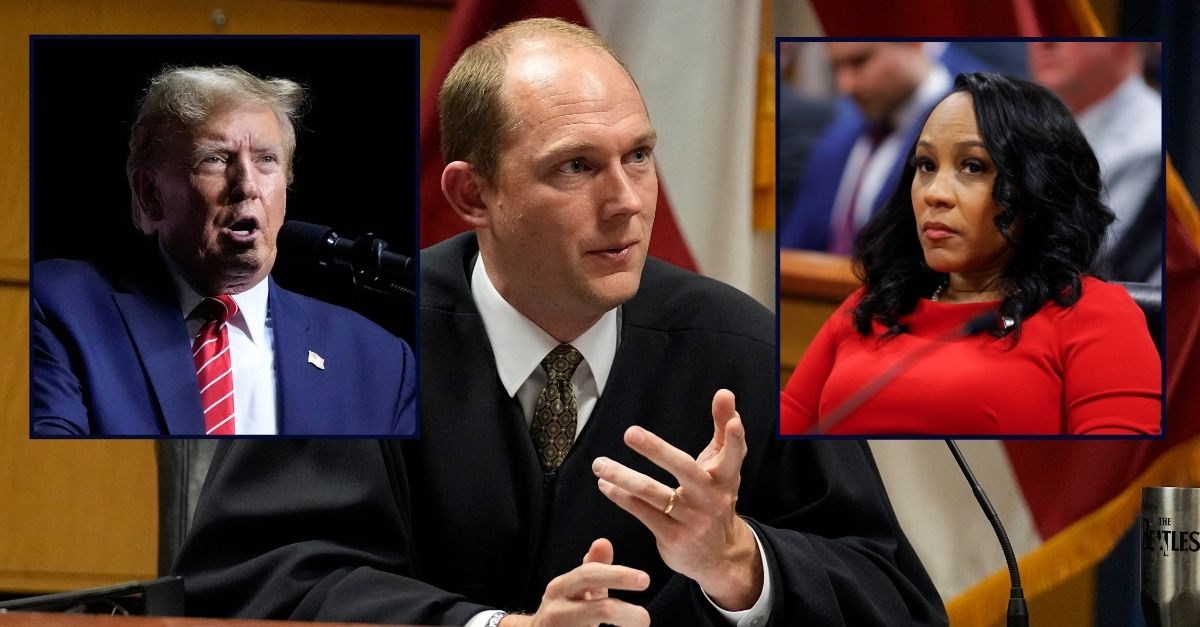
Main image: Fulton County Superior Judge Scott McAfee speaks in court, Tuesday, Feb. 27, 2024, in Atlanta. (AP Photo/Brynn Anderson, Pool); Inset left: FILE – Republican presidential candidate former President Donald Trump speaks, March 9, 2024, in Rome, Ga. (AP Photo/Mike Stewart, File); Inset right: Fulton County District Attorney Fani Willis looks on during a hearing on the Georgia election interference case, March, 1, 2024, in Atlanta. (AP Photo/Alex Slitz, Pool)
In a recent setback for Fulton County District Attorney Fani Willis, a Georgia judge has dismissed her attempt to intervene in a high-stakes legal battle involving attorney fees amounting to $16.85 million.
The case revolves around President Donald Trump and several former co-defendants who are seeking to recover legal expenses following the collapse of a racketeering (RICO) case initiated by Willis. This effort is grounded in a relatively new law in Georgia, which was passed in 2025.
This law allows defendants to claim financial compensation if a prosecutor is disqualified for “improper conduct.” The legislation, known as SB 224, was championed by Republican supporters of Trump in the state legislature. It came into being after Willis’s case against Trump faced significant challenges and eventually fell apart in 2024.
Trump’s legal team has already presented comprehensive documentation, spanning 200 pages, to claim approximately $6.26 million. This sum covers the costs of lawyers and vendors involved in the defense against the election interference allegations.
In addition, several other former co-defendants have also filed motions to reclaim over $10.79 million, which they spent in their defense against the charges brought by the Fulton County District Attorney’s Office.
Several other erstwhile co-defendants filed their own motions in excess of $10.79 million spent defending against the RICO charges brought by the Fulton County District Attorney’s Office.
The elected prosecutor was formally removed from overseeing the years-old case in late December 2024, though progress had stalled several months before. On life support in the appellate realm, the RICO prosecution lingered on, in neutered form, for months.
In November 2025, the case was finally and forever shuttered in “the interests of justice” by the prosecutor appointed in Willis’s absence.
That dismissal set the stage for the various recoupment motions.
“This dismissal paves the way for the award of reasonable attorney fees and litigation expenses,” Trump’s motion reads. “Each of the necessary elements have been met: DA Willis was disqualified based upon improper conduct, the criminal case was dismissed, and the criminal case was pending when the statute went into effect.”
Willis pushed back, asking Fulton County Superior Court Judge Scott McAfee to intervene and challenge the claimed “costs and fees.”
In her motion to stay the proceedings, Willis pointed out that the statute itself is “new and unchallenged” and “prescribes no process other than a bench trial.” The DA mused about “errors in the proceedings” that might occur without a prosecutor’s “participation.”
“Without intervention by the District Attorney, any award would violate basic fundamental notions of due process by denying her an opportunity to be heard or even challenge the reasonableness of the claimed attorney fees before it is taken from her budget,” Willis argued.
But the prosecutor’s efforts were to no avail.
On Monday, McAfee ruled that since Willis was “wholly disqualified” in the underlying case, she cannot inject herself in an ancillary aspect of the case to defend the interests of the district attorney’s office.
“[T]he motion to intervene is denied,” the order reads.
The bench trial over the potential payments, however, will not be a cakewalk for the parties angling to be paid. The state’s Prosecuting Attorneys’ Council (PAC) took over the case once Willis was removed and will “adequately represent” the office’s interests, McAfee found.
The judge also determined Fulton County itself – a separate administrative entity from the DA’s office – is allowed to intervene.
That’s because the county provides the “overwhelming source of funding” for the DA’s office, McAfee noted, adding the “financial buck appears likely in some form to eventually stop at the county’s desk.”
As for the arguments Willis raised in her stay motion, the court found Willis would have to reprise and defend the same decisions that led to her removal from the case by the Georgia Court of Appeals.
Ultimately, the decision over the amount claimed by the 14 different defendants will be up to the judge, who acknowledged that everyone involved is operating on entirely new territory.
“Novelty abounds,” McAfee wrote.
Trump’s lead attorney in the Georgia case promised to move for costs and fees late last year. In a statement, he praised the court’s ruling.
“Judge McAfee has properly denied DA Willis’ motion to intervene in POTUS’ action for reimbursement of attorney fees because her disqualification for improper conduct bars Willis and her office from any further participation in this dismissed, lawfare case,” Steve Sadow said in a post on X (formerly Twitter).
The case will move forward with evidentiary hearings on each party’s claimed costs and fees, McAfee said, in chronological order of filing.