Share this @internewscast.com
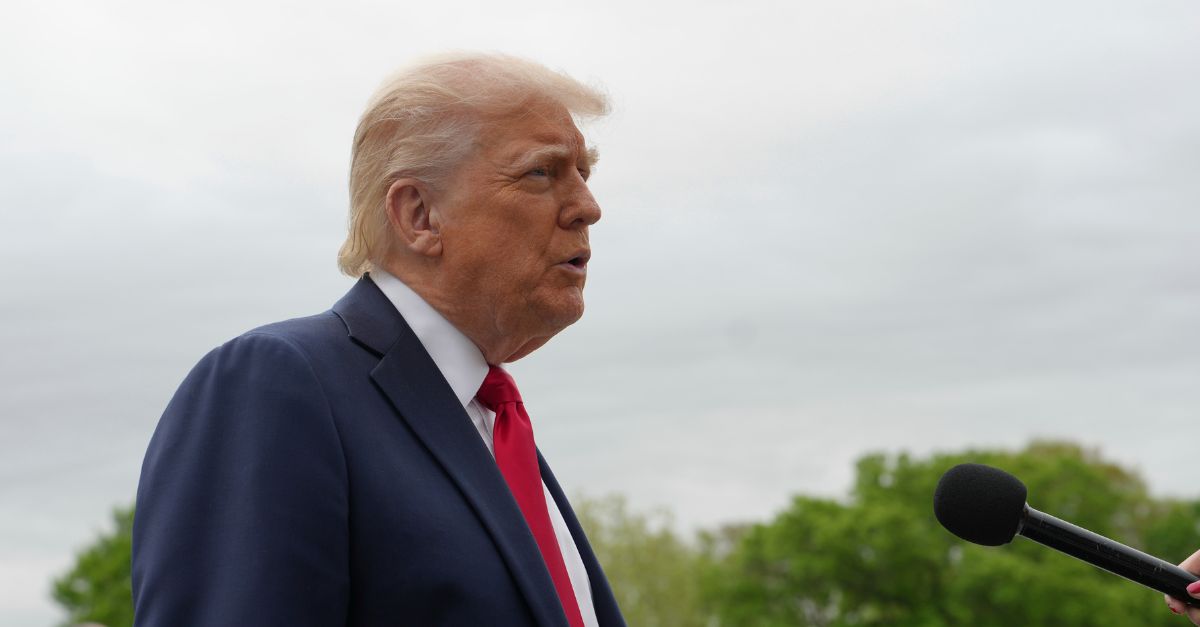
President Donald Trump speaks to the media following the White House Easter Egg Roll in Washington, D.C., on April 21, 2025, (Photo by Andrew Leyden/NurPhoto via AP).
A federal judge in California has thrown out a lawsuit from the Trump administration aimed at challenging the state’s egg regulations. The judge’s ruling was filled with playful references to eggs and the poultry that lay them.
The lawsuit, initiated in June 2025, targeted California’s consumer protection laws, which are designed to enhance health and safety standards in egg production and safeguard egg consumers.
In their 16-page complaint, lawyers from the Department of Justice claimed, “California has significantly contributed to the surge in egg prices by imposing unnecessary bureaucratic hurdles on egg production. Through various voter initiatives, legislative measures, and regulations, the state has effectively hindered farmers nationwide from employing certain agricultural methods that previously kept egg prices low.”
Since the lawsuit’s filing, there has been a flurry of legal activity, with numerous parties on both sides submitting motions. As of this week, the court was considering three motions to dismiss the case and two motions for summary judgment.
On Wednesday, U.S. District Judge Mark Scarsi, appointed by President Donald Trump during his first term, decided to grant one of the motions to dismiss. He cited the Department of Justice’s “failure to allege facts supporting a valid theory of standing” as the reason for his decision.
In his opinion, Scarsi humorously described the lawsuit as the federal government’s attempt to “enforce the pecking order between federal and state laws” and mentioned the “clutch of intervenors” previously permitted to join the case.
The lawsuit itself is based on the idea that federal law — in this case, the Egg Products Inspection Act of 1970 — preempts a recent series of state laws passed by ballot initiatives and the state legislature.
But the court did not get around to analyzing preemption arguments.
Rather, the judge short-circuited the analysis at what he, again jokingly, referred to the very first step of judicial inquiry: standing.
“Three of Defendants and Defendant-Intervenors’ motions challenge Plaintiff’s constitutional standing to maintain this lawsuit,” the order reads. “And unlike with the chickens and eggs at issue here, there is no question that an analysis of standing must come first.”
Using such an analytical framework to quickly dismiss a claim is widely known by legal scholars as “conservative standing doctrine.”
This judicial theory was created in two cases from the 1920s by conservative judges who sought to restrain the use and limits of constitutional redress. In other words, standing doctrine was created — and has over time been honed and sustained — to limit lawsuits against the government. While technically procedural in nature, as opposed to relying on the underlying merits arguments in a dispute, standing arguments tend to be fact-intensive.
In a footnote, the court muses that the standing problems evident in the DOJ’s filings “may be an issue of pleading and not of proof.”
That is, the judge seems to believe the government simply has not tried very hard to even make a cognizable argument — as opposed to being unable to make such an argument with relevant facts.
At the outset, the court explains how since the government “is not the target of the challenged government action,” its ability to sue is “substantially more difficult to establish.” And, this means the Trump administration must meet a high and exacting standard.
That did not come close to happening here, the court says.
“The United States fails to plead facts toward any of the elements,” the order goes on. “In its briefs, the federal government asserts that it ‘is suffering an ongoing injury to its sovereignty because the Sales Ban and Labeling Requirements violate the EPIA and are expressly preempted.’”
Scarsi, however, says such an argument is conclusory.
From the order at length:
Questioned at the hearing about where the United States articulated its sovereign injury theory in the complaint, counsel merely pointed to allegations that the EPIA preempts the California laws and regulations at issue. Not only are these allegations undisguised legal conclusions in search of substantiating facts, but they also raise no inferences about the sovereign injury asserted in Plaintiff’s briefing, depriving Defendants and Defendant-Intervenors of adequate notice of the federal government’s standing theory.
The judge goes on to offer an example of the deficiency — tying the government’s arguments to the kind of facts they should cite.
“Plaintiff offers numerous allegations that the subject laws and regulations harm working-class Americans by effectively inflating egg prices, but nowhere in the complaint does Plaintiff provide any facts raising an inference that California’s laws and regulations diminish the sovereignty of the federal government,” the order continues.
The order also says the DOJ’s basic premise “is a mistake.”
The government argued that California’s alleged violation of the EPIA also violated the Supremacy Clause of the U.S. Constitution. Instead, Scarsi explains that preemption provisions like the one in the EPIA instead “confer on private entities…a federal right to engage in certain conduct subject only to certain (federal) constraints.”
“This is because preemption principles derived from the Supremacy Clause ‘provide a rule of decision,’ not ‘an independent grant of legislative power to Congress,’” the judge adds.
The court then explains how the government’s sovereign injury theory is precluded by standing doctrine. The judge says the Supremacy Clause does not give the United States the right to sue at-will.
The court defends this interpretation of standing, at length:
Suppose the United States suffered a constitutional injury any time federal law preempts state law. Should the United States be permitted—or perhaps even required—to participate in a civil suit between private parties every time a defendant moves to dismiss a claim based on federal preemption?
…
Further, suppose the executive or the decisionmakers at the Department of Justice simply do not like a state law because it is in tension with their policies. Without requiring the United States to show some redressable injury, the federal government might initiate a campaign of preemption suits under the aegis of its sovereignty to bring state laws in line with its own political agenda. The potential for abuse of the federal courts for political purposes is manifest.
Scarsi then offers one final joke to offer the government a chance to amend its lawsuit “with extreme liberality” and try again.
“Plaintiff has not pleaded facts showing it has standing to maintain this lawsuit, and the theory of standing it asserts in its briefing is incognizable,” the order goes on. “The motions to dismiss are granted insofar as the movants assert Plaintiff fails to allege facts demonstrating its constitutional standing. Because this is a threshold defect that alone demands dismissal of the first amended complaint, the Court does not reach any other issue presented in the motions. Although Plaintiff put all its eggs in the sovereign-injury theory of standing, other standing theories may be articulable on repleading.”