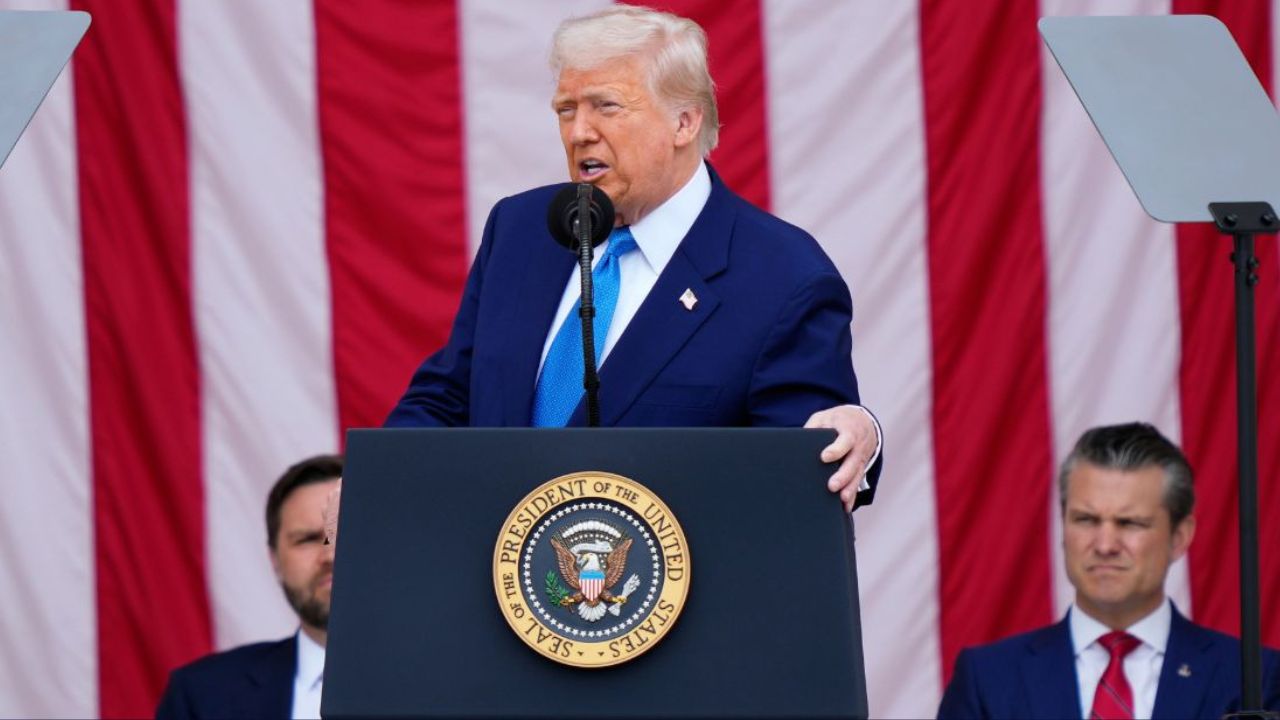
President Donald Trump speaks during the Memorial Day Address at the 157th National Memorial Day Observance at Arlington National Cemetery on Monday, May 26, 2025, in Arlington, Virginia. Vice President JD Vance and Defense Secretary Pete Hegseth watch from the side (AP Photo/Julia Demaree Nikhinson).
A federal judge in Manhattan has directed the Trump administration to explain the legal basis for deadly military strikes against boats in the Caribbean.
In a 66-page ruling issued Wednesday, U.S. District Judge Paul Engelmayer, an appointee of former President Barack Obama, rejected several arguments from the Justice Department for withholding an Office of Legal Counsel (OLC) memorandum addressing the strikes.
The Defense Department began attacking boats in August 2025 under a presidential directive authorizing military action against “foreign criminal groups.” The administration said the vessels were carrying drugs into the United States. According to a lawsuit filed by the American Civil Liberties Union and allied organizations, approximately 234 people have been killed, while the government has not produced conclusive evidence supporting those allegations.
The legal battle started in December 2025, when the ACLU submitted a Freedom of Information Act request for the OLC memo. The Defense Department rejected the request and withheld the document in its entirety, relying on three exemptions under the federal government’s principal transparency law.
During the litigation, the administration and the ACLU reached tentative agreement on two of those exemptions, the ruling says. That could have opened the door to releasing portions of the memo, with redactions, after the judge conducted an in-camera review.
The government nevertheless argued that a separate privilege allowed it to keep the entire OLC memo secret.
In ruling on both sides’ motions for summary judgment, Engelmayer concluded that the privilege argument was insufficient at this stage of the case.
The judge emphasized the memo’s central role in the administration’s legal defense of the boat strikes, even though the document’s factual discussion may be limited.
The court noted that, in public statements defending the legality of the attacks, Defense Department and administration officials have relied on the OLC memo as the exclusive explanation of their authority. The opinion said the government had identified no other document establishing the legal basis or limits of the strikes, either during the public debate or in the litigation.
The parties agree that some portions of the memo may properly remain secret for national security or statutory reasons, Engelmayer wrote. The central dispute concerns the memo’s legal analysis—a section the ACLU is seeking to make public.
The judge also pointed to an acknowledgment by a Justice Department lawyer that the analysis might contain factual material requiring redaction under national security or statutory exemptions, but that the legal reasoning itself likely could not be withheld on those grounds.
Engelmayer further ruled that conventional privileges, including attorney-client and deliberative-process privilege, do not automatically shield the memo. In his view, the administration developed and used the document as “working law” governing its conduct.
“The assembled record compellingly supports the finding that DOD—the agency that asserts disclosure authority over the Memo—has treated the Memo as its effective law and policy governing the boat strikes,” the judge wrote.
The court explained its reasoning further:
The judge said other parts of the administration, including the White House, had presented the memo in much the same way. Under standards established by the Second Circuit, he concluded, the Defense Department had expressly adopted the memo and incorporated it by reference, making it functionally binding and therefore “working law.”
The court added that the department’s handling of the memo matched nearly every factor the Second Circuit uses to determine whether a document represents an agency’s working law.
Explaining the doctrine, Engelmayer cited precedent rejecting the use of “a body of secret law which [an agency] is actually applying in its dealings with the public but which it is attempting to protect behind a label.”
Although the judge rejected two major government arguments for invoking privilege, he did not immediately order the memo’s release. Instead, he said he must first examine the document privately before deciding what information, if any, must be disclosed.
The ruling rejects the agencies’ reliance on deliberative-process and attorney-client privileges, but says the current record is insufficient to determine whether the government waived its claim of presidential communications privilege. Engelmayer therefore ordered the agencies to provide additional information so he can resolve that remaining question.
The post Judge rubbishes ‘secret law’ and rejects Trump admin excuses for withholding OLC memo on fatal boat strikes in the Caribbean, court will review behind closed doors first appeared on Law & Crime.