
Share this @internewscast.com
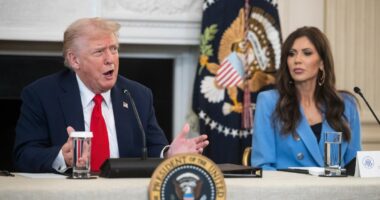
President Donald Trump listens as Homeland Security Secretary Kristi Noem speaks during a tour of “Alligator Alcatraz,” a new migrant detention facility at Dade-Collier Training and Transition facility, Tuesday, July 1, 2025, in Ochopee, Fla. (AP Photo/Evan Vucci).
The Trump administration has been prohibited from conducting “warrantless” immigration enforcement activities in or within a 100-foot radius of church entrances nationwide. This ruling marks a significant decision in the ongoing debate over religious freedom and immigration enforcement.
In a comprehensive 62-page memorandum and order, U.S. District Judge F. Dennis Saylor, appointed by George W. Bush, concluded that such enforcement operations should only occur in extremely limited situations to uphold religious freedoms. Judge Saylor expressed deep concerns about the potential for law enforcement agents to conduct raids or detain individuals without a judicial warrant, particularly during church services or religious ceremonies.
“The idea that law-enforcement agents, acting independently and without adequate oversight, could disrupt a church service or wait outside to question or detain congregants is deeply concerning,” Judge Saylor remarked. “Under this policy, agents might raid a church with drawn weapons during any religious event, whether it’s a Sunday service, wedding, baptism, christening, or funeral, relying solely on their ‘discretion’ and ‘common sense.'”
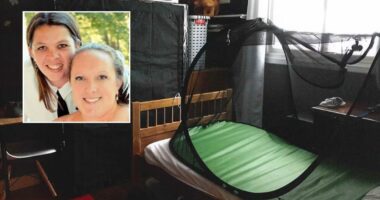
This legal battle began with a 44-page lawsuit filed in July 2025 by a coalition of churches against the Department of Homeland Security (DHS). The lawsuit alleged that the government’s actions violated the Religious Freedom Restoration Act (RFRA), the First Amendment, and the Administrative Procedure Act (APA). The coalition argued that fear of immigration raids had led to a decline in church attendance and financial support, with some congregations even resorting to underground meetings to protect their members.
In response to the lawsuit, the court addressed a motion for an administrative stay and an alternative request for a preliminary injunction. While the court refused to consider the APA claim and denied the stay, it did grant the injunction, providing a measure of relief to the churches and their congregants.
The court, acting on a motion for an administrative stay with an alternative request for a preliminary injunction, declined to entertain the APA claim and denied the stay while granting the injunction.
Saylor firmly rejected prioritizing the Trump administration’s anti-immigration campaign over religious freedom.
From the opinion, at length:
It hardly requires mentioning that freedom of religion is both a core American value and a basic liberty protected by the First Amendment and laws of the United States. That freedom encompasses not merely the freedom to believe, but the freedom to worship, including the freedom to attend church and to participate in sacraments, rituals, and ceremonies. If government interference with those freedoms is ever justifiable, it is only in relatively extreme circumstances, such as an immediate threat to public safety. The routine enforcement of the immigration laws does not involve such a threat, and cannot justify the harm to religious freedom posed by the new policy.
While offering a concession to the federal government’s concerns over “millions of illegal immigrants within the borders,” the court juxtaposes the necessity of a “substantial government response” with the ability of churches to conduct services and raise money.
“But the need to address that problem cannot override the fundamental liberties on which our nation was founded,” the judge goes on. “And to be clear, the new policy does not simply permit the apprehension of illegal immigrants in churches; it permits, without meaningful restraints, the disruption of church services and functions and the interrogation or seizure of anyone who may be on church property, citizen and non-citizen alike.”
The ruling, however, was not an unalloyed win.
The court found not all of the plaintiffs – led by the New England Synod of the Evangelical Lutheran Church in America – are able to move forward. While accepting the Lutheran, Baptist, Metropolitan Community Church plaintiffs had suffered cognizable injuries, three Quaker groups were found not to have standing.
The court’s analysis here begins with an application of the analytical framework widely known by legal scholars as “conservative standing doctrine.”
This judicial theory was created in two cases from the 1920s by conservative judges who sought to restrain the use and limits of constitutional redress. In other words, standing doctrine was created — and has over time been honed and sustained — to limit lawsuits against the government. While technically procedural in nature, as opposed to relying on the underlying merits arguments in a dispute, standing arguments tend to be fact-intensive.
To hear Saylor tell it, the Quaker groups were unable to show they had suffered decreased attendance or financial harm as a result of the new Immigration and Customs Enforcement (ICE) policy at issue.
While broadly rejecting the “intangible” harms of “fear and anxiety” due to ICE raids, the court found the viable plaintiffs “have suffered at least three cognizable injuries-in-fact: decreased attendance at worship services; decreased attendance at social ministries; and financial consequences.”
As the judge sees it, the crux of the dispute is guided by RFRA; while rejecting the APA claim, the court declined to reach the merits of the First Amendment claim at this stage in the litigation.
The judge offers an example:
[The new ICE policy] would permit immigration-enforcement officers to set up a checkpoint just outside a church, or to question parishioners in the middle of a Catholic Mass. Without question, those activities would substantially hinder, constrain, and inhibit individuals from attending church or religious schools or programs, regardless of citizenship status, thereby imposing a “substantial burden.”
Still, the court hinted that the plaintiffs might have some luck with their First Amendment claim down the line. The judge opined that a RFRA claim “is, essentially, a free-exercise claim that is judged against a more restrictive standard than what the…Constitution requires.”
“The preliminary injunction issued by the Court will permit such operations only in exigent circumstances, regardless of supervisory approval,” Saylor goes on. “The Court can conceive of no circumstance, outside of a true emergency, in which a law-enforcement operation to enforce the immigration laws inside a church would be justifiable under the First Amendment and RFRA.”