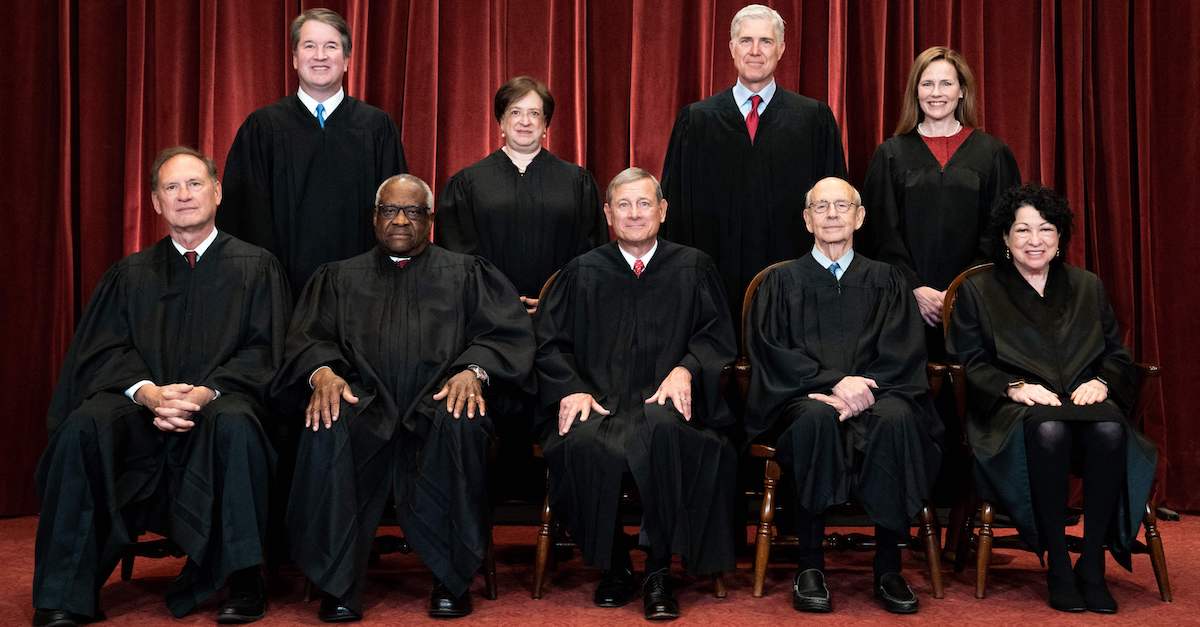
Seated from left: Associate Justice Samuel Alito, Associate Justice Clarence Thomas, Chief Justice John Roberts, Associate Justice Stephen Breyer and Associate Justice Sonia Sotomayor, standing from left: Associate Justice Brett Kavanaugh, Associate Justice Elena Kagan, Associate Justice Neil Gorsuch and Associate Justice Amy Coney Barrett pose during a group photo of the Justices at the Supreme Court in Washington, DC on April 23, 2021.
During Tuesday’s oral arguments in Ysleta Del Sur Pueblo v. Texas, the justices of the Supreme Court of the United States considered whether to permit a federally recognized Native American tribe to run bingo games on its reservation land near El Paso, Texas.
The Ysleta del Sur Pueblo tribe, supported by the Alabama-Coushatta tribe, wishes to operate its bingo-themed casino on the small Ysleta del Sur Pueblo reservation near El Paso. The issue is whether the tribes may engage in certain gaming activities, specifically live bingo games and casino-style slot machines, despite Texas state law disallowing those games.
Texas argues that the Pueblo are subject to the 1987 Ysleta del Sur Pueblo and Alabama-Coushatta Indian Tribes of Texas Restoration Act (“Restoration Act”), which bars any gaming that violates Texas law. Alternatively, the tribes argue that the more permissive 1988 Indian Gaming Regulatory Act (“IGRA”) controls, and that it allows the kinds of gaming they seek to operate.
During Tuesday’s oral arguments, the justices appeared overtly skeptical of arguments advanced by attorney Brant Martin on behalf of the tribal plaintiffs. Chief Justice John Roberts commented that at the time the tribes entered into an agreement with the federal government for restoration of their federal trust, “each side got something, but not everything.” The Pueblo, Roberts explained, were willing to abide by a state-law prohibition against gaming.
Furthermore, Roberts pointed out, the case before the Court comes with a lengthy record of legislative intent. “We’ve never seen this must legislative history,” Roberts remarked, drawing a chuckle from Justice Clarence Thomas.
At several times during the arguments, the justices found themselves engaged in a detailed discussion of bingo, as they analyzed whether the gaming sought by the Pueblo would actually violate the Texas Bingo Enabling Act (the state law contemplated in this dispute).
“Are there people calling out numbers? And saying ‘B-12,”” asked the chief justice.
Martin answered that the Pueblo do operate live-called bingo in addition to slot-machine bingo, and that Texas “has complained about all of it.”
“I’m curious about the bingo machines,” remarked Justice Stephen Breyer, laughing a bit.
The Biden administration participated in the arguments as an amicus, supporting the tribal plaintiffs. Assistant to the Solicitor General Anthony Yang presented the government’s argument. Much of the discussion then centered around the Court’s 1987 decision in California v. Cabazon Band of Mission Indians; the Cabazon Band case called attention to the difference between gaming that is flatly prohibited by state law and gaming that is allowed, subject to certain restrictions.
The justices at times raised some broader concerns about law as it applies to Indian tribes. Justice Sonia Sotomayor pressed Yang on the implication of the 1986 Tribal Resolution, saying that in her mind, under that resolution, “You need Indian approval to have any state law applied on a reservation.”
Justice Elena Kagan expressed frustration with the guidance offered by the numerous and often conflicting canons of law, wondering aloud, “maybe we should just toss them all out,” and commenting, “I think kind of we should.”
Justice Neil Gorsuch picked up on Kagan’s line of reasoning, asking Yang, “The government doesn’t waive sovereign immunity lightly, right — that’s one of our canons, right?” Gorsuch continued, “And isn’t the Indian canon very similar in its function in saying that we don’t lightly assume that Congress has allowed state authorities to regulate an independent sovereign?”
Principal Deputy Solicitor General of Texas Lanora Pettit began her remarks to the court by characterizing the Pueblo’s relationship with the federal government as the Fifth Circuit had in its decision in favor of Texas: “The tribe wanted federal recognition and was willing to cede some of its sovereignty.”
When Justice Kagan questioned Pettit, she tied the fate of Texas’ argument to a reading of the Cabazon Bond case.
“If we were in a world without context, I think you would win,” the justice said.
“The question is, do we have so much context [about the specific statutory meaning] that you lose?” Kagan asked. “Cabazon is like written all over this statute,” the justice continued, adding: “Why isn’t it in this statute in a way that defeats your claim here?”
Immediately following Ysleta Del Sur Pueblo v. Texas, the justices heard arguments in Denezpi v. United States, a case that raised issues of the sovereignty of Indian tribes within the context of constitutional guarantees against double jeopardy.
[image via Erin Schaff/POOL/AFP via Getty Images]
Have a tip we should know? [email protected]
Source: This post first appeared on