
Share this @internewscast.com
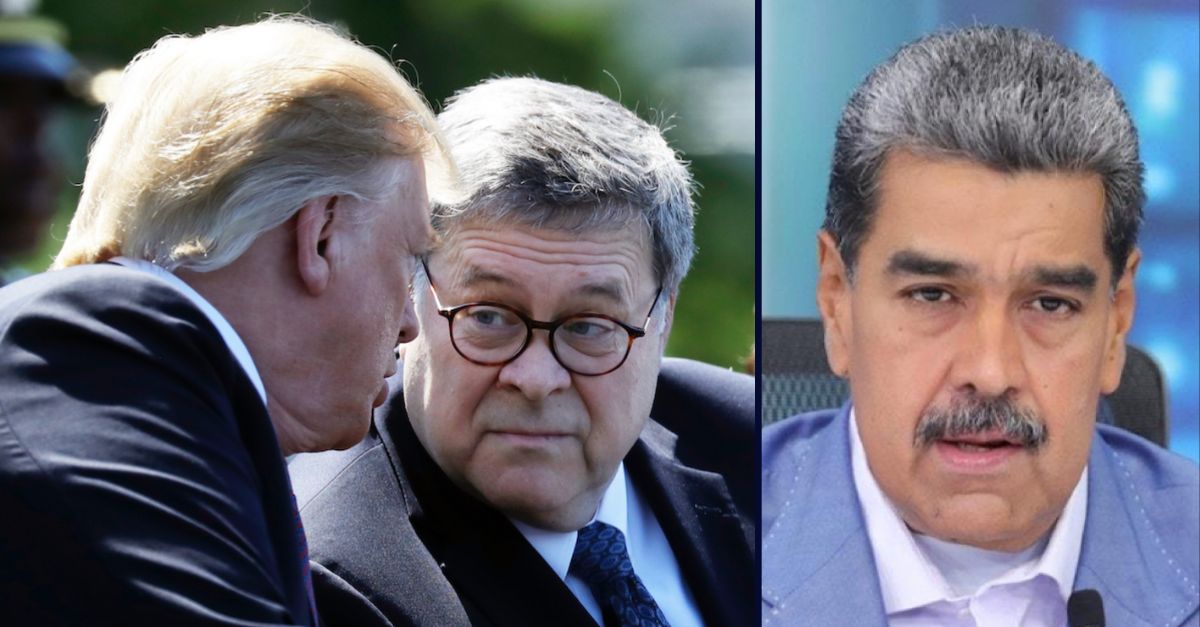
Left: Donald Trump and Bill Barr attend National Peace Officers” Memorial Service at the U.S. Capitol on May 15, 2019 (AP Photo/Evan Vucci). Right: Nicolas Maduro appears in an image on a wanted poster (DOJ).
Saturday morning brought startling news to many Americans as they learned that the U.S. military had conducted a daring operation in Venezuela. The mission culminated in the arrest of Venezuelan leader Nicolas Maduro and his wife, Cilia Flores, who are now set to face federal drug conspiracy charges in the United States. This bold move has sparked a flurry of discussions surrounding issues of precedent, authority, and the broader implications under international law.
In the aftermath of the operation, nations such as China, Russia, North Korea, and Iran swiftly issued strong condemnations. However, legal experts have drawn parallels to the U.S.’s 1989 invasion of Panama, where President George H.W. Bush ordered the capture of dictator Manuel Noriega on similar drug charges. A notable legal scholar highlighted an opinion from the Department of Justice’s Office of Legal Counsel (OLC), written in 1989 by Bill Barr, who later served as Attorney General under President Trump. This memo potentially provides a framework for the current administration to justify the raid on Maduro.
Harvard Law Professor Jack Goldsmith, who previously led the OLC under President George W. Bush, shared his insights on the matter through his Substack blog, “Executive Functions.” Goldsmith, known for his departure from the Bush administration over controversial “torture memos,” offered a preliminary analysis on the legality of the Venezuelan invasion. He referenced Barr’s earlier legal reasoning as a potential basis for the actions undertaken by President Donald Trump and Attorney General Pam Bondi’s Department of Justice.
Goldsmith expressed his views on the overarching power of the executive branch in military operations, stating, “Congress has given the president a gargantuan global military force with few constraints and is AWOL in overseeing what the president does with it. Courts won’t get involved in reviewing unilateral presidential uses of force. And no country plausibly could stop the U.S. action in Venezuela.” He highlighted that the practical legal framework for presidential war powers is largely shaped by executive precedents and opinions, suggesting that the DOJ could have easily crafted a justification for the Venezuelan operation.
To support his argument, Goldsmith pointed to Barr’s 1989 memo, which addressed the FBI’s authority to “Override International Law in Extraterritorial Law Enforcement Activities.” This document illustrates how the DOJ’s OLC could theoretically generate an opinion to rationalize the recent actions in Venezuela, reinforcing the notion that executive precedents hold significant sway in such international maneuvers.
As proof that the DOJ’s OLC could create such an opinion, Goldsmith turned to Barr and the 1989 memo on the subject of the FBI’s authority to “Override International Law in Extraterritorial Law Enforcement Activities.”
In the opening lines, Barr noted that he was submitting the memo to the attorney general in response to a request to “reconsider” a 1980 opinion, one that stated the FBI had “no authority under 28 U.S.C. § 533(1) to apprehend and abduct a fugitive residing in a foreign state when those actions would be contrary to customary international law.”
Following a “comprehensive review of the applicable law,” Barr said, he reached the opposite conclusion.
“[W]e conclude that the 1980 Opinion erred in ruling that the FBI does not have legal authority to carry out extraterritorial law enforcement activities that contravene customary international law,” the opinion said, finding that such arrests could go forward regardless of inconsistencies with international law and Article 2(4) of the U.N. Charter — and without violating the Fourth Amendment — due to the president’s “inherent constitutional authority” to order the FBI to take that action through the attorney general.
While Barr’s memo addressed “only whether the FBI has the legal authority to carry out law enforcement operations that contravene international law,” Goldsmith further noted that Secretary of Defense Pete Hegseth described Maduro’s capture as the result of a “joint military and law enforcement raid.”
That prompted Goldsmith to assess that the Barr memo “will likely be presented as the main domestic legal foundation” for the Maduro raid.
On Monday, Maduro and Flores appeared in federal court in Manhattan and entered not guilty pleas, with Maduro declaring “I am innocent” of narco-terrorism offenses and claiming he is still president of Venezuela.
BREAKING: Venezuela’s ousted leader Nicolas Maduro and his wife, Cilia Flores, have pleaded not guilty to federal drug charges following their capture by U.S. forces in Caracas, with Maduro claiming, “I am innocent.”
Follow live updates: https://t.co/Z9K2wDDnIR pic.twitter.com/9JLr7luthy
— ABC News (@ABC) January 5, 2026