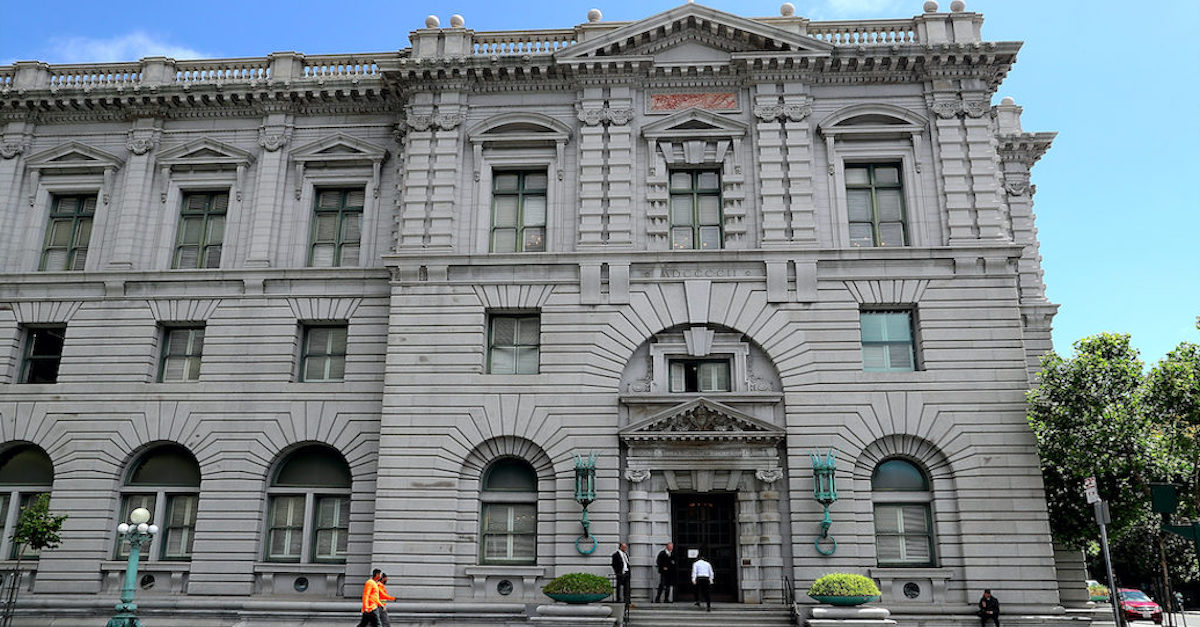
The U.S. Court of Appeals for the Ninth Circuit
The U.S. Court of Appeals for the Ninth Circuit struck down a portion of a statute Thursday which made it a crime to encourage illegal immigration. A three-judge panel of the appellate court vacated a man’s conviction, ruling that the statute was overbroad and unconstitutional.
Helaman Hansen worked with a group called Americans Helping America Chamber of Commerce (AHA), which encouraged undocumented immigrants to obtain U.S. citizenship through adult adoption. Nearly 500 individuals paid enormous sums of money to the group, and an investigation revealed that Hansen and AHA received more than $1.8 million in revenue from their victims. Contrary to AHA’s promises, adult adoption is not a means of becoming a U.S. citizen.
Hansen was prosecuted, convicted, and sentenced to 240 months in prison for twelve counts of mail fraud, three counts of wire fraud, and two counts of encouraging or inducing illegal immigration for private financial gain. Specifically, he was found guilty of encouraging two two immigrants to illegally overstay their visas. Hansen argued —and the appeals court agreed — that the statute underlying his conviction had been overbroad and that his conviction should be overturned.
The law at issue was 8 U.S.C. § 1324(a)(1)(A)(iv), and the three-judge panel of the Ninth Circuit said it interpreted the law “as prohibiting someone from (1) inspiring, helping, persuading, or influencing, (2) through speech or conduct, (3) one or more specified aliens (4) to come to or reside in the United States in violation of civil or criminal law.”
The panel included U.S. Circuit Judges Ronald Gould and M. Margaret McKeown (both Bill Clinton appointees), and Ronald Reagan-appointed Senior Judge Jane A. Restani, sitting by designation from the United States Court of International Trade.
Judge Gould penned the decision for the panel, overturning Hansen’s conviction and declaring the statute unconstitutional.
Gould reasoned that the government was correct that the statute encompasses some criminal conduct, specifically, “procuring and providing fraudulent documents and identification information to unlawfully present aliens, assisting in unlawful entry, misleadingly luring aliens into the country for unlawful work, and smuggling activities.” However, he continued, many of those crimes are already covered by other sections of the statute, leaving the portion in question “little independent work to do.”
Against that backdrop of lack of necessity for the statute, Gould also found that “Many commonplace statements and actions could be construed as encouraging or inducing an undocumented immigrant to come to or reside in the United States.” The judge listed examples such as encouraging an undocumented immigrant to take shelter during a natural disaster, advising an undocumented immigrant about available social services, and telling a tourist that she is unlikely to face serious consequences if she overstays her tourist visa. Because those actions would clearly constitute protected speech under the First Amendment, their inclusion in the statute’s prohibitions are problematic.
The proportions, according to the panel, simply do not work. The statute’s “legitimate sweep” was very narrow, while its offense to free speech was quite broad. Quoting a 1999 case, Judge Gould acknowledged that the court is “mindful that invalidating subsection (iv) for overbreadth is ‘strong medicine’ that is not to be ‘casually employed,”” as he and the panel vacated Hansen’s conviction.
Judge Gould did not conduct a lengthy First Amendment analysis in the opinion, nor did he emphasize the distinction between protected speech and unprotected speech that actively promotes lawlessness. Under longstanding tenets of First Amendment jurisprudence, several categories of speech fail to qualify for constitutional protection, including criminal solicitation, threats, and speech that incites violence. The Ninth Circuit focused its analysis not on the facts of Hansen’s or similar cases, but rather, on the lack of precision in the statutory construction.
The Ninth Circuit’s holding is somewhat at odds with an unpublished 2011 decision (cited in Judge Gould’s decision in the present case) in which the U.S. Court of Appeals for the Fourth Circuit ruled that the same statute was not overbroad.
[image via Justin Sullivan/Getty Images]
Have a tip we should know? [email protected]
Source: This post first appeared on