
Share this @internewscast.com
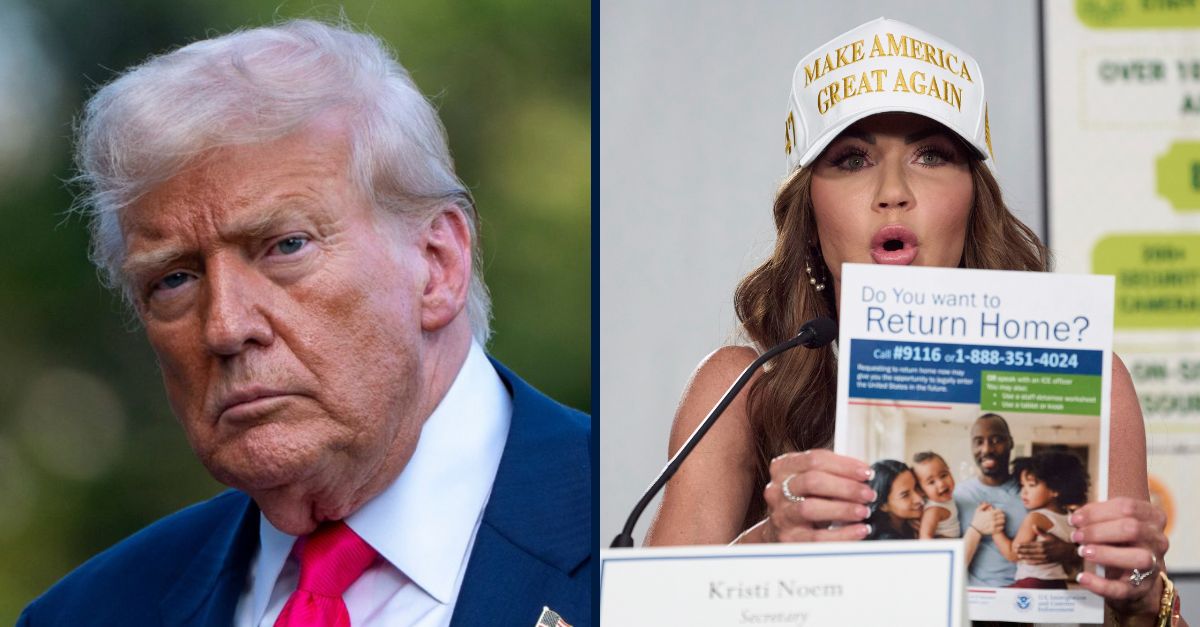
Left: President Donald Trump walks from Marine One after arriving on the South Lawn of the White House, Tuesday, July 15, 2025, in Washington. (AP Photo/Alex Brandon, File). Right: Homeland Security Secretary Kristi Noem speaks during a roundtable at “Alligator Alcatraz,” a new migrant detention facility at Dade-Collier Training and Transition facility, Tuesday, July 1, 2025, in Ochopee, Fla. (AP Photo/Evan Vucci).
In a significant legal battle, two dozen Republican-led states have thrown their support behind the Department of Justice and former President Donald Trump in a contentious case concerning the deportation of alleged members of the Venezuelan gang, Tren de Aragua (TdA). This development comes as the Trump administration gears up for a crucial rehearing in the coming year, following a previous setback in the courts.
The core of the issue lies in the Trump administration’s assertion that the 5th U.S. Circuit Court of Appeals made an error when it nullified the former president’s proclamation from March. This proclamation had classified the TdA as a “Foreign Terrorist Organization,” alleging that it comprises “thousands of members” engaging in irregular warfare and hostile activities against the United States, purportedly with the backing of Venezuelan President Nicolas Maduro.
In a show of solidarity, attorneys general from states such as Alabama, Florida, Texas, and 21 others have filed a brief supporting the federal government’s stance. Their argument emphasizes the necessity for decisive measures against criminal organizations like TdA, which they claim are causing significant disruption within U.S. borders.
“The nation’s best interests are served when the President can rely on intelligence and national-security expertise to make informed decisions on modern threats,” the states’ filing argued. They stressed that such matters should not be subject to judicial interference, insisting that the determination of an ‘invasion’ or ‘predatory incursion’ is a political decision reserved for the executive and legislative branches.
During oral arguments in June, the three-judge panel expressed some reservations about the case. By September, under the leadership of U.S. Circuit Judge Leslie Southwick, the panel ruled against Trump’s use of the 1798 wartime law. They concluded there was neither an “invasion” nor a “predatory incursion” as defined by the statute, noting that the U.S. is not at war with either the TdA or Venezuela. They also affirmed that the president’s broad discretion in such matters remains subject to judicial review.
It was clear during June oral arguments that there was some uneasiness among the majority of a three-judge panel. By September, the panel, led by U.S. Circuit Judge Leslie Southwick, concluded that Trump’s invocation of the 1798 wartime law failed for the reasons that there was “no invasion or predatory incursion” afoot under the meaning of the statute, that the U.S. is neither at war with TdA nor Venezuela, and that the president’s admittedly “broad discretion” was reviewable by the courts.
Southwick, a George W. Bush appointee, was joined by U.S. Circuit Judge Irma Carrillo Ramirez, a Joe Biden appointee, in holding that the Trump administration’s reliance on the AEA statute was blocked and that the government would have to rely instead on other statutory authority to remove alleged “foreign terrorists” from the country.
But U.S. Circuit Judge Andrew Oldham, a Trump appointee, clearly warmed to the administration’s arguments in favor of Trump’s authority and ended up penning the lone dissent — one which the government is embracing in its request that the whole 5th Circuit second-guess the panel’s ruling. Oldham accused the majority of essentially making themselves president, treating Trump like some “run-of-the-mill plaintiff,” and holding him to a different standard than any president ever.
“For 227 years, every President of every political party has enjoyed the same broad powers to repel threats to our Nation under the Alien Enemies Act (‘AEA’). And from the dawn of our Nation until President Trump took office a second time, courts have never second-guessed the President’s invocation of that Act. Not once,” he began, stating that the U.S. Supreme Court has “time and time again” said the president’s “declaration of an invasion, insurrection, or incursion is conclusive.”
“For President Trump, however, the rules are different. Today the majority holds that President Trump is just an ordinary civil litigant. His declaration of a predatory incursion is not conclusive. Far from it. Rather, President Trump must plead sufficient facts—as if he were some run-of-the-mill plaintiff in a breach-of-contract case—to convince a federal judge that he is entitled to relief,” Oldham went on. “That contravenes over 200 years of legal precedent. And it transmogrifies the least-dangerous branch into robed crusaders who get to playact as multitudinous Commanders in Chief. I respectfully but emphatically dissent.”
The DOJ consequently sought review by the full — en banc — 5th Circuit, and the docket shows that the en banc oral argument has been set for Jan. 22.
Like the DOJ, the red state amici curiae or friends of the court are leaning heavily on Oldham’s dissent to make their case that the courts have no say when the president finds an “invasion or a predatory incursion” actually “exists.”
“[J]udicial review of the President’s determinations is foreclosed for at least two reasons. First, as ably explained by Judge Oldham in his dissent from the panel majority’s opinion, some statutes ‘preclude judicial review,’ and the AEA is ‘such a statute.’ This position finds support in nearly ‘200 years of legal precedent,’” the AGs said. “Second, to the extent that this Court chooses to analyze the case under the framework of the political question doctrine, it also forecloses review of the President’s determination.”
The 5th Circuit filing in the ongoing AEA fight comes not long after the U.S. Circuit Court of Appeals for the District of Columbia shut down a federal judge’s contempt inquiry into the government’s mid-March AEA deportations. Chief U.S. District Judge James Boasberg had ordered up witness testimony for this week to help him determine whether DHS Secretary Kristi Noem should be referred for prosecution, in connection with a potential “willful violation” of a court order blocking deportations.
The D.C. Circuit’s stay means that inquiry will be stalled into the new year.