Share this @internewscast.com
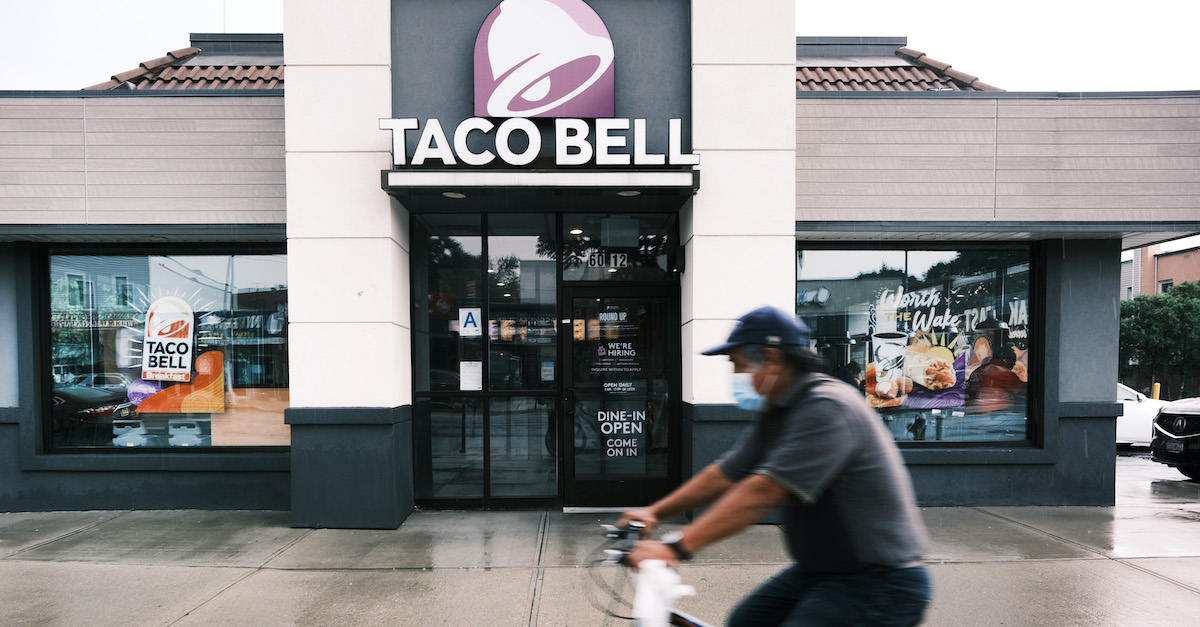
NEW YORK, NEW YORK – JULY 21: A Taco Bell restaurant stands along a Queens street on July 21, 2021 in New York City.
The U.S. Supreme Court on Monday gave a former Taco Bell employee a small but significant victory in her battle to recoup wages that were allegedly stolen by a massive franchisee who owns over 150 locations of the popular, Mexican-themed fast food chain.
In the case stylized as Morgan v. Sundance, former hourly Taco Bell employee Robyn Morgan (and several hundred others) claimed that Sundance, Inc., the franchisee in question, forced workers to clock out before the end of their shifts while they still continued to work, that the company devised a policy where management would “shift” hours from one week to the next in order to ensure weekly recorded hours never exceeded 40 so that overtime was not paid, and that many employees were never paid for their shifted hours whatsoever.
Filed under the Fair Labor Standards Act, the 2018 class action lawsuit sought substantial damages for overtime and wage theft.
As of 2012, wage theft committed by business owners was the leading form of theft in the United States–surpassing all other thefts, including robberies, burglaries, auto theft, and larcenies by at least a measure of 3-1, according to the FBI and the Economic Policy Institute.
For nearly eight months, the litigation process played out–finally fizzling out with an unsuccessful mediation effort. Then the company switched tactics and moved to compel forced arbitration–per the terms of contractual legalese signed by Taco Bell employees.
Morgan and the other Taco Bell employees opposed having a private third-party picked by Sundance decide their claims. According to the National Employment Law Project, forced arbitration allows employers to steal billions of dollars from low wage workers per year. The plaintiffs countered Sundance’s request by arguing the company had waived its right to arbitration by engaging in the legal proceedings and not asking for arbitration sooner.
A district court sided with the plaintiffs. On appeal, the U.S. Court of Appeals for the Eighth Circuit reversed, employing a legal analysis that said the plaintiffs had failed to show that Sundance had “prejudiced” their hourly employees by switching tactics.
The workers then filed a petition for writ of certiorari.
The dispute in legal briefs–and during oral argument–was voluminous and focused on the overarching question of whether or not Sundance had, in fact, waited too long to move for arbitration. Both sides’ efforts touched upon numerous legal issues including the intersection of federal and state law and various legal theories like forfeiture, estoppel, laches, and procedural minutiae. But Monday’s unanimous opinion expressly disavows most of those argued finer points of law.
The narrow ruling before the nation’s high court centers around whether or not the Federal Arbitration Act actually has any kind of requirement that a defendant’s waiver depends upon a showing of “prejudice” to the plaintiffs at all. Writing for the majority, Justice Elena Kagan found that there is no such requirement at all.
“Nine circuits, including the Eighth, have invoked ‘the strong federal policy favoring arbitration’ in support of an arbitration-specific waiver rule demanding a showing of prejudice,” the opinion notes–pointing out the competing understanding of the FAA in various courts of appeal. “Two circuits have rejected that rule. We do too.”
Kagan explains that for decades, nine circuits have decided to create “arbitration-specific variants of federal procedural rules” such as the waiver-prejudice issue before the nine justices.
“For that reason, the Eighth Circuit was wrong to condition a waiver of the right to arbitrate on a showing of prejudice,” she notes.
Kagan goes on to explain that waiver is a basic legal concept that operates the same in federal law–except for some time, except in some circuits, and except where arbitration is concerned:
Outside the arbitration context, a federal court assessing waiver does not generally ask about prejudice. Waiver, we have said, “is the intentional relinquishment or abandonment of a known right.” To decide whether a waiver has occurred, the court focuses on the actions of the person who held the right; the court seldom considers the effects of those actions on the opposing party. That analysis applies to the waiver of a contractual right, as of any other.
So, how did so many circuits get it wrong?
Blame the U.S. Court of Appeals for the Second Circuit.
In one 1968 case, the traditionally pro-business, Manhattan-based court wrote that their understanding of the federal arbitration laws means “there is an overriding federal policy favoring arbitration.”
“Over the years, both that rule and its reasoning spread,” Kagan explains. “Circuit after circuit (with just a couple of holdouts) justified adopting a prejudice requirement based on the ‘liberal national policy favoring arbitration.””
But, as it turns out, they simply invented that, according to Kagan.
“[T]he FAA’s “policy favoring arbitration” does not authorize federal courts to invent special, arbitration-preferring procedural rules,” the opinion continues–saying the FAA aims to make arbitration as enforceable as other contracts, but doesn’t carve out special status for them.
“Accordingly, a court must hold a party to its arbitration contract just as the court would to any other kind. But a court may not devise novel rules to favor arbitration over litigation,” Kagan continues. “If an ordinary procedural rule—whether of waiver or forfeiture or what-have-you—would counsel against enforcement of an arbitration contract, then so be it. The federal policy is about treating arbitration contracts like all others, not about fostering arbitration.”
Notably, the victory for Morgan, et, al. is somewhat limited–all the Supreme Court is saying is that the Eighth Circuit (and seven other circuits) have been using the wrong framework to dispense with such claims. On remand, the court has to approach the issue differently. But the focus must be on what the alleged wage-stealing company did, not what the plaintiff workers did.
“Our sole holding today is that [a court] may not make up a new procedural rule,” the opinion concludes.
In a statement to Law&Crime, Morgan’s attorney Karla GilBride and public interest law firm Public Justice hailed their victory–a decidedly rare opinion in favor of workers from the Roberts Court:
We are pleased that the Supreme Court announced today in no uncertain terms that the Federal Arbitration Act does not support judge-made procedural rules favoring arbitration over litigation or favoring arbitration agreements over other types of contracts All Robyn Morgan wants in this case is to be paid fairly by her former employer and to have her legal arguments treated fairly by the courts, without a thumb on the scale because those arguments happen to involve arbitration. We are hopeful that today’s decision will bring Ms. Morgan a step closer to a fair result in her dispute with Sundance, and we’re also hopeful that it will send a message to all corporations who include arbitration provisions in their contracts with workers and consumers that those arbitration provisions will be treated just like any other term in their contract—no worse, but also no better.
[image via Photo by Spencer Platt/Getty Images]
Have a tip we should know? [email protected]