
Share this @internewscast.com
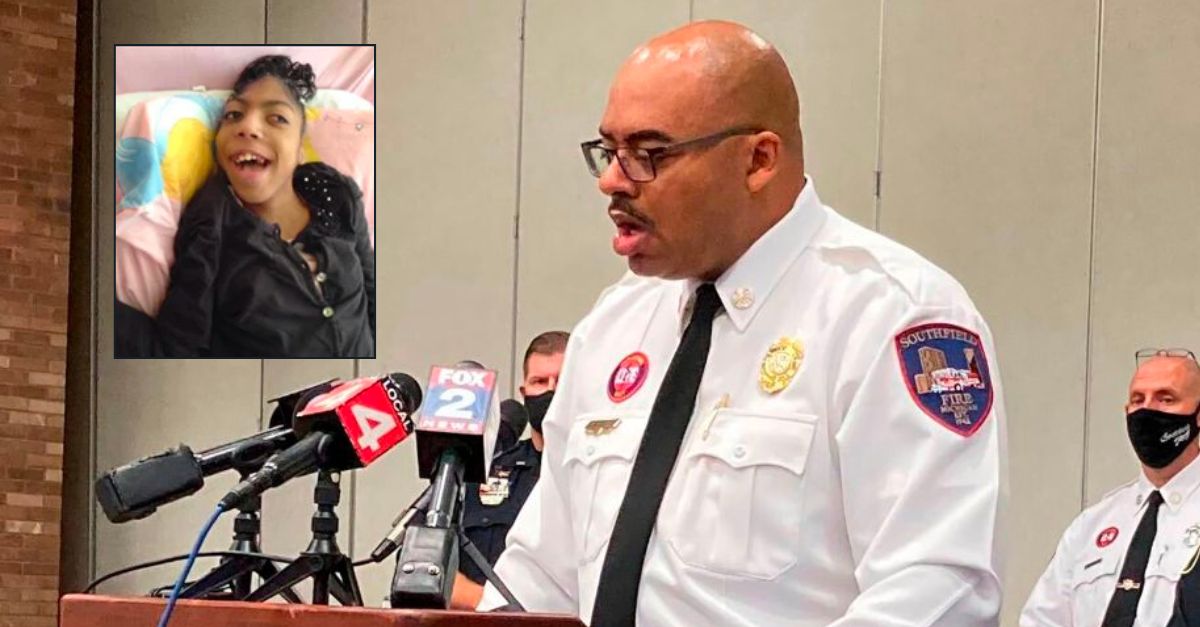
Southfield, Mich., Fire Chief Johnny Menifee holds a news conference on Wednesday, Aug. 26, 2020, in Southfield, Mich., in response to questions about a woman, Timesha Beauchamp, who was found alive at a funeral home. A Southfield emergency medical crew said there were no signs of life when they were called to Beauchamp”s home on Aug. 23, 2020. (AP Photo/Ed White). Inset: Timesha Leshay Beauchamp (via O.H. Pye, III Funeral Home).
A Michigan city has agreed to pay a multimillion-dollar settlement to a family after paramedics mistakenly declared a woman dead, only for her to be discovered alive at a funeral home.
Southfield, located near Detroit, has settled a gross negligence lawsuit by agreeing to compensate Timesha Beauchamp’s family with $3.25 million, according to the Associated Press.
Twenty-year-old Beauchamp, who had cerebral palsy, was primarily cared for by her mother. On August 23, 2020, her mother found her unresponsive and called emergency services. Four EMTs arrived, performed CPR and ventilation, but concluded she was dead after unsuccessful resuscitation efforts. She was taken to a funeral home, where an embalmer discovered she was still alive upon opening the body bag. Beauchamp was then rushed to a hospital and placed on a ventilator, where she survived for another six weeks before succumbing to a brain injury.
“We acknowledge that no settlement can reverse the profound tragedy of August 23, 2020, or alleviate the pain suffered by Ms. Beauchamp’s family,” Southfield stated to the AP. “The case presented extraordinarily challenging circumstances amid the complexities of a global pandemic.”
The family views the settlement as a step toward justice.
“She found herself in a situation that should have never happened,” remarked Steven Hurbis, the attorney representing Beauchamp’s family, to the AP.
As Law&Crime previously reported, representatives for Beauchamp’s estate brought a lawsuit against the city of Southfield, Michigan, and the individual emergency medical workers for gross negligence and violation of Beauchamp’s constitutional rights. The case has already made its way through multiple courts, including to the U.S. Court of Appeals for the 6th Circuit, which ruled in July 2023 that the EMTs were entitled to qualified immunity from the estate’s constitutional claims.
But a Michigan appeals court ruled unanimously in July 2024 to revive the suit.
On appeal from the dismissal, a three-judge panel of the Michigan Court of Appeals reversed and found that the trial court had been premature in dismissing the case before discovery had been conducted.
Primarily at issue is the determination of proximate causation. Beauchamp’s estate alleged that Beauchamp’s death and other injuries were caused by the first responders. The plaintiffs argued that had the EMTs not erroneously declared Beauchamp dead, her family members could have sought additional medical care for her and avoided transporting her in a body bag.
The appeals court did affirm the trial court’s dismissal of claims against two police officer defendants who were called to the scene, noting that the officers’ conduct could not have been the cause of Beauchamp’s injuries when the four EMTs were actually the ones responsible for handling her medical care.