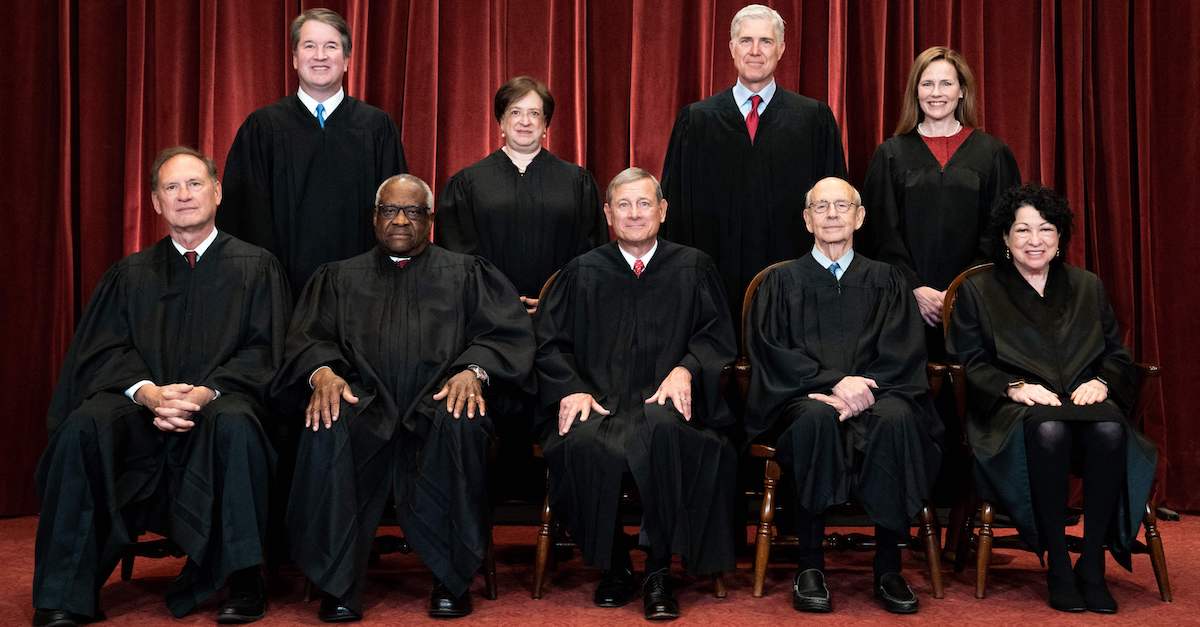
Seated from left: Associate Justice Samuel Alito, Associate Justice Clarence Thomas, Chief Justice John Roberts, Associate Justice Stephen Breyer and Associate Justice Sonia Sotomayor, standing from left: Associate Justice Brett Kavanaugh, Associate Justice Elena Kagan, Associate Justice Neil Gorsuch and Associate Justice Amy Coney Barrett.
The Supreme Court of the United States heard two hours of oral arguments Monday in West Virginia v. Environmental Protection Agency, a major environmental case questioning the extent of the Environmental Protection Agency’s (EPA) authority to regulate greenhouse gas emissions. The courtroom conversation at times delved into highly technical statutory and procedural questions, but attention repeatedly returned to fundamental questions of administrative agency authority.
The justices took turns raising aspects of the “major questions doctrine,” a legal rule that says when a question of great political or economic importance is at stake, Congress must be specific in its delegation of authority to regulate the matter. Several justices compared the EPA’s carbon emissions rules to recent hot-button issues such as the OSHA vaccine regulations and CDC eviction moratorium.
The legal dispute before SCOTUS grew from differences among the Obama, Trump, and Biden administrations in efforts to regulate carbon pollution. The Barack Obama administration adopted the 2015 Clean Power Plan (“CPP”), a rule which set power-plant emissions goals for individual states. After a coalition of states and private plaintiffs sued, SCOTUS ruled 5-4 against CPP in February 2016; as a result, the rule never went into effect.
After Donald Trump withdrew the United States from the Paris Agreement, his administration repealed CPP altogether, then instituted its own rule known as the Affordable Clean Energy Rule (the “ACE Rule”). This rule also aimed to combat carbon emissions, but did so more leniently, allowing states to set their own emissions goals. Another set of plaintiffs sued the Trump administration, arguing that it should neither have repealed CPP, nor instituted the ACE Rule. The U.S. District Court for the District of Columbia sided with the plaintiffs, vacating both the repeal of CPP, and the ACE Rule itself. The court remanded the case to the EPA for further administrative proceedings. The Biden administration has not yet issued its own rule on emissions. The current case before the justices is an appeal of the D.C. Circuit’s ruling.
The petitioners in the case before SCOTUS are West Virginia Attorney General Patrick Morrisey (R), who is joined by Republican attorneys general from more than a dozen other states, as well as two private coal companies. On the opposing side stands the Biden administration and the EPA, which are supported by various environmental groups, many Democratic lawmakers, and most large power companies.
One major issue in the case is a procedural hurdle regarding timing and the court’s authority to adjudicate the case. Given that there is no EPA rule currently on the books that applies to the states about emissions, the dispute may be improper for the court to decide. Justice Brett Kavanaugh went directly to this concern during his exchange from the bench, asking Solicitor General of West Virginia Lindsay See, “What happens if the EPA issues a new rule before we decide this?” Later in the arguments, Solicitor General of the United States Elizabeth Prelogar mentioned that the EPA expects to propose a new rule “this calendar year.”
The conversation, though, quickly turned to the major questions doctrine. Justice Elena Kagan began by asking just “how big” a “major question” needs to be.
“Big enough within particular industries,” General See answered.
Later Kagan presented her take on the major questions doctrine to attorney Jacob Roth, who argued on behalf of the private petitioners. Using relatively simple language, Kagan walked Roth through her take on the doctrine:
There is ambiguity in the statute, that’s the first condition.
The second condition is the agency has stepped far outside of what we think of as its appropriate lane (you know, like the FDA regulating tobacco, that sort of thing — something that’s like “what? the FDA regulates tobacco?).
The third is: even though it is conceivable on the face of the provision being most directly looked at, it kind of wreaks havoc on a lot of other things in the statute.
Justice Amy Coney Barrett asked whether there exists “any daylight” between the major questions doctrine and the “non-delegation doctrine” (the legal principle that branches of government may not legally delegate power that they themselves do not possess).
Chief Justice John Roberts questioned the correct interpretation of the major questions doctrine several times during the arguments. At one point, Roberts questioned Prelogar, raising the examples of the CDC’s eviction moratorium, the FDA’s cigarette prohibitions, and the OSHA vaccine regulations. Roberts commented that such uses of agency power would certainly seem “surprising,” and asked how that determination might relate to the agency’s power to impose them.
Justice Samuel Alito commented to Prelogar that the EPA regulation in question “is not a technical matter,” such as how emissions from particular sources might be reduced. Rather, the justice said, “you are claiming that the interpretation gives you the authority to set industrial policy and energy policy and balance such things as jobs, economic impact, the potentially catastrophic effects of climate change as well as costs.”
Attorney Beth Brinkmann, arguing on behalf of the respondent private power companies, faced a lengthy discussion with Justice Alito, who asked about how the major questions doctrine functions in the context of an agency regulating something out of the ordinary. Alito again raised the parallel example of the OSHA vaccine regulations, asking whether it would be considered a major question despite it being a relatively narrow exercise of agency power.
Attorney General Morrisey has called the case a “wrestling match” between Congress, the executive branch, and state governments. Following Monday’s arguments, Morrisey said in a statement to Law&Crime that this case “will determine who decides the major issues of the day: unelected bureaucrats or Congress, comprised of those elected by the people to serve the people.”
Morrisey commented that the case is not about stopping climate change efforts. He said that the “future of our nation is at stake,” and added that SCOTUS could “rein in an unelected bureaucracy.” Morrisey reacted to oral arguments, saying: “Our team did a great job in explaining why the Supreme Court should define the reach of EPA’s authority once and for all.”
[image via Erin Schaff/POOL/AFP via Getty Images]
Have a tip we should know? [email protected]
Source: This post first appeared on