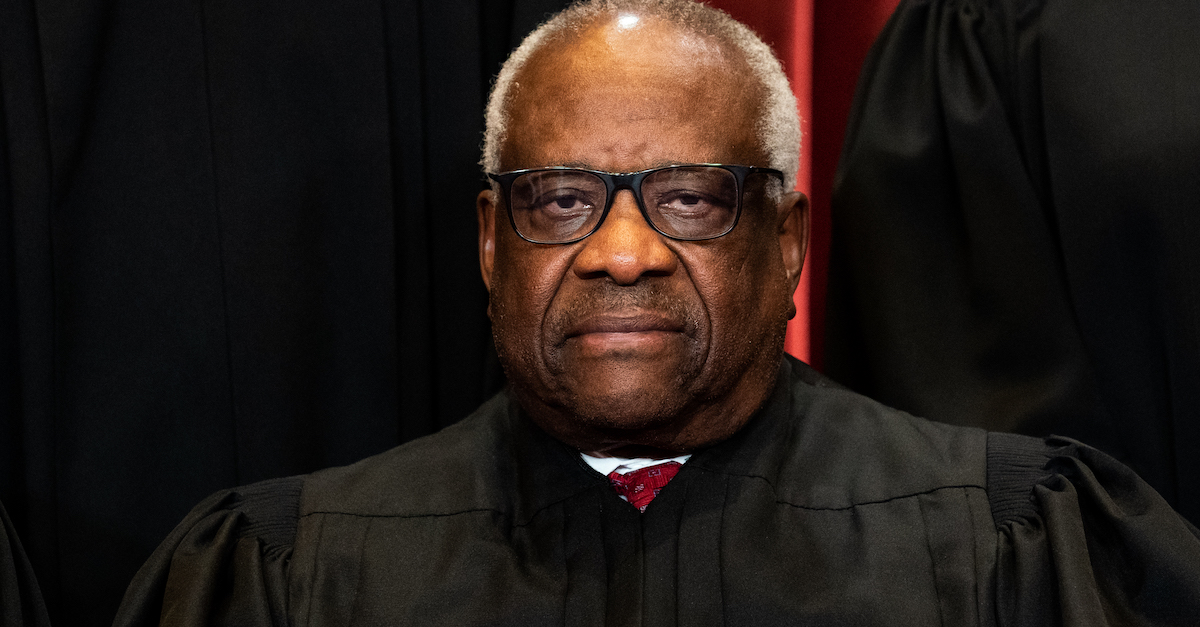
Associate Justice Clarence Thomas sits during a group photo of the Justices at the Supreme Court in Washington, DC on April 23, 2021.
The Supreme Court of the United States ruled 8-1 to overturn the conviction of Darrell Hemphill, who was convicted of the 2006 fatal shooting of 2-year-old David Pacheco Jr. Justice Sonia Sotomayor penned the majority ruling, holding that Hemphill’s Sixth Amendment rights had been violated when prosecutors introduced statements made by a different man during a plea deal; Justice Clarence Thomas was the lone dissenter.
Pacheco had been sitting in a minivan when he was killed by a stray bullet during a street fight in the Bronx. Eyewitness accounts of the shooting led police to a nearby apartment where they found matching bullets and the blue sweater the shooter had been seen wearing. Three individuals were ultimately identified as having been involved with the shooting: Ronnell Gilliam, Nicholas Morris, and Darrell Hemphill.
Morris entered into a plea deal for the shooting, then recanted, saying Hemphill had really been the shooter. Morris later pleaded guilty to gun possession charges in connection with the same incident. Years later, DNA evidence matched Hemphill and the blue sweater, and Hemphill was then indicted for the murder.
At Hemphill’s trial, he blamed Morris for the shooting. Hemphill’s lawyer noted that officers had recovered 9mm ammunition from Morris’ nightstand hours after a 9mm bullet killed Pacheco. Moreover, a prosecution witness gave evidence that implicated Morris as the shooter, though Morris himself did not testify.
In an effort to put context to Hemphill’s defense, prosecutors introduced parts of the transcript of Morris’ plea allocution to the gun possession charge as evidence to rebut Hemphill’s defense. Hemphill’s counsel objected on the grounds that allowing the plea allocution violated Hemphill’s rights under the confrontation clause, as Morris was unavailable for cross-examination.
The trial judge ruled that that Hemphill’s case had “opened the door” to allow Morris’ plea allocution is as evidence that was “reasonably necessary” to “correct” the “misleading impression” created by Hemphill’s defense case. Hemphill was convicted and sentence to 25 to life in prison.
Both the New York state intermediary and highest appellate courts affirmed, but SCOTUS reversed. Justice Sotomayor penned the 14-page opinion for the majority, holding that the trial judge had been wrong to allow one-sided evidence simply to put Hemphill’s defense in context. She wrote:
For Confrontation Clause purposes, it was not for the judge to determine whether Hemphill’s theory that Morris was the shooter was unreliable, incredible, or otherwise misleading in light of the State’s proffered, unconfronted plea evidence. Nor, under the Clause, was it the judge’s role to decide that this evidence was reasonably necessary to correct that misleading impression. Such inquiries are antithetical to the Confrontation Clause.
Justice Samuel Alito, joined by Justice Brett Kavanaugh wrote a brief concurrence, which focused on the idea that a criminal defendant such as Hemphill might, in some contexts, waive their rights under the Confrontation Clause. Although a defendant could impliedly waive their rights by “engag[ing] in a course of conduct that is incompatible with a demand to confront adverse witnesses,” they wrote, Hemphill had not done so.
Alito wrote that while “evidence that is misleading as to the real facts does not, in itself, indicate a decision regarding whether any given declarant should be subjected to cross-examination,” there are still “other circumstances” under which a defendant’s choice to introduce certain evidence could be considered a waiver of the right to confront.
In a 10-page dissent, Justice Clarence Thomas broke with the Court by focusing on the procedure underlying Hemphill’s appeal. Because Hemphill failed to raise his Sixth Amendment claim before the New York Court of Appeals (New York’s highest court), Thomas opined that federal courts have no jurisdiction over the issue under 28 U. S. C. §1257.
Thomas, however, noted that the Court has not been particularly faithful to this rule of late, writing, “our cases have since departed from this principle without squaring that departure with §1257’s unqualified text.” Remarking that, “For nearly 200 years, this Court adhered to the proper presentation requirement as a jurisdictional rule,” and had “routinely dismissed cases for lack of jurisdiction when the petitioner failed to properly present his federal claim to the state court.” Thomas called the Court’s change of course “a grave matter.”
[image via Erin Schaff/POOL/AFP via Getty Images]
Have a tip we should know? [email protected]
Source: This post first appeared on