
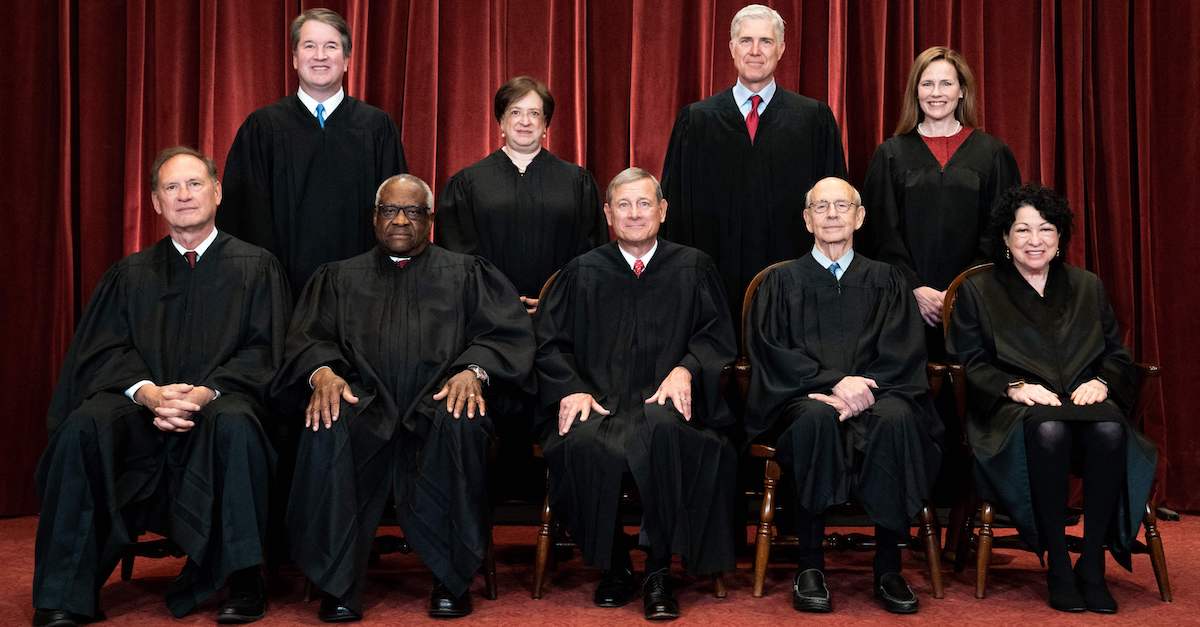
The Supreme Court of the United States ruled unanimously Monday to resurrect a lawsuit against Northwestern University brought by university employees over the school’s alleged violation of its fiduciary duties in managing employee retirement plans. All eight justices who participated (Justice Amy Coney Barrett was not involved in the case) sided with the aggrieved employees who claimed plan administrators violated their “duty of prudence.”
The case is Hughes v. Northwestern University.
Northwestern’s retirement plan must comport with the Employee Retirement Income Security Act of 1974, known as “ERISA.” Under ERISA, fiduciaries who manage the plan must discharge their duties “with the care, skill, prudence, and diligence under the circumstances then prevailing that a prudent man acting in a like capacity and familiar with such matters would use in the conduct of an enterprise of a like character and with like aims.” A group of current and former employees sued the school, alleging that the fiduciaries who managed their plans were insufficiently prudent in that they offered “needlessly expensive investment options” and paid “excessive record keeping fees.”
Specifically, plaintiffs claimed that the fees charged for investments into mutual funds and index funds were excessive, and the bookkeeping rates charged were exorbitant and out of line with acceptable practices. The allegedly problematic investments were just some options available to investors, who were free to choose among over 200 investment options.
The district court dismissed the case, and on appeal, the U.S. Court of Appeals for the Seventh Circuit affirmed. The appellate court’s decision focused on the fiduciary’s choice to present a diverse menu of options to investors. The court held that the wide array of choices presented to investors, “eliminat[ed] any claim that plan participants were forced to stomach an unappetizing menu.”
The justices, however, disagreed. Justice Sonia Sotomayor penned the six-page decision for the eight-member Court, holding that the Seventh Circuit focused on the wrong aspect of the fiduciary duty in question. She explained that fiduciaries must do more than simply present endless choices. Rather, “plan fiduciaries are required to conduct their own independent evaluation to determine which investments may be prudently included in the plan’s menu of options.” Further, “if the fiduciaries fail to remove an imprudent investment from the plan within a reasonable time, they breach their duty.”
Because the lower court did not fully assess any violation of the duty of prudence, the justices sent the case back down so the lower court “may reevaluate the allegations as a whole.”
[Erin Schaff/POOL/AFP via Getty Images]
Have a tip we should know? [email protected]
Source: This post first appeared on


