
Share this @internewscast.com
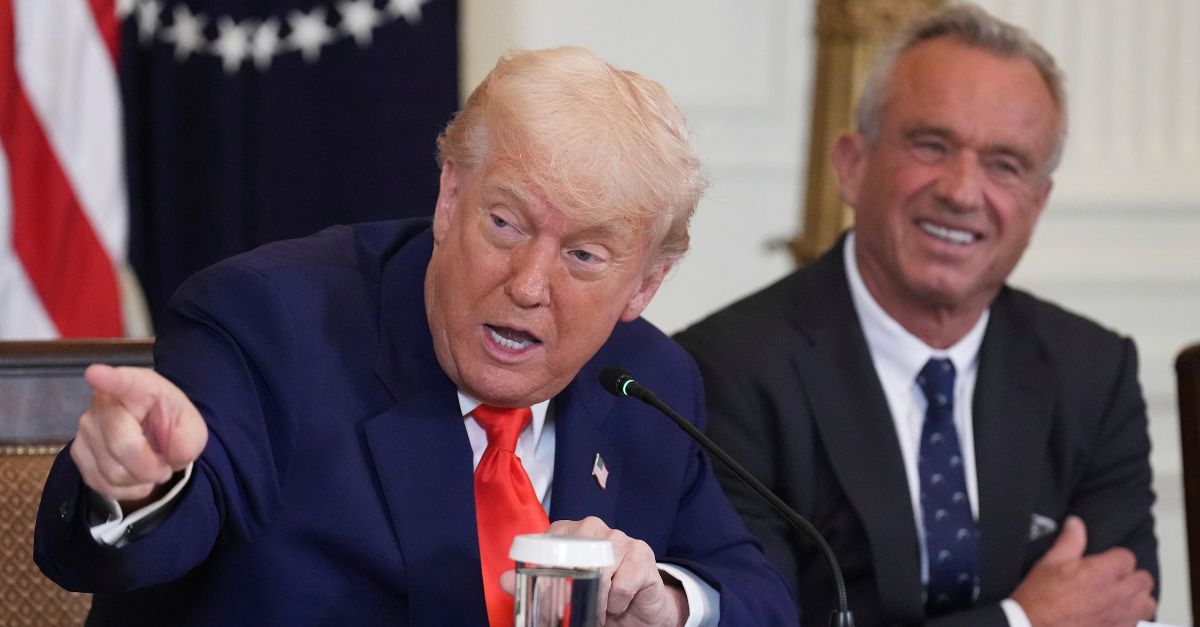
President Donald Trump speaks at a Make America Healthy Again (MAHA) Commission Event in the White House’s East Room on Thursday, May 22, 2025, with Health and Human Services Secretary Robert F. Kennedy Jr. listening (AP Photo/Jacquelyn Martin).
The Trump administration has requested that a federal court of appeals permit substantial layoffs at the U.S. Department of Health and Human Services (HHS) to proceed, amidst ongoing litigation over the authority to execute such dismissals at the district court level.
HHS Secretary Robert F. Kennedy Jr. revealed on March 27 that 10,000 employees from the agency would be let go and several sub-agencies would be closed, aligning with the Trump administration’s “Make America Healthy Again” initiative.
On May 5, a group of plaintiffs, led by the state of New York, launched a 101-page lawsuit claiming the resultant standstill at HHS was “the intended outcome of the March 27 Directive.” On July 1, U.S. District Judge Melissa R. DuBose, appointed by Joe Biden, issued a preliminary injunction preventing the government from “executing any actions to carry out or enforce” any layoffs or proposed reorganization.
The Trump administration is now appealing to the U.S. Court of Appeals for the 1st Circuit to halt the lower court’s decision, citing reasons of efficiency, executive management, and cost savings.
The administration argues in its motion, “The injunction is a significant intrusion on the Executive Branch’s ability to govern its own affairs. It requires the government to indefinitely maintain and financially support employees whose services are no longer needed, even though the government cannot recover those expenses if it wins on appeal…To rectify these mistakes and prevent further damage to the government, this Court should quickly issue a stay while the appeal is pending.”
In its 22-page emergency motion for a stay pending appeal, the U.S. Department of Justice primarily relies on a series of favorable rulings by the U.S. Supreme Court on its so-called “shadow docket.”
In each of three separate, but similar, cited cases, a majority of justices on the nation’s high court stayed district court injunctions barring administrative agencies – like the Department of Education and the Office of Personnel Management – from moving forward with controversial plans to slash federal workforces and end programs.
“Those interim orders ‘squarely control’ here because they necessarily ‘inform how a court should exercise its equitable discretion in like cases,'” the DOJ argues. “The government’s unbroken string of Supreme Court victories on these issues thus confirms that the stay factors are satisfied and the government is entitled to a stay.”
The motion goes on to argue the merits of the case as the Trump administration sees it – by relitigating earlier claims that the district court lacks jurisdiction over the matter. While these claims fell on deaf ears before DuBose, such arguments might convince the appellate panel.
To hear the DOJ tell it, the plaintiff states did not have standing to bring “an amorphous challenge” to the agency’s restructuring efforts “based on speculation” that the remaining employees would be unable to perform statutorily mandated functions assigned to HHS. The motion further argues the lower court “erred” in accepting such arguments.
“Plaintiffs lack standing to bring a broad, prospective challenge based on speculation about the Department’s inability to meet its obligations,” the motion goes on. “Most of the district court’s analysis was premised on the notion that the planned restructuring would harm the states’ citizens, not the states themselves. It is black-letter law, however, that states cannot sue the federal government on behalf of their citizens as parens patriae. A state might respond to a reduction in federal services by providing additional state services, but a desire to ‘supply social services such as healthcare and education,’ is not cognizable.”
The government also insisted the dispute is fundamentally a personnel action and therefore governed by the Civil Service Reform Act (CSRA).
In essence, the DOJ argued that even if the plaintiffs could prove they belong before a court, a district court is the wrong avenue for relief.
“Even if plaintiffs had standing, the district court would still lack jurisdiction to enjoin federal personnel decisions,” the motion goes on. “In the CSRA, Congress ‘established a comprehensive system’ that provides the ‘exclusive means’ for reviewing such matters. And those ‘exclusive means’ are [Merit Systems Protection Board] proceedings brought by affected employees, not lawsuits by third parties in district court.”
In this case, several states are suing – not employees themselves.
The Trump administration argued this state of affairs or more or less proved their point, because “Congress did not create a mechanism for states or other strangers to the employment relationship to challenge the termination of federal employees.”
In short, the DOJ argued the states were intentionally left out of the CSRA – and that federal workers have no other recourse for being fired under the auspices of a reduction in force (RIF), or mass firing.
“Were the law otherwise, gamesmanship would abound,” the motion continues. “Any party believing that a RIF would affect government services could bring a lawsuit until someone found a court willing to enjoin it. This case proves the point: the order in this case requires the government to continue paying employees whose terminations were separately at issue in the [aforementioned Supreme Court shadow docket] litigation.”