
Share this @internewscast.com
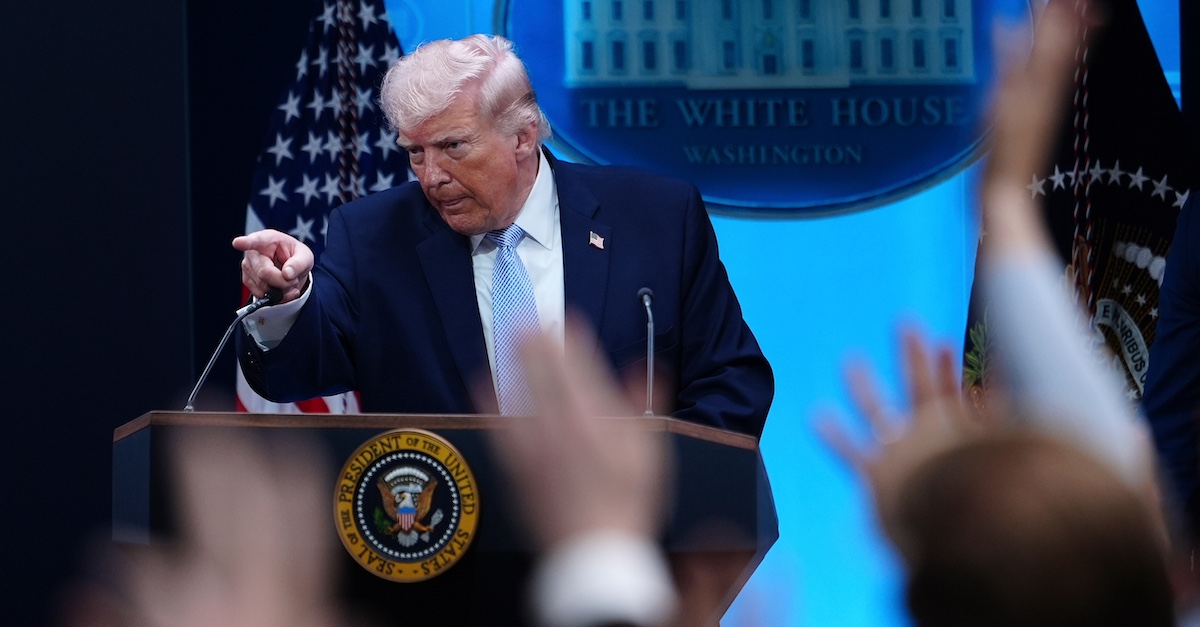
President Donald Trump gestures while speaking with reporters in the James Brady Press Briefing Room at the White House, Monday, April 6, 2026, in Washington (AP Photo/Julia Demaree Nikhinson).
There’s an ongoing clash between Donald Trump and members of the Pulitzer Prize Board, and this week the former president disclosed the next individuals he plans to question in private.
According to court documents examined by Law&Crime, two notices emerged Thursday in a Florida state court. These notices indicate that Kathleen Carroll, the former executive editor of the Associated Press, and Kevin Merida, the former executive editor of the Los Angeles Times and a current Pulitzer board member, are scheduled for video depositions on April 15 and April 21, respectively.
The specifics of Carroll’s questioning remain unclear. Though she is not a defendant in the case, Carroll is a former board member and once served as co-chair. Law&Crime reached out to a Trump attorney for comments regarding the notice about Carroll.
Trump is pursuing discovery in hopes of proving that the Pulitzer board disregarded its esteemed standards by not retracting several 2018 awards given to The Washington Post and The New York Times. These awards were for their reports on the late special counsel Robert Mueller’s investigation, Michael Flynn, the Steele Dossier, former FBI Director James Comey, Donald Trump Jr., the 2016 Trump Tower meeting with a Russian lawyer, and Russian troll farms.
These recent notices come after multiple other depositions and Trump’s recent demand for documents from board member and New Yorker editor David Remnick. Trump is probing Remnick’s “communications” with Fusion GPS co-founders, the firm responsible for funding the dossier by former British spy Christopher Steele. The court filing mentions an August 2016 meeting Remnick had with Glenn Simpson and Peter Fritsch, seeking details about the discussions surrounding that meeting and subsequent interactions over the next six years. In a 2019 interview published by the New Yorker, the co-founders defended their research amidst a series of articles by Jane Mayer.
Trump’s interest in this matter is further explained in a previously unsuccessful lawsuit. The lawsuit alleged that Fusion GPS and his then-political rival, Hillary Clinton, engaged in a racketeering scheme to create a “fraudulent ‘dossier'” intended to damage his campaign, his business ventures, and to overshadow his first presidential term.
The board has made waves of its own in discovery with requests for Trump’s tax returns, records on “medical and/or psychological health” and “any prescription medications,” and for a “complete and unredacted copy” of Mueller’s report, putting to the test Trump’s claims that a “defamatory” board statement backing Russia probe reporting awards harmed his reputation.
Just as Mueller’s former law firm recently opposed a Trump executive order as retaliation for its employment and views of the former special counsel, the board has argued that it took the president’s claims seriously, investigated them, and had the articles independently reviewed — only to be punished with a lawsuit for declining to rewrite history.
After the board resisted the president’s look into its “internal deliberations and review” and lost a long-shot bid to halt the lawsuit in its entirety until he’s out of office, Trump forced Stephen J. Adler, the “independent reviewer” the board relied on, to sit for a deposition. Semafor identified Adler as the reviewer in January.
In 2022, the board released the statement Trump claimed was defamatory, rebuffing his demands to rescind the awards. The statement cited “two independent reviews” of the Times and Post’s reporting — Adler’s conclusions that the prizes “stand,” as “no” aspects of the award-winning articles were “discredited.”
Once his investigation concluded, Mueller famously testified before Congress that Trump was not “exculpated” even though the former special counsel did not allege a grand conspiracy between the Trump campaign and Russia or obstruction offenses. Trump submits that makes the Russia probe a “Collusion Hoax” and its boosters defamers, even as the special counsel’s report identified “numerous links between the Russian government and the Trump campaign.”