
Garda Commissioner Justin Kelly was vacationing this week as the fuel crisis intensified, prompting calls for law enforcement to adopt a stricter approach towards protestors blocking essential infrastructure, the Mail on Sunday reports.
The Commissioner decided to cut his family holiday short, returning to Ireland on Friday morning to take charge as reports indicated that far-right elements had infiltrated the protest groups.
This led to a more assertive strategy aimed at dismantling the blockades, which had resulted in significant fuel shortages, threatening to paralyze the nation. However, government officials are questioning why this decisive action took so long to materialize.
This firmer enforcement strategy was implemented to successfully clear protestors from the blockade at Whitegate, Co. Cork, the country’s sole oil refinery, yesterday.
As government ministers prepared for crucial discussions with industry leaders at Government Buildings, several individuals were detained as law enforcement worked to regain access to the refinery.
Despite the operation’s success, there remain concerns about possible violent clashes at other critical infrastructure sites and roads still obstructed by protestors.
Senior sources last night said that gardaí moved to lift the blockade in Whitegate after receiving intelligence that ‘far-right’ agitators were conducting operations at the refinery.
Gardaí also obtained evidence that a protest at O’Connell Street in Dublin and a blockade of Galway Port had also been ‘infiltrated’ by extremists.
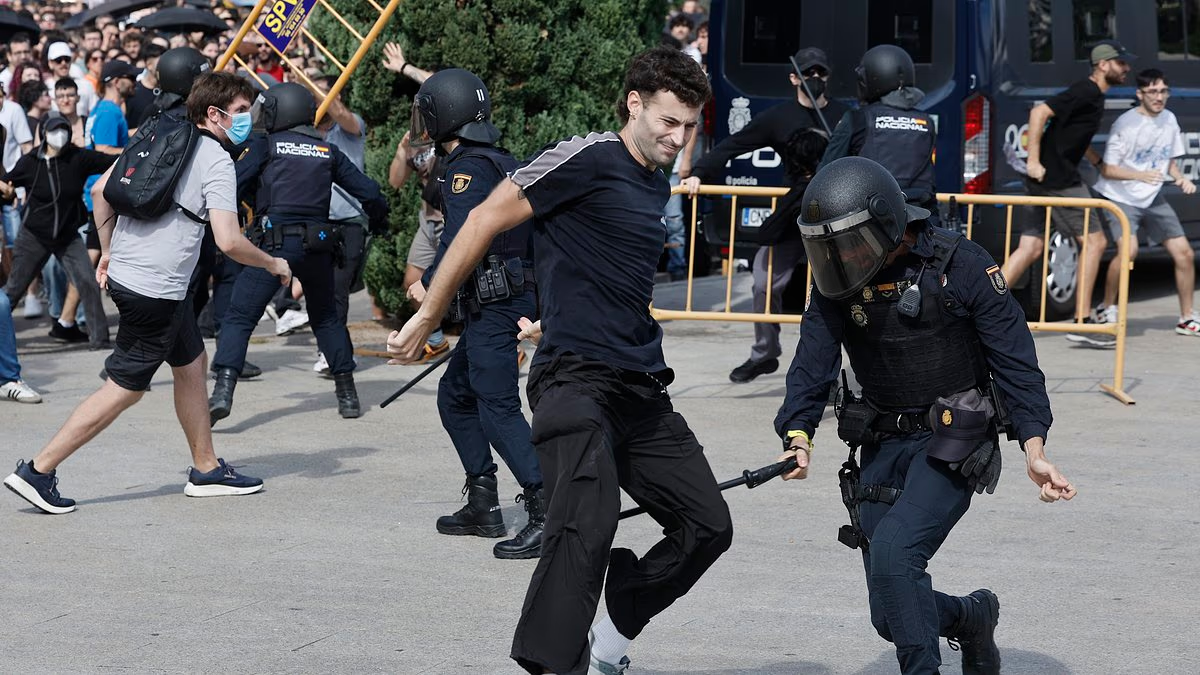
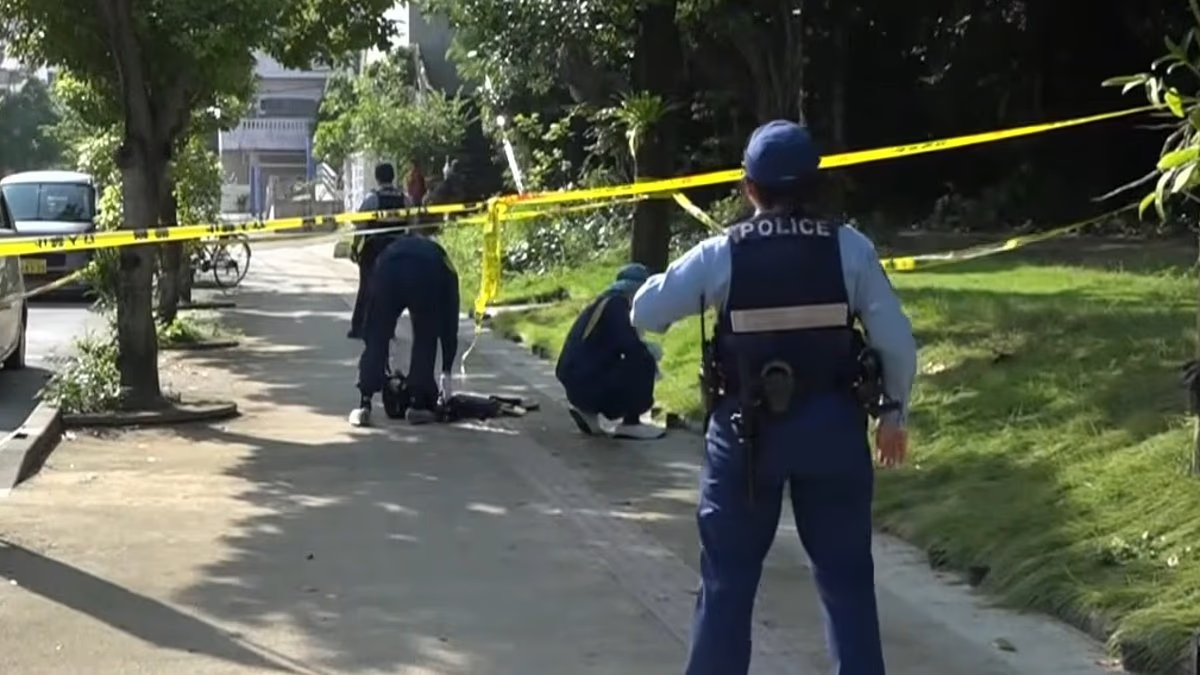
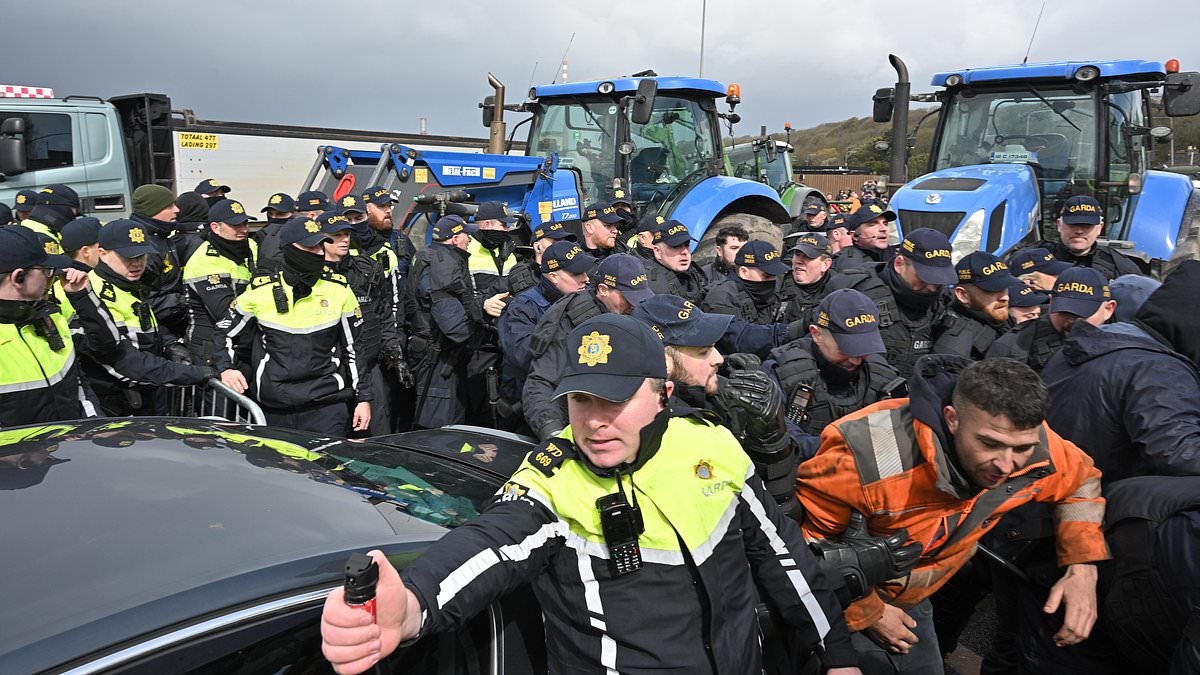
Yesterday, when members of the Public Order Unit removed trucks blocking tankers from accessing Whitegate as hundreds of forecourts across the country ran out of fuel supplies, pepper spray was used against protesters who tried to prevent gardaí from lifting the blockade.
Fears of an escalation of violence failed to materialise but gardaí are braced for more confrontations against protesters who continue to block the ports at Foynes and Galway, and busy national roads.

Garda Commissioner Justin Kelly speaking to the media at Garda Headquarters, Dublin, on the fifth day of a National Fuel Protest against rising fuel prices

Pepper spray needed to be used to clear the road at Whitegate in Cork. Photo: SEAN DWYER

Gardai were forced to use pepper spray to try and disperse protesters at Whitegate on Saturday. Photo: SEAN DWYER
Last night Commissioner Kelly issued a defence of Garda actions, and a stark warning: ‘We never want to do this, but the blockaders have left us with no choice.
‘We gave the blockaders fair warning that we were moving to enforcement and they choose to ignore it and continue to hold the country to ransom.’
‘In the coming hours and days we will have further such operations.
Asked directly by the Irish Mail on Sunday about Commissioner Kelly’s working week, the Garda Press Office would only say: ‘The Garda Commissioner is on duty and overseeing current Garda operations from Garda Headquarters.’
But a senior Garda source told the MoS: ‘The Commissioner was on a family holiday, and he came back because of the situation… he cut his family holiday short.’
These sources insisted the Garda chief was involved in operational matters remotely from the beginning of the week while he was out of the country until Friday morning.
However, senior Government figures last night questioned why it took until yesterday morning for gardaí to finally begin clearing barricades.
Ministers who spoke to the MoS yesterday said they were ‘deeply unhappy’ that the country’s top law enforcement officer was out of the country as the blockading of roads and infrastructure entered its fifth day.
One minister said: ‘Many of us in Government couldn’t understand why we didn’t have these protesters moved off public roads earlier in the cycle.
‘We were assured that the Department [of Justice] expected a “more proactive approach” from the gardaí as the “Garda Commissioner was now back in the country”.
Speaking last night, a Cabinet source said to the MoS: ‘I think the gardaí did a great job today. But I think there are legitimate questions in Government as to why it took so long.
‘Now, maybe a lay person like me just doesn’t understand in the sense of maybe there were logistical reasons. And, you know, there’s a complexity. But I still think there are questions to be asked, by Government, of the gardaí,’ said the minister.
The Government claimed that when Justice Minister Jim O’Callaghan made statements saying that the blockades should have ended, then action should have been taken immediately.
‘I don’t have an issue at all with the job Jim has done this week. But I just think when the Minister for Justice says A B and C are going to happen, well then A B, C and D needs to happen.’
Ministers said that the public asked of them: ‘the biggest query I’m getting into my inbox isn’t what you’re doing about the blockades. It’s why is there a blockade at all?’’
The Government corroborated the Garda briefing that the protests had been infiltrated by far-right elements.
‘What’s happening on O’Connell Street today, we’re seeing a lot of Irish tricolours with the phrase “Make Ireland great again” scrawled all over them and waving flags, and we saw Gavin Pepper there yesterday.
‘There’s a fair few people that aren’t farmers or contractors.’
Ministers added that all blockades will be lifted in the coming days and motorways will be made passable by the gardaí, with continuing operations.
However, the chaotic scenes that were allowed to gather pace this week sparked a blame game among Coalition leaders – and criticism of Garda management’s handling of the crisis.
Garda sources said they could sense the ‘blame game’ was beginning in Cabinet over the slow Garda response to the crisis brought on by fuel blockades.
The source said: ‘Let’s see what happens with some of the other ports. Like we’re doing okay in Foynes to a certain degree, Rosslare is okay, Galway is still a bit hairy, and that’s generally because of some of the individuals that are down there.
‘They’ve kind of been infiltrated a little bit by the far right. Down there, there’s a couple of the people, you know, who are looking at the by-election in Galway, are kind of using it for the far right.
‘So you can see it now down even on O’Connell Street, today is kind of turning into a far-right protest down there. So we’re definitely seeing that. We’re definitely seeing that in a number of locations this evening.’
Gardaí are also concerned about the intimidation of ordinary workers by protesters.
‘We’re definitely seeing increases in intimidation of fuel truck drivers or fuel delivery drivers,’ a senior source said.
Gardaí said the evidence of far-right infiltration and incidents in which protesters were checking motorists’ IDs contributed to the force ‘taking a harder line’.
Sources confirmed that if protesters do not disperse at other locations – including Galway, Foynes, Rosslare and O’Connell Street – public order units will conduct similar operations to yesterday’s lifting of the blockade at Whitegate.
Gardaí will give directions to protesters under the Public Order Act, and if they are not obeyed, the crowds will be dispersed. This may involve physically removing vehicles and, in the extreme, the dispersal of crowds with batons and pepper spray.
‘We will see similar operations like what we did in Whitegate if they continue with their blockades in other locations,’ the source said. ‘It may not come to that, because, you know, when they’re given a direction with a Public Order Act they might disperse.’
On Friday night, Commissioner Kelly issued a memorandum which essentially cancelled all leave for rank-and-file officers. The Garda presence outside the Whitegate refinery then significantly increased.
Asked about the strategy for dealing with the protests and blockades of vital infrastructure, a Garda spokesman said: ‘We have seen the impact of these blockades on people who have jobs to go to, medical appointments to attend, and families to feed. These blockades are against the law.
‘As part of our well-established graduated policing response in dealing with protests, An Garda Síochána is in enforcement phase in relation to those impacting on critical infrastructure unless they desist.’
The decision to clear the blockade at Whitegate was also influenced by a stark memo from Fuels for Ireland on the collapse of national supplies.