
Share this @internewscast.com
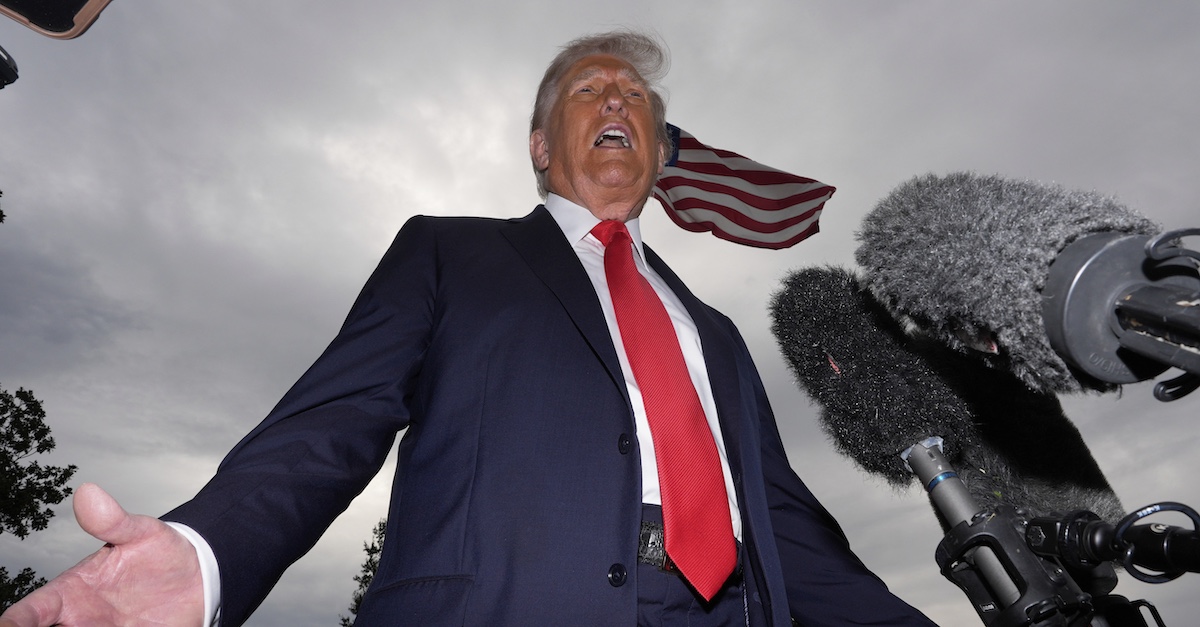
President Donald Trump talks with journalists before leaving on Marine One from the South Lawn of the White House on September 16, 2025, in Washington (AP Photo/Alex Brandon).
After Florida’s highest court dismissed attempts by Pulitzer Prize Board members to halt Donald Trump’s defamation case until he left office, the president’s legal team has filed a notice in the trial court to set a date for the deposition of an independent reviewer. This individual was identified as having defended the Russia investigation reporting awards granted to The Washington Post and The New York Times in 2018.
The brief notice, delivered by Trump’s attorney R. Quincy Bird, indicates that Stephen J. Adler is slated to be questioned under oath on the morning of October 21. This is a significant development, given that the board referenced Adler’s endorsement of the awards in the statement Trump claims is defamatory.
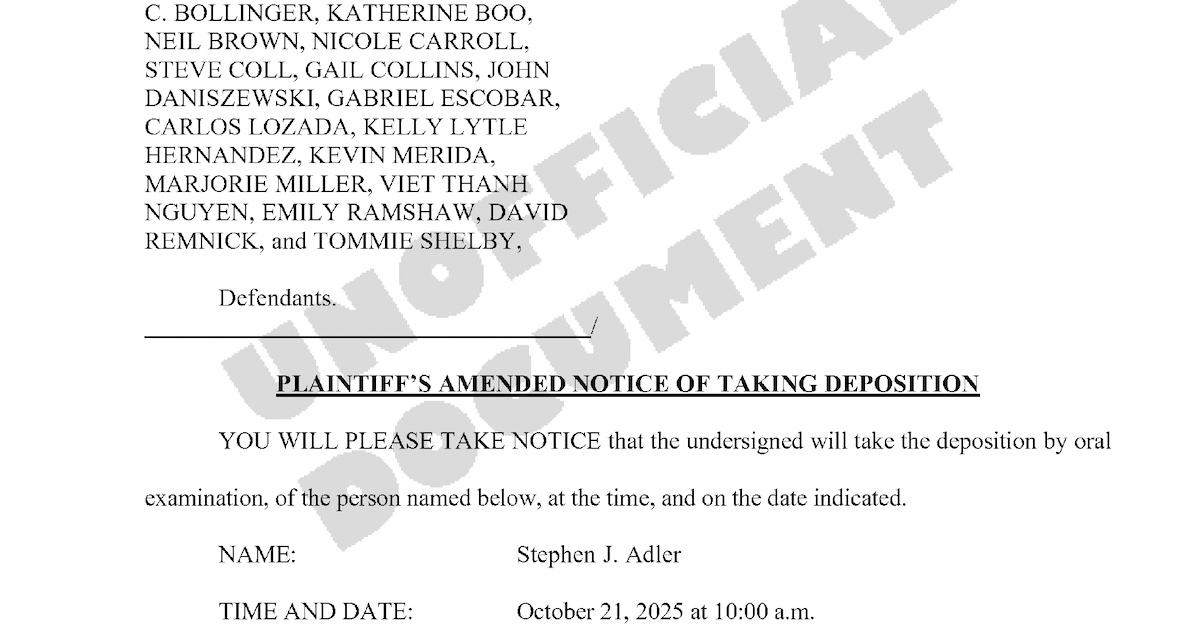
A court document shows that Stephen Adler is set for a deposition in October.
After overcoming obstacles at the Florida Supreme Court in the previous month, Bird expressed anticipation for a “very enlightening discovery process.” Now, progress toward that goal includes arranging Adler’s deposition, as outlined in the notice dated September 12.
Adler, who serves as chairman of the Reporters Committee for Freedom of the Press Steering Committee and has had a distinguished career as a reporter and editor at the Wall Street Journal and Reuters — including leading Pulitzer Prize-winning teams — was identified by Semafor in January as a confidential reviewer of the Times and Post articles in question.
In response to that story, the board reportedly confirmed Adler’s role as an “independent reviewer.”
“The Pulitzer Board approaches concerns about the Prizes with great seriousness. Regarding President-elect Trump’s challenge to the 2018 national reporting prizes, we selected an independent reviewer known for outstanding credentials, unquestionable integrity, and comprehensive knowledge of Pulitzer Prize standards and history,” the statement reportedly indicated.
That same month, as Trump proposed a subpoena of Adler, the defendants sought a protective order to keep “confidential” the Pulitzer Prize Board’s “internal deliberations and review,” making the case that disclosure thereof could “chill the candor of future Board deliberations and independent reviews.” Senior 19th Judicial Circuit Judge Robert Pegg rejected that request in early February, pointing out the Pulitzer Prize Board is “not a legally cognizable entity,” and so the “‘internal deliberations of the Pulitzer Prize Board’ is properly read as the ‘internal deliberations of the co-Defendants’ which are otherwise discoverable […] and not covered by a claim of privilege or statutory protection,” the docket reviewed by Law&Crime shows.
Pegg said that because the defendant board members failed to show they “would be subject to annoyance, embarrassment, oppression, or undue burden of expense” in the absence of a protective order, the request was denied. The defendants responded by withdrawing their objections.
In 2022, the board released a statement rebuffing Trump’s demands to rescind the 2018 prizes even as he claimed the Pulitzer Prize Board was “perpetuating the absurdly false and defamatory narrative contrived by the President’s political opponents: that he and his campaign somehow colluded with Vladimir Putin and the Russian government to gain advantage in the 2016 U.S. presidential election, and thereafter maintained some nefarious connection with Russian elements during the presidential transition and Trump administration (the ‘Russia Collusion Hoax’).”
The board’s statement cited “two independent reviews” of the Times and Post’s reporting to conclude that the prizes “stand,” as “no” aspects of the award-winning articles on former special counsel Robert Mueller’s Russia probe were “discredited”:
The Pulitzer Prize Board has an established, formal process by which complaints against winning entries are carefully reviewed. In the last three years, the Pulitzer Board has received inquiries, including from former President Donald Trump, about submissions from The New York Times and The Washington Post on Russian interference in the U.S. election and its connections to the Trump campaign—submissions that jointly won the 2018 National Reporting prize.
These inquiries prompted the Pulitzer Board to commission two independent reviews of the work submitted by those organizations to our National Reporting competition. Both reviews were conducted by individuals with no connection to the institutions whose work was under examination, nor any connection to each other. The separate reviews converged in their conclusions: that no passages or headlines, contentions or assertions in any of the winning submissions were discredited by facts that emerged subsequent to the conferral of the prizes.
Pegg disagreed on that point, at least for the purposes of the early stages of the case, when refusing to toss the suit of the Okeechobee County court in 2024, writing the statement constituted “actionable mixed opinion.”
“Defendants cannot claim the statement is pure opinion when they withheld information from their audience that would have provided an adequate factual foundation for a common reader to decide whether to agree or disagree with Defendants’ decision to let 2018 Pulitzer Prizes in National Reporting stand, and whether the awarded reporting had in fact been discredited by facts that emerged from the Mueller Report or the other government investigations that had been made public since the conferral of those prizes,” Pegg ruled, noting that Mueller’s investigation did not ultimately allege conspiracy between the then-45th president’s 2016 campaign and Russia — though the special counsel’s report did identify “numerous links between the Russian government and the Trump campaign.”
Since that time, the suit has largely been in a holding pattern as Andrew W. Mellon Foundation President Elizabeth Alexander and The Atlantic’s Anne Applebaum, among more than a dozen other board members named in Trump’s suit, appealed all the way up the Florida Supreme Court to halt the case until the end of Trump’s second term as president.
The board members first lost out in state appellate court in May, as a panel rejected the notion that the defendants put forth — that the suit moving forward now would be too burdensome for Trump to carry out his presidential duties. That argument didn’t fare any better with the state’s supreme court, which declined in August to take any action shutting down the civil case or further considering the board’s appeal.
Board members’ attorneys had insisted that if Trump can claim presidential immunity from suit the members should essentially able to assert that right for him, which Trump’s lawyers criticized that as “analytically confused and wrong” since that immunity belongs to the chief executive alone. And while the board repeated the defense that the “twenty award-winning articles […] reported facts that Respondent has never contested, and none of the Articles has since been retracted or corrected,” Trump attorneys called that defense “ludicrous” and the board’s “own version of reality.”
“In their Statement of the Case and Facts, Petitioners stray far beyond the facts stated in the district court’s opinion. They even falsely pretend that President Trump has never contested the articles published by The New York Times and The Washington Post maliciously and wrongly asserting that his campaign colluded with Russia to win the 2016 election,” a Trump brief said, adding that the board members “are not entitled to their own version of reality.”