
Share this @internewscast.com
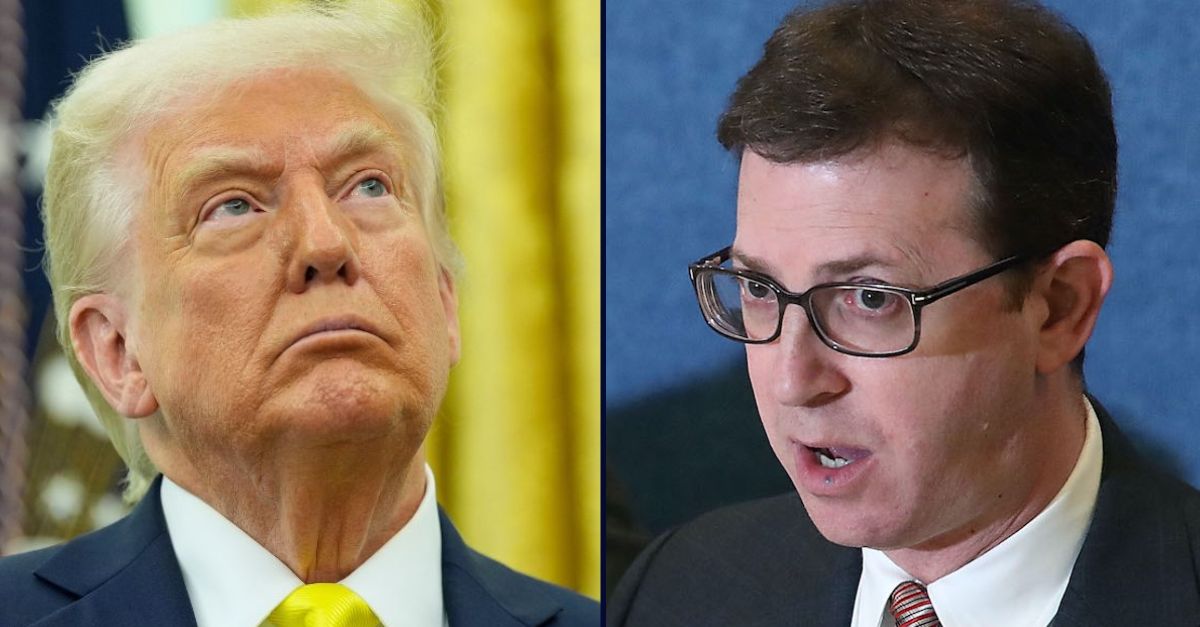
Left: President Donald Trump listens during a swearing-in ceremony for Dr. Mehmet Oz to be Administrator of the Centers for Medicare and Medicaid Services, in the Oval Office of the White House, Friday, April 18, 2025, in Washington (AP Photo/Alex Brandon). Right: Attorney Mark Zaid speaks about unfair competition lawsuit against President Donald Trump on March 9, 2017, in Washington, D.C. (Photo by Mark Wilson/Getty Images).
Prominent national security attorney Mark Zaid has successfully regained his security clearance following a ruling by a federal judge on Tuesday night.
Back in late March, then-President Donald Trump enacted an executive order that revoked security clearances from Zaid and several other notable figures.
The executive order stated that the president had concluded it was “no longer in the national interest” for these individuals—many of whom are perceived as critics of Trump—to maintain access to classified information.
In response, Zaid filed a lawsuit in early May in a Washington, D.C., federal court. He challenged the actions of the 45th and 47th president, labeling the order as “improper political retribution” and “dangerous, unconstitutional retaliation.”
U.S. District Judge Amir Ali, appointed by President Joe Biden, has now issued a decisive ruling in favor of Zaid, detailed in a 39-page memorandum opinion and order.
The opinion begins by asserting, “The Constitution forbids government officials from using their power to retaliate against people for their speech, and that is so even when the speech is critical of the government.”
The court also quickly cuts to the heart of the matter in a way that clearly foreshadows the eventual win for the plaintiff.
“This case involves the government’s retribution against a lawyer because he represented whistleblowers and other clients who complained about the government, carried out by summarily canceling the attorney’s security clearance without any of the process that is afforded to others,” the opinion goes on. “In defending its actions, the government does not meaningfully rebut that the decision to deny this attorney the usual process was based on his prior legal work for clients adverse to the government.”
In ruling against the government, the court first had to determine whether Zaid’s claim was justiciable, or able to be tried by a court.
The U.S. Department of Justice argued that the basic issue of a clearance revocation was beyond the realm of what a judge could even consider.
“The government acknowledges it chose to revoke Zaid’s security clearance without any of the process it usually affords but argues the legality of its summary revocation is ‘a quintessential political question’ that cannot be reviewed by federal courts,” the opinion goes on. “However, its position is premised on ignoring binding precedent that says otherwise, including simply omitting relevant caselaw from the motion to dismiss and preliminary injunction opposition.”
However, Ali made clear his belief that actual “precedent has rejected” the idea that security clearance decisions are immune from judicial review. Rather, the judge says, there is a distinction between judgments made about a given employee’s security clearance and claims related to the constitutionality of the “methods used” to make such judgments.
“Here, none of Zaid’s claims challenge or otherwise ask the court to review an individualized national security determination—to the contrary, they challenge the legality of denying him any such individualized review,” the court’s opinion continues. “That kind of claim is one the court can, and therefore must, review.”
Ali’s review of the record unequivocally found the Trump administration’s methods unconstitutional on multiple fronts.
First, the court determined the revocation violated the First Amendment.
“When Zaid petitioned the government and courts on behalf of whistleblowers and other clients, he was engaging in activity the First Amendment protects,” the opinion goes on. “And the adverse action here—revoking a person’s security clearance—is more than sufficient to constitute retaliatory action.”
Ali then ties Zaid’s protected speech to Trump’s retaliation, at length:
[Zaid’s] protected expression, petitioning on behalf of people or in matters disfavored by the government, is what caused the government to summarily revoke his clearance. The President expressed repeated, public displeasure with Zaid—calling him a ‘sleazeball’ and saying he should be sued for ‘treason’—and expressly tied it to his representation of a government whistleblower. The record also shows that the decision to summarily revoke Zaid’s clearance took place just days after Zaid filed a lawsuit against the government on behalf of FBI employees to protect them from being targeted for their work related to the January 6 attack on the U.S. Capitol. And that decision was made just days apart from several other presidential orders found to be targeting attorneys based on their choice of clients. Based on the preliminary injunction record, the court finds that Zaid’s representation of whistleblowers and other clients adverse to the government was the sole reason for summarily revoking his security clearance.
The court goes on to note that the DOJ did not seriously contest why Zaid’s security clearance was revoked, but argued that there might have been other constitutional reasons for doing so.
The judge rejected that idea out of hand, saying there was nothing in the record to that effect and such “interests were not at play here.”
In dovetailing fashion, the court also determined the revocation violated Zaid’s procedural due process rights and Fifth Amendment right to counsel — specifically his right to provide it.
“He has introduced evidence that because of the summary revocation he can no longer maintain his national security practice of representing current and former government employees whose cases involve classified information,” the opinion goes on. “The summary revocation has interfered with Zaid’s ongoing attorney-client relationships because he is no longer able to access classified information or use classified information he previously learned.”
Ultimately, the court gave Zaid a slightly conditional win — setting a deadline of Jan. 13, 2026, for the preliminary injunction to take effect. This 21-day interlude gives the Trump administration ample time to file any number of appeals and at least hold up the reissuance of Zaid’s clearance.
Still, the plaintiff was ecstatic about the district court win.
“This is not just a victory for me, it’s an indictment of the Trump administration’s attempts to intimidate and silence the legal community, especially lawyers who represent people who dare to question or hold this government accountable,” Zaid said in a statement provided to Law&Crime. “I will not be intimidated and look forward to continuing to defend the brave men and women who stand up to the unlawful retaliation of the Trump administration.”