In a small, serene hospital chapel in Florida, Beverly Bryan sat quietly, her head bowed and hands tightly clasped, as she prayed fervently for her husband’s recovery. Her husband, a Navy veteran, was undergoing surgery.
Just moments before, the tranquility had been shattered by a stark announcement over the hospital’s loudspeaker: there was a medical emergency in the operating room.
Bill Bryan, aged 70, was at Ascension Sacred Heart Hospital Emerald Coast in Miramar Beach for what was expected to be a routine spleen removal procedure.
Despite a seemingly reassuring 99 percent chance of survival, the outcome was tragically different. Bill did not survive the surgery.
Dr. Thomas Shaknovsky soon entered the chapel to deliver the devastating news to Beverly. He explained that her husband had succumbed to a ruptured artery, an unexpected complication. The doctor revealed that Bill’s spleen was diseased and had grown to four times its normal size.
Beverly, however, who had built a career as a nurse over several decades, immediately felt something was amiss. The swelling the doctor described had not shown up in scans taken just days before, leaving her puzzled about how such a rupture could have occurred.
Still, she was too overcome with grief to press him. The doctor sat beside her, prayed with her and assured her that her husband was in a better place.
He later followed up with a text: ‘Praying for you and your family,’ according to messages shared with the Daily Mail. When she did not respond, he tried again the next morning: ‘I am just reaching out to check on you. Please call me when you’re free.’
Now, Beverly believes Dr Shaknovsky’s reasons for reaching out were not pure.

Prosecutors allege that Dr Thomas Shaknovsky removed the wrong organ from a patient who later died at Ascension Sacred Heart Emerald Coast hospital in Miramar Beach, Florida, in 2024

Bill Bryan died on the operating table in August 2024 during what should have been a standard procedure to remove his spleen. Above, with his wife Beverly


Text messages sent to Beverly by Dr Shaknovsky were shared with the Daily Mail
‘I don’t think he was trying to be nice. I think he was just trying to get an idea of whether or not I had actually believed what he told us,’ she told the Daily Mail. ‘It was apparent to me that something wasn’t right.’
In another message, Dr Shaknovsky reiterated that he was praying for the Bryans and added, ‘We are all heartbroken. I just wanted to reach out to you and let you know I’m here if I can help in any way I know he’s in the better place. He was a wonderful person and I know he’s with the lord.’
The shocking truth of what happened in the operating room emerged just hours before Bill was due to be cremated.
He had not died from an aneurysm. Instead, investigators with the Alabama Board of Medical Examiners found that his liver had been mistakenly removed during the operation – a catastrophic error that caused fatal blood loss.
‘I never dreamed my husband would not live through that surgery,’ Beverly said. ‘[Dr Shaknovsky] is a menace to society.’
It soon emerged that Bill was not the only patient to have recently been harmed or died under the surgeon’s care.
In an incident from May 2023, a year before Bill’s death on August 21, 2024, Dr Shaknovsky was accused of removing part of a patient’s pancreas during a routine surgery.
The patient, Michael Turner, was supposed to have his left adrenal gland removed – a small gland that sits above the kidney – but instead lost part of his pancreas, a completely different organ located deeper in the abdomen.
Dr Shaknovsky said at the time that the adrenal gland had ‘migrated’ to another part of the patient’s body, according to court documents.
Turner accused Dr Shaknovsky of medical malpractice and claimed to have suffered permanent injury and mental anguish as a consequence. State records show that the medic paid $400,000 to settle Turner’s claim.
Turner’s filing alleges that, beyond his case, Dr Shaknovsky had been subject to multiple complaints regarding ‘adverse surgical outcomes’ after joining Ascension Sacred Heart in May 2020.

Dr Shaknovsky was arrested last week after being indicted by a grand jury on second-degree manslaughter charges. He has pleaded not guilty

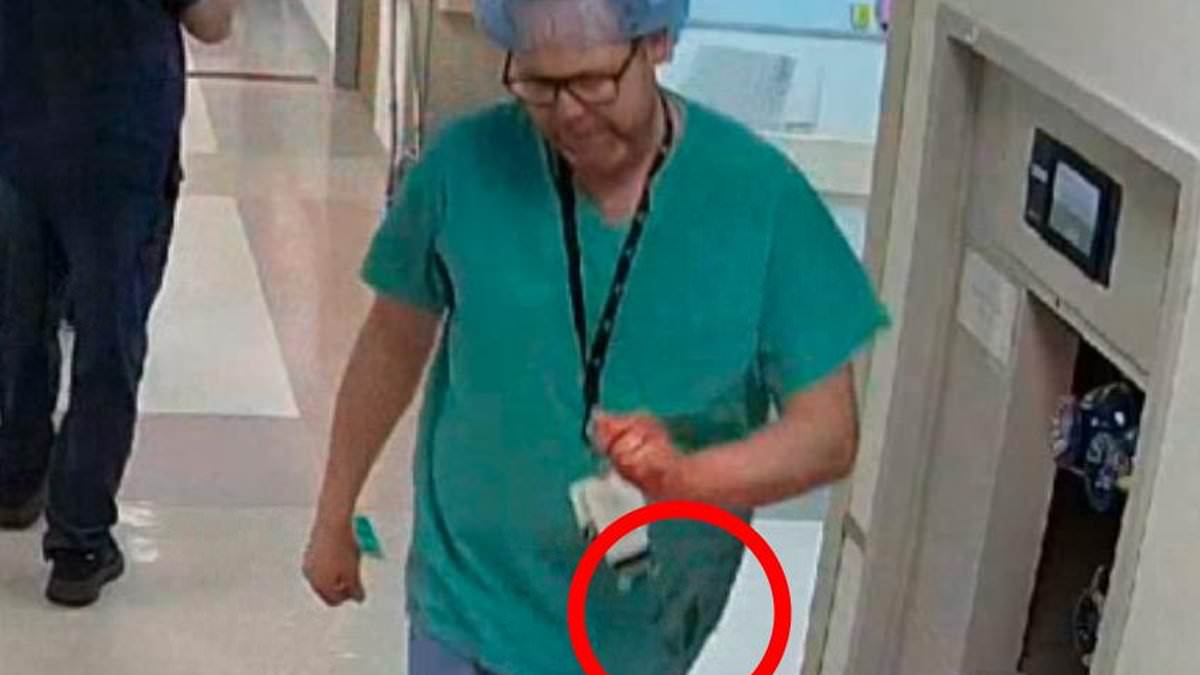
Dr Shaknovsky on the night of Bill Bryan’s fateful surgery at Ascension Sacred Heart Hospital
In July 2023, months after the bungled adrenal gland surgery, another patient, Dorothy Dorsett, died days after being operated on by Dr Shaknovsky.
Dr Shaknovsky was accused of removing part of Dorsett’s intestine, triggering a massive fatal infection, according to a second lawsuit.
Shortly after the surgery, she was moved to the ICU and died, the filing states.
The claims made in the lawsuits were ratified by an investigation conducted by the Alabama Board of Medical Examiners, records show.
The lawsuit over Dorsett’s death continues and Dr Shaknovsky has denied wrongdoing.
Joe Zarzaur, a lawyer representing Beverly, Turner and Dorsett’s family in the civil claims against Dr Shaknovsky, called the medic’s trail of surgical errors unconscionable.
‘The first complication we know of happened in 2022, and we now have about 16 different people who have come forward to report bad results,’ Zarzaur claimed.
‘The day before Mr Bryan’s surgery, he [Dr Shaknovsky] had another complication, where the patient had to be rushed to another facility.’
Zarzaur claimed Dr Shaknovsky was an incompetent surgeon who should never have been able to operate on Bill to begin with.
He likened the surgeon to Christopher Duntsch, a Dallas-based neurosurgeon known as Dr Death, who, between 2011 and 2013, operated on 38 patients, leading to two deaths and the maiming and paralyzing of 33 others.
‘Let me put it in the words of the expert surgeons that I’ve hired in this case, to consult with me,’ said Zarzaur.
‘They said either this man is a Dr Death character, or he’s got a substance abuse problem, or some kind of brain injury or condition that is causing him to not understand what he’s doing, because the mistakes he’s making are not mistakes.’

Bill was a US Navy veteran and a retired boilermaker from Muscle Shoals, Alabama

Another of Dr Shaknovsky’s patients, Dorothy Dorsett, died in August 2023 after surgery. Her family has filed a medical malpractice lawsuit against him
Pointing to the Medical Examiner’s report, Zarzaur said the liver’s size and the complexity of detaching it from multiple vital connections make it nearly impossible for any competent surgeon to mistake it for another organ.
‘When you look at the records… it makes me feel as if it’s more towards the Dr Death kind of scenario,’ alleged Zarzaur.
After an 18-month investigation, Dr Shaknovsky was indicted by a grand jury on a charge of second-degree manslaughter in connection with the death of Bill. He was taken into custody in Miramar Beach on April 13.
Dr Shaknovsky could not be reached for comment. He pleaded not guilty last week and has since been released on a $75,000 bond.
The disgraced surgeon lives at a sprawling five-bedroom, seven-bathroom mansion valued at $4.2 million in Destin, Florida.
For Bill’s widow, the news of Dr Shaknovsky’s arrest came as a great relief.
Beverly told the Daily Mail her family has been torn apart by Bill’s death, and she is now hopeful that no others will have to suffer as hers has.
Even getting out of bed in the morning can be a challenge some days, she said.
Adding to the family’s anguish was learning of how her husband’s final moments of life were spent on the operating table.
She and Bill, from Muscle Shoals, Alabama, had been vacationing in Florida when Bill started complaining of sharp pains in his abdomen.

The surgeon lives at a sweeping five-bedroom, seven-bathroom mansion valued at $4.2 million in Destin, Florida
A subsequent scan revealed a suspected enlarged spleen and ‘blood in the peritoneum with no active hemorrhage,’ a court order filed by the Alabama Board of Medical Examiners revealed.
Per the filing and Beverly’s recollection, Bill wanted to return home to undergo surgery, but Dr Shaknovsky spent two days ‘pressuring’ Bill to have the procedure in Florida.
He told Bill he needed to have his spleen removed urgently. He eventually agreed.
However, the procedure was not regularly performed at Ascension Sacred Heart, records from the state’s Health Department show.
Colleagues present in the operating room also had ‘concerns that [Dr Shaknovsky] did not have the skill level to safely perform this procedure,’ per the Health Department.
Problems surfaced almost immediately.
The doctor began the procedure as a keyhole surgery – a minimally invasive technique using small incisions and a camera – but switched to open surgery when he could not clearly see Bill’s organs, something the Health Department said may have been caused by a swollen colon blocking part of his view that he had not identified beforehand.
Staff members in the operating room reported that Bill’s colon ‘burst out of the abdominal cavity.’ He soon began hemorrhaging and went into cardiac arrest.
Nurses and other staff members tried to revive him while Dr Shaknovsky continued to dissect Bill’s organ, ‘even though the abdomen was full of blood,’ the department said.
It is also claimed that Dr Shaknovsky did not ask for a clamp or cauterizer – a medical tool to stop bleeding. He eventually removed Bill’s liver, believing it was his spleen.
‘The staff looked at the readily identifiable liver on the table and were shocked when Dr Shaknovsky told them that it was a spleen,’ the state documents said. ‘One staff member felt sick to their stomach.’

Dr Shaknovsky has been released on a $75,000 bond and will reappear in court next month
In its report, the Health Department noted that, in addition to being on opposing sides of the abdomen, ‘spleens and livers are anatomically distinct, have different consistencies, and are different colors.’
In a later interview, Dr Shaknovsky told the state the same story he told Beverly: that he dissected the spleen from its surrounding tissue when an apparent aneurysm in the spleen ruptured suddenly.
The account contradicted those of numerous others in the operating room, records show. An autopsy found his spleen was intact. There was no evidence of a ruptured aneurysm.
Beverly said she will be forever haunted by the details of her husband’s death.
‘It’s made my life almost unbearable to think that my sweet, wonderful husband was treated this way,’ she said, her eyes welling with tears.
‘But since these criminal charges were made, it make its more bearable to know that [Shaknovsky] will not hold a knife in his hand to operate on people if he’s convicted.’
A spokesman for Ascension Sacred Heart said safety was the hospital’s ‘top priority.’
‘Dr Shaknovsky was never a Sacred Heart Emerald Coast employee and has not practiced at any of our facilities since August 2024,’ the representative said.
‘We remain focused on upholding the standards our patients and community expect of us.’
Dr Shaknovsky’s next court appearance has been set for May 19. He faces up to 15 years in prison if convicted.