
Share this @internewscast.com
Trump announces capture of Venezuela’s Maduro, wife
Fox News correspondent Lucas Tomlinson reports on a significant development involving Venezuelan leader Nicolás Maduro, as announced by President Donald Trump. According to Trump, Maduro and his wife were apprehended and transported out of Venezuela during what he termed a ‘large-scale strike.’
Maduro, once a bus driver and union organizer, climbed the political ranks in Venezuela to become a contentious figure on the global stage. The U.S. had been actively seeking his capture, offering a $50 million reward for information leading to his arrest.
President Trump revealed that Nicolás Maduro was “captured and flown out of the country” early Saturday morning following a comprehensive military operation executed by the United States.
This event signals a dramatic downfall for Maduro, who was in the midst of his third term as Venezuela’s president. His tenure was marked by severe economic troubles, widespread protests, controversial election outcomes, and accusations of drug trafficking.
Born on November 23, 1962, in Caracas, Venezuela, Maduro’s political journey included a formative year in communist Cuba in 1986, where he received ideological training—the extent of his formal education beyond high school.

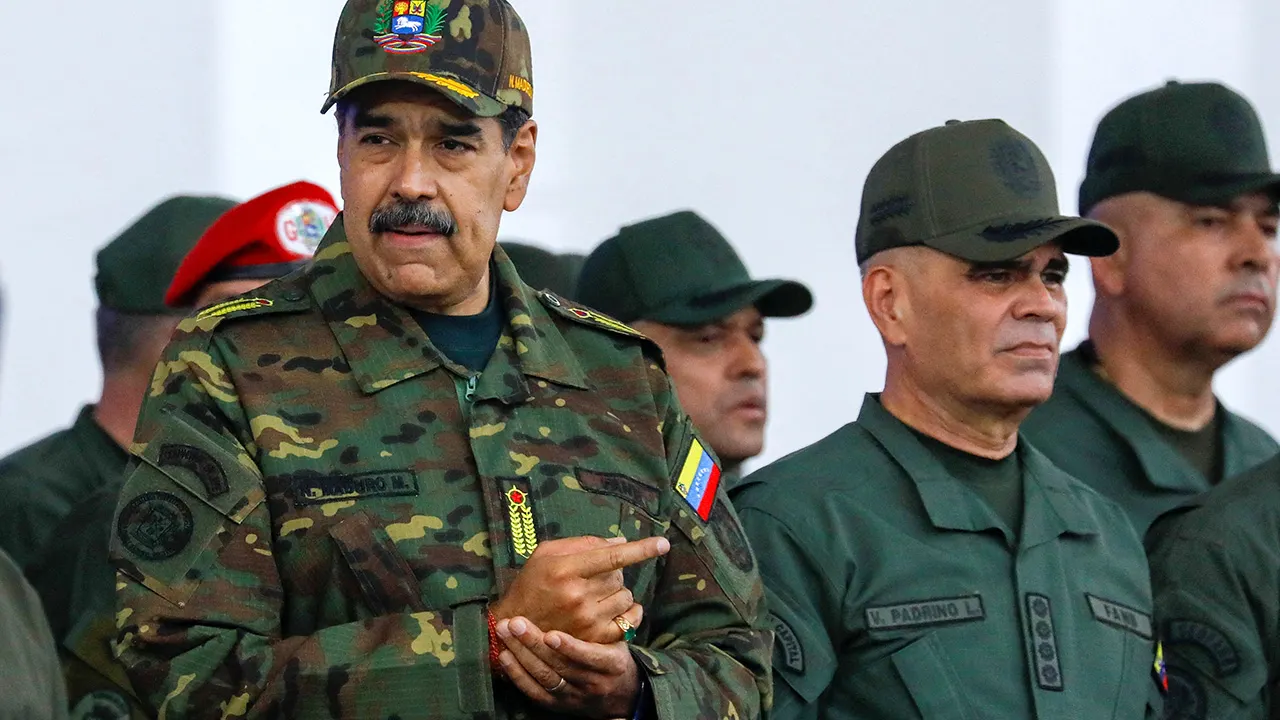
The image captures Venezuela’s President Nicolás Maduro addressing armed forces, Bolivarian Militia, police, and civilians during a rally opposing potential U.S. actions against Venezuela at Fort Tiuna military base in Caracas on November 25, 2025. (Leonardo Fernandez Viloria/Reuters)
Upon returning home, Maduro found work as a bus driver and union organizer. He embraced the late Venezuelan President Hugo Chávez after the then-army paratrooper in 1992 staged a failed coup against an unpopular austerity government. Around the same time, he met his longtime partner, Cilia Flores, a lawyer for the jailed leader.
After Chávez was freed and elected president in 1998, Maduro, a young lawmaker, helped push his agenda of redistributing the OPEC nation’s oil wealth and political power.
In 2000, Maduro was elected to Venezuela’s National Assembly. He later became the president of the National Assembly in 2005.
Then in 2006, Chávez appointed Maduro as Venezuela’s foreign minister. Six years later, Maduro was appointed as Venezuela’s vice president.
When Maduro took power in 2013 following his mentor’s death from cancer, he struggled to bring order to the grief-stricken nation. Without “El Comandante” in charge, the economy entered a death spiral — shrinking 71% from 2012 to 2020, with inflation topping 130,000% — and opponents and rivals inside the government saw an opportunity.
Less than a year into Maduro’s presidency, hardliner opponents launched demonstrations demanding his exit.
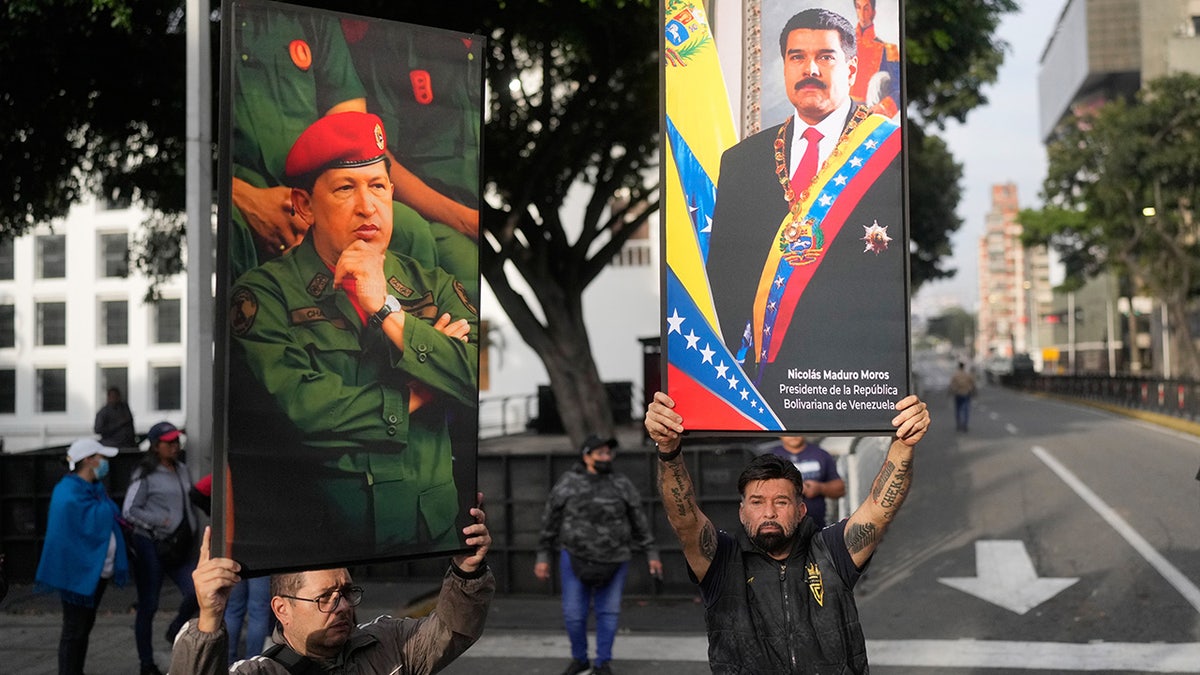
Government supporters display posters of Venezuelan President Nicolás Maduro, right, and former President Hugo Chávez in downtown Caracas, Venezuela, on Saturday, Jan. 3, 2026, after U.S. President Donald Trump announced that Maduro had been captured and flown out of the country. (Matias Delacroix/AP)
Leaning heavily on Venezuela’s security forces, Maduro crushed the protests. However, with supermarket shelves empty amid widespread shortages, they resumed with more intensity three years later, leaving more than 100 people dead. In 2018, the International Criminal Court initiated a criminal investigation into possible crimes against humanity.
The crackdown continued into the 2018 presidential race, which the opposition boycotted when several of its leaders were barred from running. Dozens of countries led by the U.S. condemned Maduro’s first re-election as illegitimate and recognized Juan Guaidó, the head of the National Assembly, as Venezuela’s elected leader.
“Since 2019, more than 50 countries, including the United States, have refused to recognize Maduro as Venezuela’s head of state,” the State Department said in a profile of Maduro on its website.
“Maduro helped manage and ultimately lead the Cartel of the Suns, a Venezuelan drug-trafficking organization comprised of high-ranking Venezuelan officials. As he gained power in Venezuela, Maduro participated in a corrupt and violent narco-terrorism conspiracy with the Revolutionary Armed Forces of Colombia (FARC), a designated Foreign Terrorist Organization,” it added.
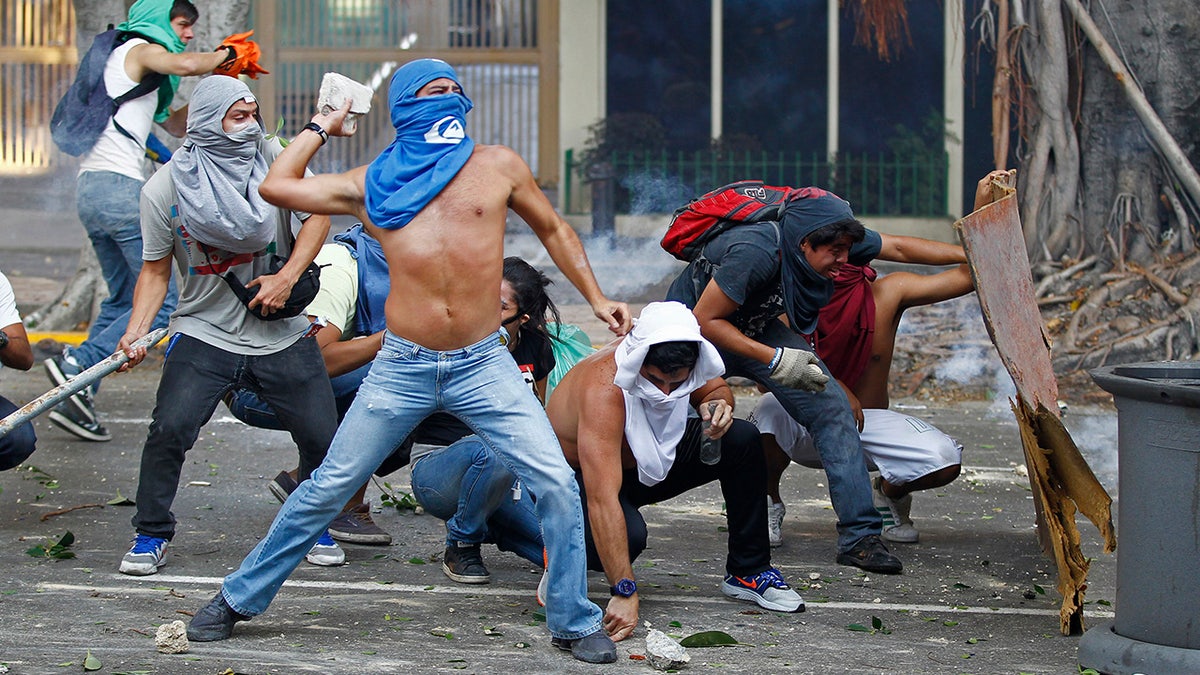
Demonstrators confront police as they protest against the government of President Nicolas Maduro in Caracas, on Feb. 22, 2014. (Carlos Garcia Rawlins/Reuters)
“Maduro negotiated multi-ton shipments of FARC-produced cocaine; directed the Cartel of the Suns to provide military-grade weapons to the FARC; coordinated with narcotics traffickers in Honduras and other countries to facilitate large-scale drug trafficking; and solicited assistance from FARC leadership in training an unsanctioned militia group that functioned, in essence, as an armed forces unit for the Cartel of the Suns,” the State Department continued.
“In March 2020, Maduro was charged in the Southern District of New York for narco-terrorism, conspiracy to import cocaine, possession of machine guns and destructive devices, and conspiracy to possess machine guns and destructive devices,” it also said.
Maduro was re-elected again in 2024 in another disputed election.
“Given the overwhelming evidence, it is clear to the United States and, most importantly, to the Venezuelan people that Edmundo González Urrutia won the most votes in Venezuela’s July 28 presidential election,” then-Secretary of State Antony Blinken said at the time.
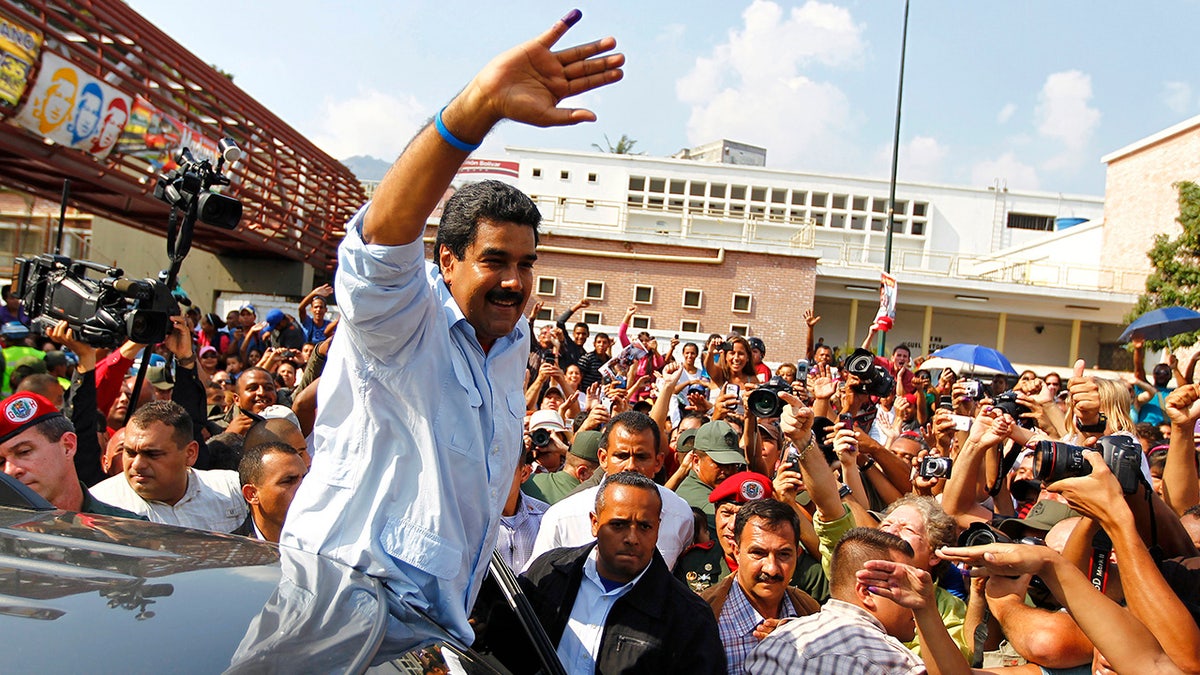
Acting Venezuelan President Nicolas Maduro waves to supporters as he leaves after voting for the successor to the late President Hugo Chavez, in Caracas on April 14, 2013. (Carlos Garcia Rawlins/Reuters)
Maduro then delivered a fiery inauguration speech in January 2025, likening himself to a biblical David fighting Goliath and accusing his opponents and their supporters in the U.S. of trying to turn his inauguration into a “world war.”
He said his enemies’ failure to block his inauguration to a third six-year term was “a great victory” for Venezuela’s peace and national sovereignty.
“I have not been made president by the government of the United States, nor by the pro-imperialist governments of Latin America,” he said, after being draped with a sash in the red, yellow and blue of Venezuela’s flag. “I come from the people, I am of the people, and my power emanates from history and from the people. And to the people, I owe my whole life, body and soul.”
Months later, Attorney General Pam Bondi announced a $50 million reward for information leading to Maduro’s arrest.
“Maduro uses foreign terrorist organizations like TdA (Tren de Aragua), Sinaloa and Cartel of the Suns (Cartel de Soles) to bring deadly violence to our country,” Bondi said in a video message in August 2025. “He is one of the largest narco-traffickers in the world and a threat to our national security.”