

Warner Bros.
Contains spoilers for “Evil Dead Burn”
The sixth installment in the “Evil Dead” franchise brings exactly the kind of blood-soaked chaos longtime fans expect, while still finding new ways to be both ridiculous and deeply unsettling. Sébastien Vaniček’s “Evil Dead Burn” swings from grotesque dark comedy — apparently, even a Deadite licking your dentures can spell doom — to moments that are genuinely disturbing. On the surface, the film plays like a contained nightmare built around one of the most excruciating family gatherings imaginable. It also seems, at first, to confirm that the series has moved almost completely beyond Bruce Campbell’s Ash Williams, focusing instead on unlucky strangers who stumble into the orbit of the Necronomicon.
Look a little closer, though, and “Evil Dead Burn” is not quite as standalone as it initially appears. Much like “Evil Dead Rise,” it is accessible enough to work for viewers with little knowledge of the broader mythology, which should help bring in new fans. But as the story pushes toward its finale, the film reveals connections that make its place in the larger “Evil Dead” timeline more complicated. None of that lessens the fun of this gruesome, frenzied ride, but it does raise questions about how the supernatural rules and artifacts reintroduced here connect to the franchise’s past. With that in mind, the third act and ending deserve a closer look.
The ending of Evil Dead Burn is about exposing abuse
Warner Bros.
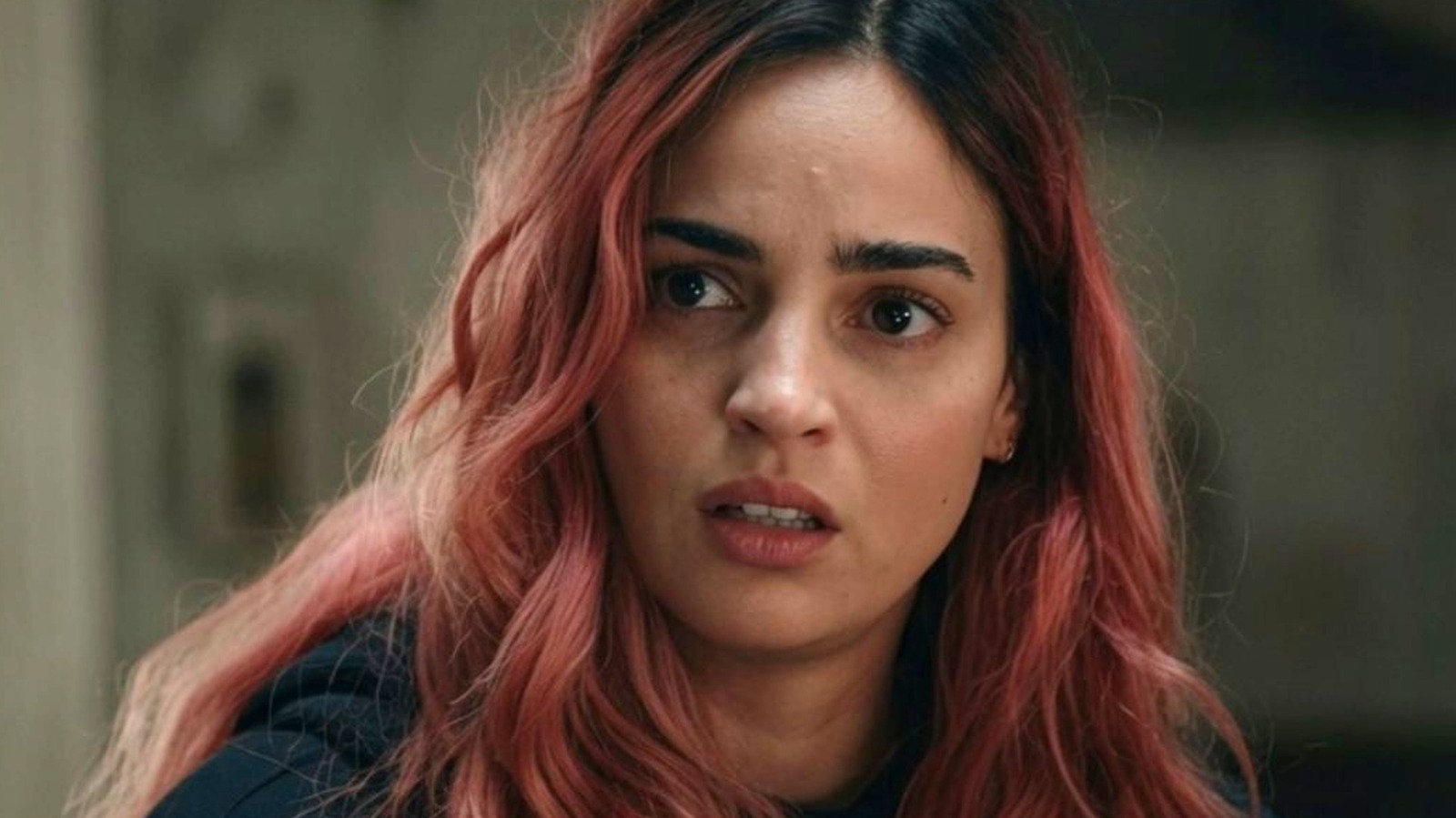
“Evil Dead Burn” also continues horror’s recent interest in using genre storytelling to explore toxic and abusive relationships, following close behind the box office success of “Obsession.” The film centers on Alice (Souheila Yacoub), a young woman forced into an uneasy reunion with the family of her recently deceased husband. Before Will’s death, the only glimpse we get of him shows him picking a fight with Alice and accusing her of flirting with his brother Joseph (Hunter Doohan). Afterward, at his funeral, Alice appears tense and emotionally detached, something Will’s family clearly resents. She wants to leave them behind and return to Paris, but they react with anger rather than concern, even as signs of Will’s abuse are visible. A hot water burn across Alice’s stomach makes clear what his family has chosen not to see.
That emotional setup becomes essential once the film barrels into its bloody conclusion. After Will’s mother, Susan (Tandi Wright), is turned, she says, “They’re not our enemies, they just want back something my father stole.” She is referring to the Kandarian Dagger, the ancient weapon long associated with fighting evil in “Evil Dead” lore. Still, the Deadites’ pursuit of the dagger ultimately matters less than Alice’s long-delayed catharsis. When Will reanimates, still insisting that he will not let her live without him, Alice finally strikes back. She stabs him with the dagger, and when he briefly returns from Deadite form to human form, she crushes his skull. The moment is not simply about defeating a monster; it is about Alice reclaiming her voice. By the time paramedics arrive, she is able to say that her “ex-husband did this,” referring to both fresh wounds and old scars.
The origins of the Kandarian Dagger explained
Warner Bros
The Kandarian Dagger has always been one of the franchise’s key artifacts, even if its history has never been entirely straightforward. It first appeared in 1981’s “The Evil Dead,” where it was discovered alongside the Necronomicon in the cellar of the remote cabin visited by Ash Williams and his friends. The cabin belonged to archaeologist Raymond Knowby, who had recovered the items from Castle Kandar during an expedition. From there, the lore becomes increasingly tangled, especially once the series begins introducing alternate realities and different versions of familiar objects. In the Starz series “Ash vs Evil Dead,” for example, another version of the dagger had been in the possession of Ruby (Lucy Lawless), a demon living in human form, for years.
In “Evil Dead Burn,” the dagger turns up in the family’s attic, stored near the Necronomicon, field recordings, and diaries — a long way from the cabin where audiences first encountered it. That detail lines up more closely with the mythology expanded in “Evil Dead Rise,” which did not include the dagger but did introduce another volume of the book. Within the wider “Evil Dead” universe, three canonical copies of the Necronomicon are known to exist. “Rise” also featured priestly recordings connected to research into the book, dating back to 1923 and found beneath the apartment building. Director Lee Cronin later suggested that Bruce Campbell’s vocal cameo as the priest could be interpreted as a time-displaced Ash Williams, trapped in the early 20th century and warning others not to read from the book.
Will’s family is connected to an important player in the Evil Dead story
Starz
That leaves one especially intriguing question: who was the absent grandfather who allowed these cursed objects to gather dust in the attic? The film never gives the family’s surname, nor does it directly name the man, but it does reveal that he was a researcher who traveled with Raymond Knowby and shared his fascination with the Necronomicon. It is the clearest bridge between “Evil Dead Burn” and the original trilogy, and it cleverly folds the franchise’s long history into the new film’s focus on inheritance, buried secrets, and the damage families refuse to confront.
The events of Sébastien Vaniček’s film were set in motion by a patriarch who is seen as a pariah for his obsessive research and long periods of absence. He’s something of a buried secret — just like the late Will’s treatment of his wife, which nobody in the family feels comfortable acknowledging. Like the Deadite curse, this is something that can only be kept in the dark for so long, with the movie using the supernatural lore of the franchise to flesh out a metaphor about hiding abuse.
In “Evil Dead Burn,” the franchise’s history returns via the character of Joseph, who is obsessively writing his own book about the grandfather he barely knew, which is why he’s been hoarding so much. In a recent Out magazine profile, Joseph actor Hunter Doohan said: “His grandfather knew Professor Knowby. I loved how this script not only ties back a little bit to ‘Evil Dead Rise,’ but this movie connects the lore through the whole franchise, which I found really exciting.”
The needle drop that dissects the toxic relationship
Warner Bros.
For a sign that Will and Alice’s relationship was toxic from the start, look no further than the lyrics to their wedding song, Jacques Brel’s “La Chanson Des Vieux Amants” (The Song of Old Lovers). The final verse, translated into English, reads: “And much of the time we act like we’re at a funeral/And much of the time we create pain/But this is not the worst trap/That living in peace is for some lovers. Certainly, you cry a little less early, I fall apart a little later/We protect our secrets less, we leave less to chance/We guard against going with the flow/Yet there is always a tender war.” To modern eyes, this sounds like excusing destructive behavior, a series of red flags misinterpreted as emotional honesty. This being the couple’s first dance song suggests Will’s behavior had always been there and either shrugged off or merely excused as passion from the start.
As well as being used quite pointedly at his funeral — which the lyrics point out their relationship felt like most of the time — it appears in a reprise in the final act, as the Deadite Will is alerted to Alice’s presence in the construction site via the song playing over her phone speaker. Coupled with his threat later in that scene that he won’t let her live without him, it plays out at one last attempt at emotional manipulation, directly alluding to the years of abuse. This moment ultimately offers more catharsis about escaping from a manipulative relationship than the ending of “Obsession” does, and it manages to address this serious theme without compromising on the over-the-top gore fans have come to expect.
Does the mid-credits scene set up Evil Dead Wrath?
Warner Bros.
The film’s mid-credits sting rewards fans with one last campy kill. We see grandmother Polly (Maude Davey) miles away from the family home, still under the Deadite curse that has temporarily cured her dementia, crawling by the side of the road after her legs have been ripped off. A young woman pulls up beside her to ask if she needs help, leading Polly to respond, “He stole my legs… but yours will do just fine!” This isn’t setting up the next unfortunate antagonist in the series, however, as it’s already been revealed by producer Robert Tapert that the next movie will be a prequel. However, with her husband established as a past associate of Raymond Knowby, that doesn’t rule out a younger actress playing Polly decades earlier.
2028’s “Evil Dead Wrath” will take place in 1972, a decade before Ash Williams set foot in that fateful cabin, so don’t expect the mid-credits scene from “Evil Dead Burn” to set up any direct continuity. What you should expect is a stylish throwback to the exploitation movies of that era. “That one, unlike ‘Burn,’ has a lot of coming-of-age sexual hijinks in it, which the ‘Evil Dead’ universe is not really known for, but this one does,” Tapert told Dread Central, adding, “It’s going to be the one since the first ‘Evil Dead’ movie that may have the most difficulty with the MPAA.” Tapert also said that “Evil Dead Wrath” will utilize Ektachrome 100 to give it the look and feel of a 1970s movie.
The post-credits scene sets up an Evil Dead cinematic universe
Warner Bros.
The incredible post-credits scene in “Evil Dead Burn” ties back into 2023’s “Evil Dead Rise” after revealing that the ashes of single mother Ellie (former “Vikings” cast member Alyssa Sutherland), shockingly possessed in the previous film, are being held at the same crematorium where Will’s funeral took place. A little girl reads over the names of the urns and lands on one marked “Ellie.” The lights flicker, and suddenly the previous movie’s big bad is standing in the mirror. The girl reaches out, and we see that Ellie is right there in the room, quickly snapping her neck before cheekily turning to the camera and delivering her kiss-off line. It’s hilarious, nasty, and, above all, it suggests that these supposedly standalone sequels are building a bigger, interconnected universe tied together by this shared curse.
This post-credits scene raises more questions than it answers, as Ellie had fused together with her children to become a multi-limbed Marauder — far more powerful than the usual Deadite — by the ending of “Evil Dead Rise.” Were they somehow separated and put into different urns? It’s not really clear, and we have no idea when Ellie will return to the big screen, but Robert Tapert has already revealed that this is part of a grander plan to connect all the sequels. He told Forbes: “We said to Sébastien [Vaniček] that you have to connect back to ‘Evil Dead Rise’ somehow. Left to all the directors’ devices, they don’t want to carry the water for what came before or what’s coming afterwards, but the one thing that Sam [Raimi] and I feel is that the ‘Evil Dead’ movies can’t just be a whole series of standalones because the audience wants to start connecting the dots.”


