
Science fiction stands as a genre designed to both captivate and caution its audience. Sci-fi creators weave intricate tales that not only stretch the boundaries of scientific possibility but also delve into philosophical, ethical, and human dilemmas. The most compelling stories in this genre draw upon contemporary themes, projecting them into imaginative futures where these issues can be explored in a safe and speculative environment.
These creative narratives construct extraordinary worlds filled with unfamiliar customs and enigmatic motives. Such stories often leave audiences deep in thought, sometimes even bewildered. High-quality sci-fi has the power to spark new theories and prompts people to question facets of reality they might have previously overlooked.
While not every sci-fi narrative is a cerebral puzzle—many substitute magic with advanced technology—this genre, more than any other, has the unique ability to broaden perspectives. A significant aspect of human existence involves pondering the meaning of life, a challenging task to undertake in isolation. Fortunately, art provides the context needed for such reflection, and films on this curated list are ideal for anyone ready to have their worldview turned on its head. These movies are not only transformative experiences but also masterful works of art worth experiencing at least once.
“Arrival” is an elegant yet accessible film based on Ted Chiang’s 1998 novella “Story of Your Life.” With Chiang’s esteemed reputation for crafting award-winning science fiction, it’s fitting that a visionary director like Denis Villeneuve brought this story to the screen. “Arrival” might just be the pinnacle of sci-fi filmmaking. In a genre often dominated by clichés and grandiosity, this film stands out with its refined visual storytelling and compelling atmosphere. Villeneuve’s talent for creating distinct cinematic identities shines through, turning an already compelling narrative into a true masterpiece.
Human understanding of time is quite limited. We perceive it linearly and shape our language around the division of past, present, and future. This linguistic framework influences our interaction with the universe. Therefore, it’s plausible that an alien species might communicate through an entirely different, perhaps unimaginable, relationship with the time-space continuum.
Arrival
In “Arrival,” we follow linguist Louise Banks, portrayed by Amy Adams, as she learns to communicate with an enigmatic, non-human alien species. The film mirrors the aliens’ experience of time and language, presenting events and moments as interconnected, disregarding conventional temporal order. As Louise delves deeper into their language, she finds her perception of time transforming, aligning with the aliens’ viewpoint. This shift serves the aliens’ mission but also triggers a profound personal journey for Louise, one that continues to resonate with introspective viewers long after the credits roll.
Humans have a fairly restrictive understanding of time. Not only do we experience it in a linear fashion, but we also design our language to account for the separation of past, present, and future. Our communication determines a lot about how humans understand and interact with the universe, so it makes sense that an alien species would have a distinct, potentially unfathomable method of language dependent on a totally different relationship to the time-space continuum.
“Arrival” follows a linguist named Louise Banks (Amy Adams) as she slowly learns how to communicate with a mysterious, non-humanoid alien race. The film is presented to viewers the way the aliens themselves experience time and language; associated events and moments occur in sequence regardless of time and place. As Louise learns their language, she realizes that her brain is being rewired to experience time this way, as well. This serves the visitors’ purposes, but it also leads to a profound (and profoundly confusing) personal journey for Louise that likely still echoes in the minds of thoughtful viewers.
Interstellar
Christopher Nolan was no stranger to mind-bending stories when he set out to direct “Interstellar.” At least one of his prior credits, “Inception,” could find a place on this list if it were longer. That said, “Interstellar” is sometimes cited as his best film, and the one that cemented his status as one of Hollywood’s most prestigious working directors today.
“Interstellar” is an epic tale that projects the best and worst impulses of humanity against the existential dread of confronting the unknown limits of time and space. His film poses difficult questions to viewers, ones without clear answers, and that’s just the tip of the discussion.
Nolan isn’t known for films with airtight continuity (even the most thorough explanations of “Interstellar’s” confusing moments can’t account for every hole) but he and his screenwriter brother Jonathan Nolan are wise to place black holes at the center of the film’s scientific endeavors. Even though human scientists have made great strides in understanding the nature of black holes, they remain mysteries. Black holes are inescapable, which means that any attempts to explore them in real life would probably result in death.
Black holes warp not just space but also time. Cooper and his crew experience significant time dilation multiple times throughout their journey, which ensures that, even if they survive their near-certain doomed mission, they’ll survive only to find that the world and people they knew are long gone. The fact that Cooper (Matthew McConaughey) is willing to enter a black hole in order to save his children’s future is emotionally climactic, and what he experiences once he’s inside of it is pure science-fiction: the imagining of something unfathomable.
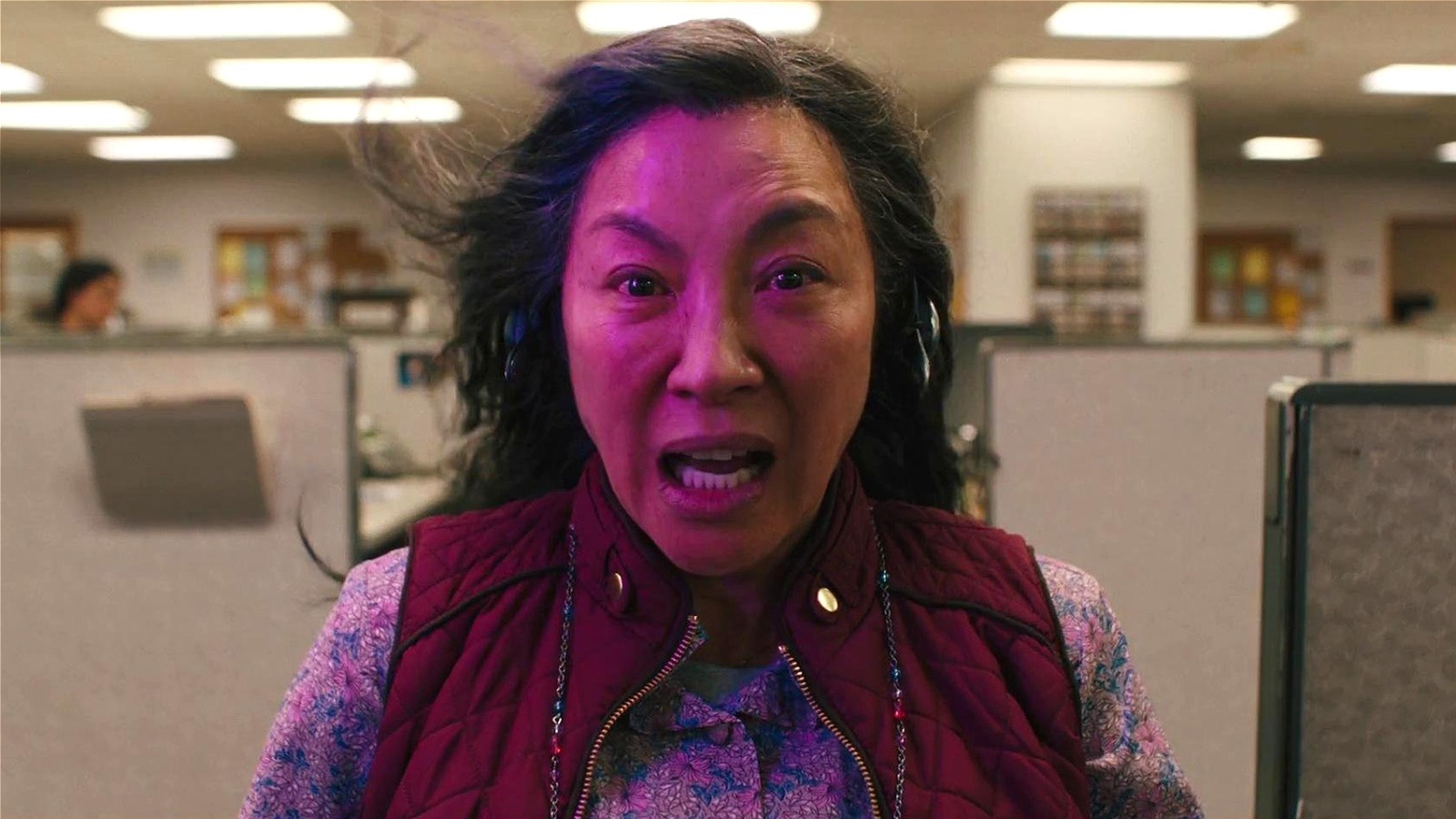
Everything Everywhere All at Once
There’s no rule that says a sci-fi story needs to be serious in order to be held up as a creative feat, and that’s part of why “Everything Everywhere All at Once” is such a beloved film. Despite the fact that its plot stretches the bounds of reality and understanding, it stays funny all the way through. That’s a great perk on top of an already impressive sci-fi plot. Humor, as well as the film’s commitment to balancing ugliness and beauty, all contribute to its success as, perhaps, the best on-screen exploration of the multiverse theory to date. The film posits that there exist an infinite number of realities, each of them generated whenever someone is faced with a new choice in life.
“Everything Everywhere All at Once” captures the essence of its title via magnificent, frenetic visual spectacle. The film operates almost like a 3D/2D-blended animated movie, with colors, shapes, textures, and sounds moving quickly and yet with a level of fluidity that allows the viewer to keep track of what’s going on.
The emotional, familial plot of the film is just as strong as that of a “realistic” drama, and the story as a whole represents a harmonious marriage between the exciting notion of undiscovered science and the magic of emotional connection. Between the film’s many alternate universes and Evelyn’s fascinating personal journey, “Everything Everywhere All at Once” is a rich text that viewers can return to time and again for mind-bending inspiration.
The Matrix
The first film that comes to most peoples’ minds when they consider the phrase “mind-bending sci-fi” is probably “The Matrix.” One of the most successful sci-fi films (and franchises) ever, “The Matrix,” which came to theaters in 1999, captured a moment in time wherein the technological revolution had many people considering the existential terrors of virtual reality, advanced biotech, and the possibility that humans could be manipulated into accepting a false simulation as real life. It also featured a lot of fantastic actors, like Keanu Reeves and Laurence Fishburne, manipulating the simulation to gain extraordinary, slow-motion combat skills. That part is more fun than mind-blowing.
“The Matrix” proved so mind-bending when it came out that it inspired an actual theory that the reality humans know isn’t real. Simulation Theory is widely explored and supported on the internet, with the community r/SimulationTheory netting an average of 71k visitors a week.
In “The Matrix,” Neo (Reeves), a computer programmer, discovers proof that the world he knows as reality is actually a simulation. He is subsequently recruited by an underground, human resistance working to free the rest of humanity from the clutches of the artificially intelligent creatures it created. “The Matrix” has never been more relevant to the state of technology than it is today, and would probably be even more impactful for a new viewer sitting down to watch 28 years after its release.
Annihilation

Paramount Pictures
Oftentimes, the most mind-bending stories are those that leave as many interpretations as possible up to the viewer. When a sci-fi story offers extensive exposition and a detailed outcome, it is satisfying, in a sense, but it also reduces the mysterious, otherworldly aura that works of the genre often lean into. Many of the sci-fi stories that stay with viewers are the ones that remain ambiguous to the very end, and that is why “Annihilation” is such a fantastic example of the genre.
Director Alex Garland made “Annihilation” with the intention of exploring a unique interpretation of nature and leaving audiences with a lot to reflect on. Garland’s film is made for viewers that are comfortable without explicit interpretation, but that doesn’t mean it isn’t structured intentionally. With an emphasis on the complex emotions of life and biological science, “Annihilation” offers a hallucinatory, unpredictable journey through a deadly phenomenon referred to as “the Shimmer.”
Within the Shimmer, everything the main characters know, even about themselves, is called into question. Garland provides the audience with a slew of intelligent points-of-view through which to observe The Shimmer, and yet none of those capable characters really conquer it. The ending of “Annihilation” is left forever open to interpretation, and yet it doesn’t leave audiences wanting. Much like life itself.


