
NBC
By now, it is becoming increasingly difficult to dispute the idea that Christopher Nolan’s “The Odyssey” has emerged as the defining pop culture version of Homer’s ancient Greek epic. Even so, Nolan’s 2026 film is far from the only worthwhile live-action take on Odysseus’ long, punishing voyage home. Nearly three decades earlier, Hallmark Entertainment and American Zoetrope delivered their own adaptation of “The Odyssey” as a television miniseries — and it holds up remarkably well.
Released in 1997, Hallmark’s “The Odyssey” was written and directed by Andrei Konchalovsky, best known for films such as “Maria’s Lovers.” His work earned him the Primetime Emmy Award for outstanding directing for a miniseries or special, while the production also won an Emmy for visual effects. The project went on to receive additional Emmy nominations for outstanding miniseries, outstanding art direction, and outstanding hairstyling. Critics were receptive as well, giving the miniseries a 79% Tomatometer score on Rotten Tomatoes. That may not match the towering response to Nolan’s “The Odyssey,” which exceeded expectations and currently holds a 94% Tomatometer rating, but the earlier version’s awards recognition and strong reviews make a persuasive case for revisiting it.
Hallmark’s The Odyssey has a cast for the ages
NBC
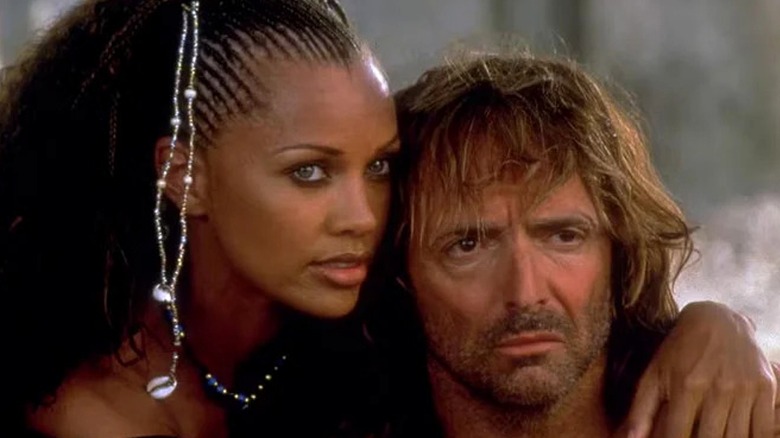
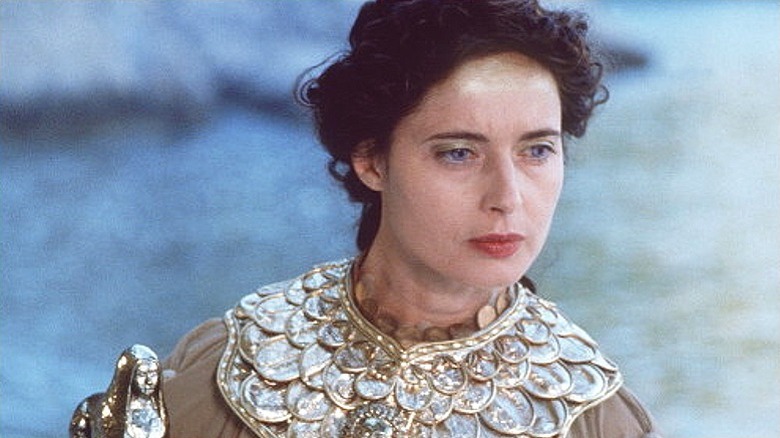
Co-executive produced by Francis Ford Coppola, Hallmark’s “The Odyssey” originally aired on NBC and assembled a notably strong cast. Armand Assante leads the miniseries as Odysseus, with Greta Scacchi as Penelope, Christopher Lee as Tiresias, Isabella Rossellini as Athena, Vanessa Williams as Calypso, and many other recognizable performers filling out the mythic world. The ensemble commits fully to the material, and the performances did not go unnoticed: both Assante and Scacchi earned Golden Globe nominations for their roles.
Told across two parts, this version of “The Odyssey” opens with Odysseus and his men being called to fight in the Trojan War and follows him through years of danger, temptation, and loss before his eventual return to Ithaca. Naturally, it covers much of the same narrative territory as Nolan’s film. Where the two adaptations sharply diverge, however, is in their treatment of the gods, monsters, and mythological figures who shape Odysseus’ journey.
One clear example is Circe. Samantha Morton’s take on the enchantress in Nolan’s “The Odyssey” delivers a startling scene few viewers were likely expecting, while Bernadette Peters’ Circe in the Hallmark miniseries offers a very different interpretation of the character. Those creative contrasts help the two versions stand apart, making it easy to appreciate both without feeling as though one simply repeats the other. Think of it as the same legendary voyage, carried by a Trojan horse of a different color.


