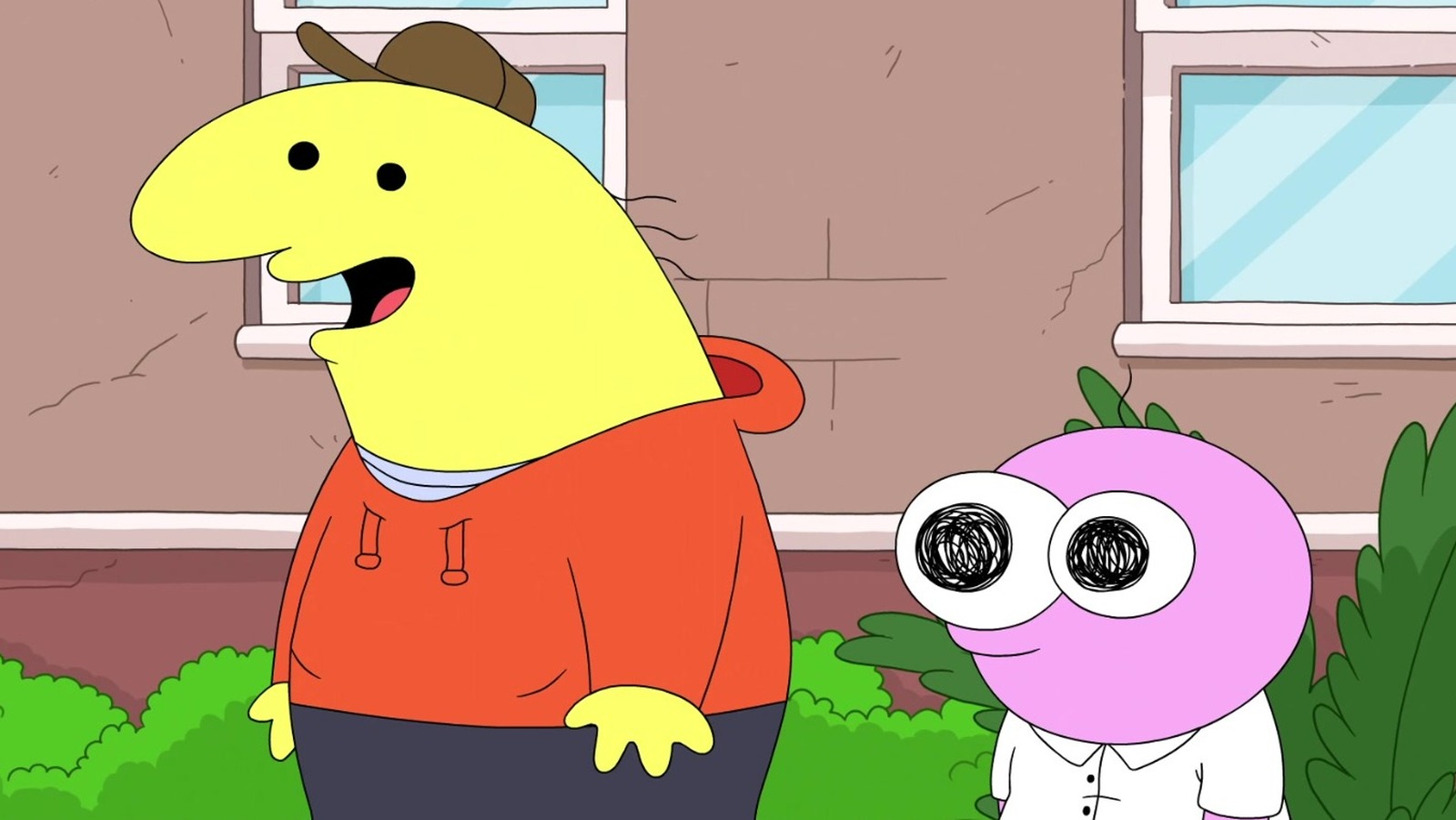

Among the standout Adult Swim offerings of the 2020s, “Smiling Friends” emerges as a delightful revelation. Created by Zach Hadel and Michael Cusack, this quirky, frenetic dark comedy revolves around a peculiar charity dedicated to making people smile. With its vibrant visuals and a mix of simplistic yet intricately detailed animation, the series trails the escapades of Pim Pimling (Cusack) and Charlie Dompler (Hadel). Each 11-minute episode dives into a whirlwind of surreal humor and bizarre cartoonish gore, leaving enthusiasts craving more surreal adventures.
After the curtain fell on the latest season in April 2026, fans were disheartened to learn that “Smiling Friends” would conclude with its third season. With no more antics of Pim and Charlie on the horizon, viewers eager for a similar comedic experience can explore other shows that echo its unique humor, visual style, and tone. Fortunately, several animated series capture the essence that makes Hadel and Cusack’s creation so compelling, many of which are, unsurprisingly, found within the same network.
While “Smiling Friends” stands out for its originality, fans seeking similar content will find a treasure trove of animated series that share its distinctive allure. Many of these recommendations hail from Adult Swim, a network synonymous with surreal, offbeat humor. Continue reading for a curated list of five shows that are perfect for those who can’t get enough of “Smiling Friends.”
Adult Swim has long been a bastion for unconventional, irreverent humor, a reputation that paved the way for the debut of “Smiling Friends” in 2020. A pioneering force in this realm was “Aqua Teen Hunger Force,” crafted by Dave Willis and Matt Maiellaro. Spanning over 140 episodes, this adult animated sitcom features Willis, Carey Means, and Dana Snyder as the voices behind Meatwad, Frylock, and Master Shake.
Attempting to define the premise of “Aqua Teen Hunger Force” misses the point; akin to “Smiling Friends,” it thrives on unpredictability. Storylines—typically involving inept intergalactic villains—serve as a backdrop for absurdity and non-sequiturs. The central trio resides in a New Jersey suburb, alongside their underachieving neighbor Carl (Willis), with none of the characters exhibiting any moral fiber.
Aqua Teen Hunger Force
Initially conceived as minor characters for “Space Ghost Coast to Coast,” Master Shake, Frylock, and Meatwad were eventually spun off into their own series. The show’s legacy is marked by its crude, chaotic humor and a gritty cartoon aesthetic, securing its place as a defining feature of the 2000s Adult Swim landscape. If you’re a fan of “Smiling Friends,” this series is a must-watch.
To describe the “premise” of “Aqua Teen Hunger Force” would defeat the purpose; much like “Smiling Friends,” it’s a show where part of the joke is the possibility of anything happening at any given point, with plots — generally in the form of intergalactic villains-of-the-week who turn out to be as annoying as they are ineffective — acting as clotheslines for non-sequiturs and absurd ideas. All you need to know is that the three protagonists live together in a New Jersey suburb, their neighbor and frequent nemesis is the underachieving Carl (Willis), and there’s nary a speck of moral decency among all four characters.
Originally conceived as one-off characters for “Space Ghost Coast to Coast,” Master Shake, Frylock, and Meatwad were ultimately scrapped from that show and given their own pilot. The rest is history: Foregrounding crude, willfully unpleasant, and generally nonsensical comedy presented through a shaggy cartoon-grunge aesthetic, the series established itself as the most abrasive and irresistibly hilarious thing on 2000s Adult Swim by some distance. If you love “Smiling Friends,” it’s sure to be right up your alley.
Superjail!
A non-negligible part of the appeal of “Smiling Friends” is the frequent and gleeful deployment of gore. If you’re a fan of the show, chances are that you savor not only the elaborate animation and visual resourcefulness of the gore itself, but the cleverness with which it’s spliced into any given episode, ripping through the doodle aesthetics with scrumptious intensity, and providing perfect punchlines to bits of physical or situational humor. If that’s indeed the case, then you will almost certainly enjoy “Superjail!”
One of the best Adult Swim series of all time, “Superjail!” aired between 2007 and 2014, and helped codify the network’s philosophy of violence as a conduit for comedic euphoria. Created by Christy Karacas, Stephen Warbrick, and Ben Gruber, it’s set in the titular parallel-dimension prison, within which the jolly, sadistic Warden (David Wain) bends space and time to his whims and pushes the inmates into a variety of zany and ultimately gruesome predicaments.
Each episode begins with a relatively “normal” (by Adult Swim standards) cartoon-shenanigans plot, only to zig and zag psychedelically until it devolves into an epic panorama of carnage that would make Robert Crumb and Hieronymus Bosch equally proud. As much a love letter to animation history as it is a twisted joke at the expense of our collective memories of hand-drawn cartoons and their supposed whimsy, it scratches that same “Smiling Friends” itch of watching hundreds of revolting things happen at a clip too relentless to take in all at once.
The Shivering Truth
Stop-motion animation has a special way of making the skin crawl when it wants to, and “The Shivering Truth” is essentially a monument to that ability. Created by Vernon Chatman, who also authored Adult Swim’s “Wonder Showzen” and “Xavier: Renegade Angel,” this enormously underrated two-season series follows an anthology format, with each episode making up its own singular entity. Episodes, in turn, are structured as triptych presentations, consisting of a cold open, an ostensible “main” plot, and a narrative pivot that dovetails with the two first portions.
As for the stories told in each of those thirds, well, they can literally range from the unlit innards of the human body to the furthest reaches of the cosmos. The only constant is that every single one explores violence, decay, death, neurosis, shame, self-perception, and existential chaos in hilariously horrifying ways, peppering everyday quandaries like marital frustration and social awkwardness with unbridled dream logic.
Much like “Smiling Friends,” “The Shivering Truth” is enormously fond of spinning ornate, over-the-top stories from the most quotidian-seeming starting points, until the process of wondering “How messed-up can this possibly get?” becomes part of the fun. Even though it’s made with a different technique from the one that “Smiling Friends” (mostly) favors, its fussily nasty puppet animation is of a piece with the sensibility of the Zach Hadel and Michael Cusack-created series. Be warned, though, that, unlike “Smiling Friends,” this is not a show that always offers the emotional safety net of a silly framework or a clean-slate happy-ish ending; when it gets dark, it goes all the way.
YOLO
The assorted works of “Smiling Friends” co-creator Michael Cusack are a pretty safe bet if you’re looking for other shows in a similar vein — but “YOLO” stands out as a particular must-watch for fans of Pim and Charlie.
Loosely adapted from Cusack’s eponymous short films, “YOLO” stars Sarah Bishop and Todor Manojlovic as Sarah and Rachel, two best friends living in Australia to whom the moniker of “party animals” wouldn’t begin to do justice. Each episode charts their efforts to get into a different ultra-exclusive rager and then live it up to the best of their ability, no matter how many mind-bending and sanity-testing obstacles they encounter along the way. Seasons are presented under different subtitles: Season 1 is “YOLO: Crystal Fantasy,” the uniquely serialized sophomore season is “YOLO: Silver Destiny,” and then there’s the more recent “YOLO: Rainbow Trinity.”
Cusack’s trademark droll humor, matter-of-fact violence, Aussie hyperspecificity, and giddy disinterest in narrative coherence are all over this series, which debuted concurrently with “Smiling Friends” and acts in many ways as a kind of mirror image to it. The fun to be had with every installment is largely a matter of relishing the bizarre curves that Cusack, aided by an inventive team of animators, will add to Sarah and Rachel’s tales of attempted hedonism, taking them as far as possible from the pleasure of a simple night out until their lives begin to resemble a Tantalean quest for unattainable ecstasy. It’s a darkly comedic setup if there ever was one, but Bishop and Manojlovic’s wry, quasi-naturalistic banter somehow keeps “YOLO” a breezy watch.
The Midnight Gospel

Netflix
Created by Pendleton Ward (of “Adventure Time” fame) alongside Duncan Trussell, Netflix’s “The Midnight Gospel” is the only show on this list that doesn’t hail from Adult Swim. Even so, it’s every bit as inventive, brazen, and singular as all the aforementioned series — and frequently as funny, even if it comes about its dark humor from a somewhat different angle. Unlike “Smiling Friends,” “The Midnight Gospel” has an undercurrent of earnest drama and melancholy, tugging at heartstrings as often as it pulls belly laughs out of grisly apocalyptic scenarios. But, aside from this slight tonal difference, the two shows are very similar in spirit.
“The Midnight Gospel” adapts episodes of Trussell’s interview podcast “The Duncan Trussell Family Hour” into half-hour-long sci-fi tales. At the center of each tale is Clancy Gilroy (Trussell), a cosmic podcaster living in a tape-shaped planet known as the Chromatic Ribbon, who uses a VR simulator to visit other planets and interview their residents. Episodes combine audio from Trussell’s podcast with supplementary voice acting by himself and his guests, allowing each conversation to spiral into a freewheeling adventure.
By combining original writing with choice soundbites from eminently interesting people — and then illustrating the resulting mixture through dazzling psychedelic animation and delightful, ultra-gory absurdist gags — “The Midnight Gospel” bridges the mundane and the philosophical in a way that will thrill any “Smiling Friends” fan with a taste for existential contemplation. At just eight episodes, it’s a show that ought to have lasted much longer, but its single existing season is a gift as it is.


