

Welcome to “Fanon Fixing Canon,” your weekly dive into resolving infamous plot holes and questionable storyline choices in beloved franchises. Using a blend of investigative journalism and dedicated fan theorizing, we aim to resolve these narrative inconsistencies, restoring the integrity of canonical stories.

Paramount Pictures
This week, we delve into one of the most debated survival scenes in cinematic history: Indiana Jones surviving a nuclear explosion by hiding in a lead-lined refrigerator. While “Indiana Jones and the Kingdom of the Crystal Skull” is remembered for its extraterrestrial elements and the introduction of Mutt Williams (played by Shia LaBeouf), it’s the refrigerator scene that has become particularly notorious, marking a significant turning point in the franchise.
To refresh your memory: Indiana Jones, portrayed by Harrison Ford, alongside his companion Mac McHale (Ray Winstone), find themselves in a race against Soviet antagonists who are in possession of an alien relic from Roswell. In a twist, Mac betrays Indy, leading to a frantic escape into a mock-up town, moments before it’s destroyed by a nuclear test. Indy scrambles into a refrigerator just in time, and while the fridge’s lead lining might protect him from radiation, the violent tumbling of the appliance suggests survival would be improbable.
This scene stands out as implausible even within a series known for its outlandish escapades. However, what if Indiana Jones’ past adventures provide a logical explanation for his seemingly miraculous survival? What if the events of “Indiana Jones and the Last Crusade” endowed him with more than just a thirst for adventure? Let’s explore this theory.
“Indiana Jones and the Last Crusade” chronicles the quest of Indy and his father, Henry Jones Sr. (Sean Connery), for the Holy Grail, a relic of legendary status. As they navigate the perilous path to the Grail, the antagonist, Walter Donovan (Julian Glover), grows impatient and wounds Henry. Indy masterfully navigates the Grail’s protective temple, ultimately reaching the final guardian, the Grail Knight (Robert Eddison), among a dazzling array of chalices. The true Grail grants life, while a wrong choice leads to demise.
With the assistance of Elsa Schneider (Alison Doody), Donovan chooses incorrectly, but Indy succeeds, selecting the authentic Grail and drinking from it. He also offers it to his father, healing his wounds. Thus, both Indiana and Henry have consumed from the Holy Grail, a legendary artifact believed to bestow eternal life and healing powers upon its drinker.
Indiana Jones drinks from the Holy Grail in Indiana Jones and the Last Crusade

Paramount Pictures
“Indiana Jones and the Last Crusade” sics two generations of Dr. Joneses after what might just be the most famous lost treasure of them all — the Holy Grail. As Indy and his dad Henry (Sean Connery) make their way toward this legendary relic, the villainous Walter Donovan (Julian Glover) grows weary of the trap-filled temple of the Grail and badly injures Henry. Indy manages to successfully navigate the temple and reach the Grail’s true guardian: the ancient-looking, Crusades-era Grail Knight (Robert Eddison) who stands in a room full of ornate cups. Here, the ones who locate the true Grail and drink from it endure, and the ones who choose poorly absolutely won’t.
With the help of Elsa Schneider (Alison Doody), Donovan chooses poorly. Indy, on the other hand, does not. He survives the ordeal, chooses the right cup, and drinks from it. Then, his dad drinks from it and is healed. In other words, both Doctors Jones have drank from the Holy Grail, which can grant eternal life and heal the drinker.
Yes, the cup’s power has its caveats. As the film’s finale very dramatically proves, the Grail can’t leave the temple. The user also needs to drink from it regularly. Due to this, the Grail’s water easily heals Henry’s injury in the temple, but after the Grail is lost and Henry exits the area, he dies in 1951 — a respectable age of 78 or 79, but hardly immortal. Still, there’s some evidence that the cup’s effects can last outside its stated area of operation.
The Grail’s power is limited but can still explain Indy’s action hero longevity

Walt Disney Studios Motion Pictures
The Grail Knight is a perfect example of how the cup’s particular immortality works, even when you follow the instructions: you do grow slightly older whenever your spirit wavers even if you drink from the cup, but if you’re worthy, you’ll live centuries. The thing is, “Indiana Jones and the Last Crusade” also mentions that the knight had two brothers who spent a century and a half in the temple and then left for Europe. One of the brothers, Richard, quickly succumbed to old age. However, the unnamed third brother kicked about for quite a while, returning to France and taking the time to narrate what amounted to his autobiography to a monk.
The very different fates of the two brothers suggest that the Grail’s effects linger in some individuals more than they do in others. Combined with the fact that the Grail values worthiness and spirit, well … who has more grit and grind in the “Indiana Jones” franchise than Indy himself?
Following this logic, there’s a decent chance that a modicum of the Grail’s powers linger in Indiana Jones. Since said effects include the ability to bounce back from physical injuries and live to a spry old age, this would not only justify how Indy survives the fridge stunt. It also wholly explains why he can still readily swing his whip and punch bad guys during the “Indiana Jones and the Dial of Destiny” era, in his 70s. Grail power, baby!
Indy has handled so many sacred artifacts that it would be surprising if he didn’t have mystical powers
Paramount Pictures
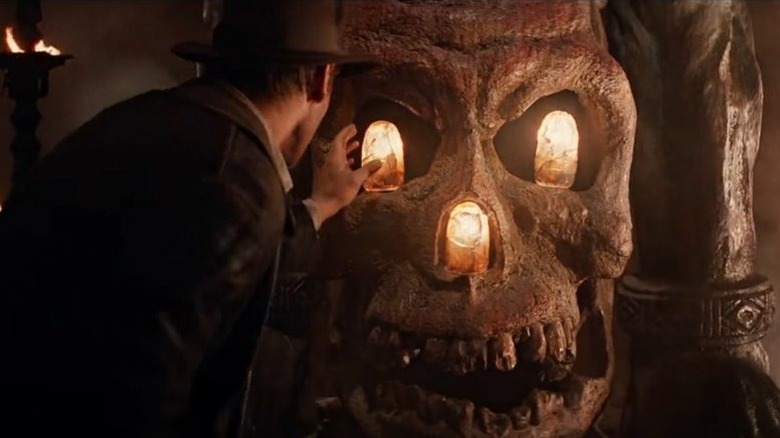
The entire “Indiana Jones” timeline is full of magic in the most literal possible sense. Even if he hadn’t personally sipped from the Holy Grail, Indy would probably be a hotbed of mystical forces thanks to the sheer number of artifacts he’s been in contact with over the years. In “Raiders of the Lost Ark,” he’s in the vicinity of the Ark of the Covenant when it’s opened, though he knows better than to witness it with his own eyes. In “Indiana Jones and the Temple of Doom,” he spends a whole bunch of time handling the sacred Sankara stones, which can purportedly give their wielders supernatural powers and are explicitly shown to have paranormal properties.
And that’s not going into the multitude of ancient artifacts Indy messes with in other movies, games, and adjacent materials. Indiana Jones has exposed himself to so many sacred, magical relics that if he lived in a comic book universe, he’d have roughly every single superpower at this point. What’s a little fridge-nuking in that context?
For all intents and purposes, Indiana Jones is the ultimate action adventure hero. Would it really be so unbelievable that his movies — which routinely deal in the mystical and the supernatural — might have come up with a stealthy way to explain how he keeps surviving scenarios that would be enough to kill 10 lesser men?


