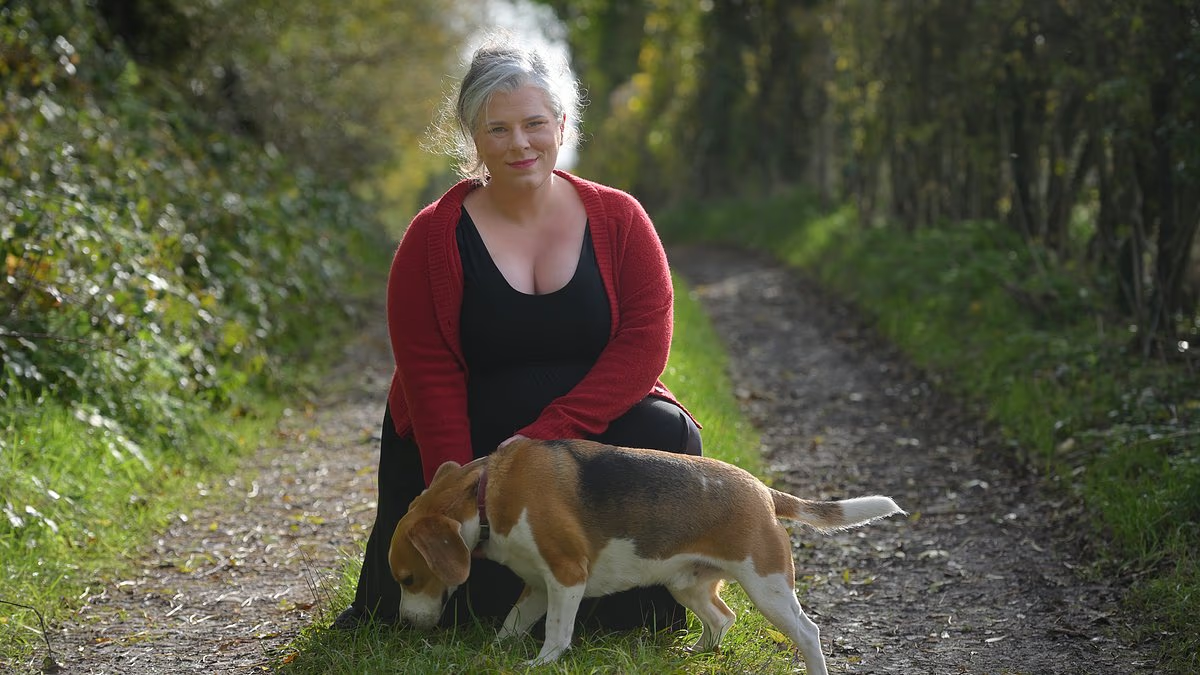

They followed the advice patients are expected to follow: they trusted the professionals treating them. Later, all four women would question whether they should have trusted their own instincts instead.
Five days after giving birth, Pauline O’Shea accepted a cardiologist’s assurance that there was nothing wrong with her heart.
Sarah Lee believed the gynaecologist who told her there was no reason to worry. Samantha Trevaskis left her first assessment convinced she was ‘crazy’.
Sharon Keegan spent decades believing she herself was the problem.
Pauline was 38, caring for a newborn daughter while her sons, aged seven and nine, adjusted to life with their new sister.
She was halfway down the stairs when it felt as though a cage were being ripped apart inside her chest. Somehow, she reached a chair and remained almost completely still for half an hour. Whenever she tried to speak, the pain returned.
‘I had to stay like a statue,’ she says. ‘Instinctively, I knew that moving would make things worse.’
Pauline did not realise she was having a heart attack. Earlier that evening, her blood pressure monitor had recorded alarming figures and she had developed an intense headache.
The out-of-hours medical service advised her to visit her GP the next morning. But once the chest pain began, she asked her husband to call the doctor again.
Paramedics performed an ECG in her kitchen and detected something they could not explain. ‘We think you should go to hospital,’ they told her.

Pauline was 38, caring for a newborn daughter while her sons, aged seven and nine, adjusted to life with their new sister
She arrived at the emergency department at about 9pm. A cardiologist did not come to see her until midday the following day.
He did not enter the cubicle. Instead, he looked around the curtain, glanced at the monitor and said, ‘Your heart is fine.’ Then he walked away.
‘That was my consultation,’ Pauline says.
From outside, she heard a nurse urging someone to examine her. ‘She’s been here since last night. Will you please see her?’
Pauline heard the exchange clearly. ‘I felt I was being treated almost like a time-waster,’ she recalls.
Another scan showed that her heart was functioning poorly. Doctors suggested the cause could be childbirth or a virus.
She was sent home on Holy Thursday without medication and given a follow-up appointment six weeks later.
She had been told her heart was healthy, and she accepted that explanation. She was returning to her baby and her two boys, with Easter only days away.
She could help her sons settle into their new family life, just as she had hoped. The scare appeared to be over, and she could concentrate on being a mother again.
But on Easter Saturday, the pain came back. Once more, she sat rigidly still and waited for it to pass. This time, she did not ask for help.
‘They said it was a virus,’ she says. ‘I just had to put up with it. There was no point going back.’ That night, she was too weak to climb the stairs to bed.
Nearly a week later, her GP visited her home, heard that her heartbeat was irregular and sent her straight back to hospital.
Staff there asked why she had waited so long. Pauline reminded them that she had already come in and had spent almost 48 hours in the hospital.
She then suffered cardiac arrest. Doctors resuscitated her twice before rushing her for an angiogram, a test she says had not been arranged during her first visit. She was asked to sign a form and say goodbye to her family.
When she regained consciousness after emergency bypass surgery, she discovered that the problem had never been a virus.
She had experienced a spontaneous coronary artery dissection, or SCAD — a tear in the wall of an artery supplying blood to the heart.
By the time she reached the operating theatre, the artery was ‘in tatters’, and she had been surviving on the other artery.
‘Luck is what kept me alive,’ she says.
The high blood pressure, severe headache and tearing chest pain had all been warning signs. Pauline believes her age and slim appearance worked against her.
She did not look like a typical heart attack patient, she says, and repeatedly heard the words: ‘You’re postpartum, right?’
For years afterwards, her heart function remained at only 20 or 25 per cent. She no longer had the strength to be the mother she wanted to be, and for weeks she could not lift her baby.
When she eventually could, she was afraid the child might hit her head if Pauline died while holding her. ‘If I had been diagnosed promptly, I would certainly have had a better chance,’ she says.
‘The pipework was repaired, but the pump had already been starved.’
Sarah Lee was 14 when her pain first appeared, but it took more than ten years to identify its cause. Over time, she learned to conceal how ill she felt.
A GP suggested contraception. The pill made her feel worse, while an Implanon rod kept the most severe symptoms under control for three years. After it was removed, ‘everything escalated tenfold’.
She fainted and sometimes spent days unable to leave her bed. Her family would sympathise, saying, ‘Oh, you poor thing,’ but also suggest that some women simply experienced more painful periods.
For years, when people asked how she was, Sarah automatically replied that she was fine.
One gynaecologist left her devastated. He told her, she recalls, that she was ‘a young girl living in a good country’ and had ‘nothing to be anxious about’.
He also suggested she should have brought her boyfriend because he might ‘understand better’.

Sarah Lee was 14 when her pain began, but it took more than a decade to discover what was causing it
In a letter to her GP, Sarah says the gynaecologist questioned her mental health and proposed operating ‘just to shut me up’.
Sarah called her GP in tears. After years of being told she merely had severe periods, that doctor — whom Sarah describes as ‘amazing’ — was the first to suggest a possible cause.
‘You never have to go back to him again,’ her GP told her.
She promised to refer Sarah to another specialist and make a complaint to the medical board.
Sarah underwent two operations in Ireland. She endured long spells away from work, repeated fainting and blood in her urine.
When she attended A&E, she was given morphine and told to contact her consultant. By then, she had undergone every treatment offered, including chemically induced menopause.
‘I knew something was wrong,’ she says.
Eventually, Sarah found Dr Konstantinos Kyriakopoulos, known as Dr Dinos, in Athens.
As she prepared for a third operation, she still wondered whether surgeons would discover anything.
‘I knew the pain didn’t match what they were telling me,’ she says. ‘I knew there had to be something underneath it.’
There was. Endometriosis had spread to her bladder, sigmoid colon and ureters.
Within a week of surgery, her urinary symptoms had gone. She told her GP that recovering from the operation was ‘not a fraction’ as painful as the years she had spent waiting for answers.
Sarah has since stopped taking her medication and is now pregnant. Her advice to women sitting in a GP’s waiting room is direct: ‘Do not let anyone tell you that it is all in your head. Sadly, we often have to advocate for ourselves.’
Samantha Trevaskis was 18 when she first sought an assessment. She was asked to keep a mood diary for two weeks, despite having a four-week menstrual cycle, and then sent home. ‘I left thinking, “I’m just crazy,”’ she says. ‘Literally crazy.’
It would take another 15 years for her to understand what was happening. Her symptoms began a week after her period ended, leaving her struggling for roughly three weeks of every month.
Sometimes she called in sick and claimed to have stomach bugs because she had no other way to describe what she was experiencing. Only her mother seemed to recognise ‘the real me’.
Her best friend, whom she had known since they were 14, once left a date with a man she really liked and took a taxi across the city after Samantha called her in tears.

Samantha Trevaskis was 18 when she first sought an assessment. ‘I left thinking, “I’m just crazy,”’ she says. ‘Literally crazy.’
When the friend arrived, Samantha was sitting there laughing and joking, appearing perfectly well.
‘I had literally just walked away from this guy I really liked,’ Samantha remembers her friend saying, ‘and there is clearly nothing wrong with you.’ Even so, her friend forgave her, as she always had.
The breakthrough came almost by chance. Samantha began injections to induce chemical menopause as part of an agreement with a gynaecologist who had always believed her account.
If the pain stopped, he would remove the ovary Samantha believed was responsible.
Two weeks later, she asked her mother: ‘Is this what life is meant to feel like? Does everyone experience life this way?’
At her three-month review, she explained what had changed. While studying for a master’s degree in psychological science, she had learned about premenstrual dysphoric disorder, or PMDD.
Now 35, she has submitted a PhD thesis on the condition. Samantha says PMDD is estimated to affect between 3 and 8 per cent of women, describing it as ‘PMS on steroids’.
The condition was added to the American Psychiatric Association’s diagnostic manual in 2013 and the World Health Organisation’s classification in 2019. When Samantha was 18, however, it appeared in neither.
PMDD remains a condition that requires far greater recognition and better treatment.
For Sharon Keegan, it was an appointment involving her ten-year-old son and a psychiatrist that finally changed how she viewed her own life.
A teacher had recommended an assessment because her son struggled to remain seated through dinner. As Sharon listened to his answers, she recognised herself.
‘It felt like being hit in the face,’ she says. Now 44, Sharon is an entrepreneur from Walkinstown, founder of fitness-wear company Peachylean and a former Dragons’ Den contributor.
As a child, she was bright and full of energy but easily overwhelmed. Whenever she became excited, she was told to quieten down.
She grew up feeling out of place, while an inner voice she calls Karen replayed every conversation and reminded her of every perceived mistake.
Throughout her teenage years, she experienced devastating lows for a week each month. Doctors prescribed antidepressants, although Sharon says she was not depressed — she felt overwhelmed.
After both of her children were born, she was diagnosed with postnatal depression.
In her 40s, she says, doctors told her three times that her hormones were normal, relying on the same blood-test results.
But Sharon is an athlete and knew her body well enough to recognise that something was not right. ‘I know my body inside out,’ she says.
It was only after she arrived at Tallaght Hospital with stroke-like symptoms that a hormone specialist covering the bank holiday identified hormone deficiencies and prescribed HRT.
She later received another diagnosis: ADHD. At last, she had an explanation for so many aspects of her life.
What remains particularly painful is thinking about the child she once was. ‘That beautiful eight-year-old girl was not supported,’ she says. ‘She went through so much without understanding why.’

What remains particularly painful is thinking about the child she once was. ‘That beautiful eight-year-old girl was not supported,’ she says
For years, Sharon watched others appear to navigate life with ease and concluded that she was the one falling short. Karen was always ready to reinforce that belief.
She decided she simply needed to work harder. So she became the high achiever and the ‘good girl’, exhausted by the effort of appearing fine while carrying that sense of inadequacy into adulthood.
The diagnosis brought relief, followed by grief. If she had known sooner, she says, ‘I would have carried far less throughout my life’.
The four stories are different, yet they share a troubling pattern: women left without answers, forced to live with pain or distress and, in some cases, persuaded to question their own judgment.
For some, it took years to find a medical professional prepared to listen. By then, the damage was measured not only in suffering, but also in the opportunities and experiences they may have missed.
A Laya Healthcare survey found that 56 per cent of women aged 25 to 44 had felt dismissed when raising a health concern with a medical professional.
Pauline now campaigns with the Irish Heart Foundation, bringing her experience to the HSE and politicians in Leinster House.
‘The patient is healthcare’s biggest stakeholder,’ she says, ‘yet they can sometimes have the smallest voice.’
- The women interviewed feature in Health Hysteria: Are Women Being Gaslit?, available now on Virgin Media Player


