
Share this @internewscast.com
Recent research reveals that adults are consuming an alarming amount of salt, equivalent to 155 packets of crisps each week, significantly heightening the risk of heart failure, diabetes, and dementia.
In response, the British Heart Foundation (BHF) is urging the Government to make healthier food choices more accessible by providing manufacturers with incentives.
This initiative involves setting mandatory targets to encourage major food companies to lower the salt content in their products as part of the forthcoming Healthy Food Standard program.
The NHS recommends that adults limit their salt intake to no more than 6 grams per day, roughly the amount found in a teaspoon, considering both naturally occurring and added salt.
However, recent data indicates that most UK adults are far exceeding this guideline, averaging about 8.4 grams daily, which is 40 percent above the recommended maximum.
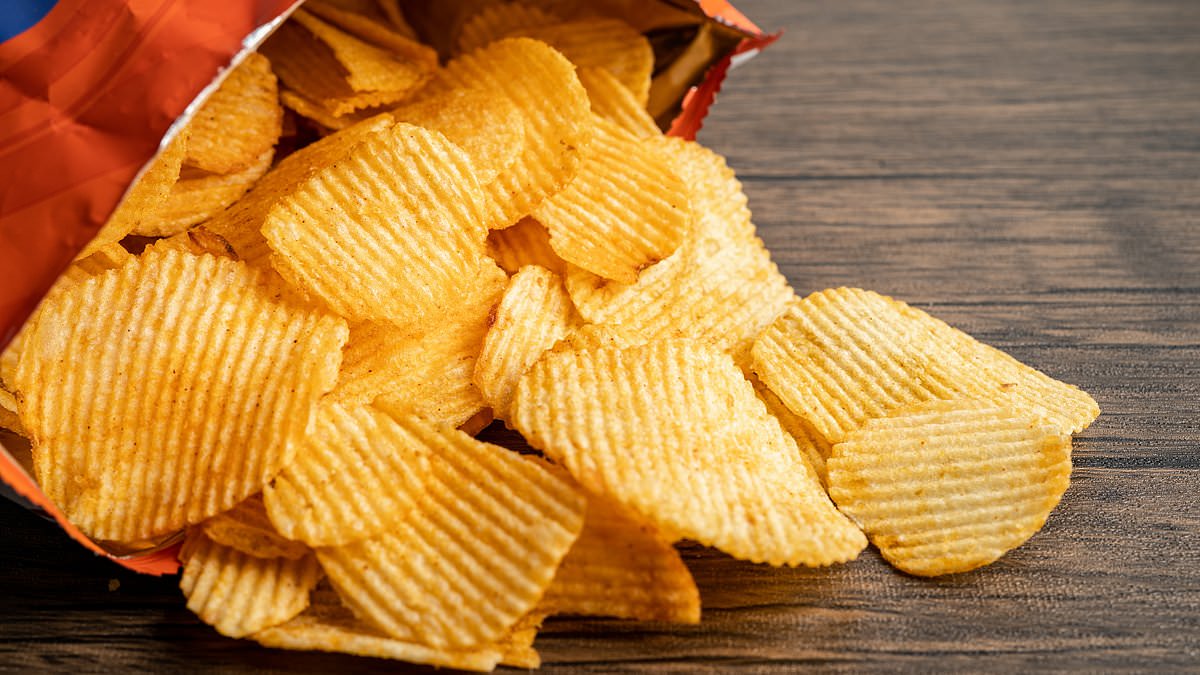
The charity equates this excess consumption to the equivalent of eating six extra packs of ready-salted crisps every day.
Just one 25g pack of Walker’s Ready Salted Crisps contains 6 per cent of an adult’s daily recommended amount.
Excess sodium is one of the biggest drivers of high blood pressure, with hypertension linked to half of heart attacks and strokes.
Research suggests reducing UK salt intake in line with official guidelines by 2030 could prevent around 135,000 new cases of heart disease.

High salt intake leads to high blood pressure which increases the risk of heart attack, stroke and dementia
But the problem is that salt is becoming increasingly difficult to avoid.
Dell Stanford, senior dietician at the British Heart Foundation, said: ‘Most of the salt we eat is hidden in the food we buy such as bread, cereals, pre-made sauces and ready meals, so it’s often hard to know exactly how much salt we’re consuming.
‘This is bad news for our heart health, as eating too much salt significantly increases the risk of high blood pressure, a major cause of heart attacks, strokes and other serious diseases.’
Together with YouGov, the charity polled over 2,000 adults and found that a shocking 56 per cent did not know how much salt they were consuming a day.
Only 16 per cent knew that the national maximum recommended salt intake is 6g, for people aged 11 and over. A fifth of people surveyed thought it was higher.
A certain amount of salt – or sodium chloride – is essential for normal bodily functioning, helping maintain a balance of body fluids and keep muscles working and nerves signalling smoothly.
But we only need between one and two grams of salt a day for all of this.
Part of the problem, Professor Matthew Bailey an expert in cardiovascular science at the University of Edinburgh, told the Daily Mail is that we crave it – increasing the risk of not just heart failure, but diabetes, depression and dementia.

NHS figures show that while most cardiac events still occur in older age, hospital admissions for heart attacks among people in their 30s and 40s have risen in recent years
He says: ‘There has been a spate of studies that show high salt intake over long periods of time is not just raising the risk of cardiovascular disease, but possibly also mental health problems and even dementia.’
When we eat too much salt, the kidneys compensate by pulling water from other tissue and organs to pump into the bloodstream and keep blood sodium levels balanced.
This extra volume puts pressure on artery walls – making them stiffer and narrower – while also making the heart work harder to pump blood around the body.
Over time, this increases the risk of heart attack, stoke and heart failure – where the organ effectively tires out from all the hard work.
As many as one in three people living in the UK are estimated to have the condition, but it’s thought that 5million could be living with it unknowingly – dramatically increasing their risk of a number of serious health conditions.
Because it causes no symptoms, many go undiagnosed until serious damage is done.
And while the link with heart disease is well established, salt’s potential impact on brain health is only now being unravelled.
Last year, data from more than 270,000 people registered on the UK biobank – showed those who ‘sometimes’ added salt to their food were 20 per cent more likely to suffer from depression than those who never added it to their meals.
Those who always added salt without fail were 45 per cent more likely to be depressed, according to the report published in the Journal of Affective Disorders.
It is also thought to increase the risk of anxiety, as excess inflammatory proteins disrupts the normal balance of sinall chemicals that control mood in the brain.
A separate study, published in the same journal last year, found that those who consume more added salt are 19 per cent more likely to develop dementia.
It is not yet exactly clear what the link is, but high blood pressure is a known contributor of vascular dementia – which affects around 180,000 people a year in the UK alone.