
A first-of-its-kind vaccine targeting the rare Ebola strain behind a growing outbreak in Africa is set to be trialled in 50 volunteers in the UK within weeks.
Researchers at the University of Oxford will give the experimental jab to healthy adult volunteers, in the hope it can trigger protection against the lethal virus.
The epidemic, which is mainly affecting the Democratic Republic of Congo (DRC) and Uganda, has so far killed around 645 people and led to nearly 1,800 confirmed infections, including one case recorded in France.
According to the latest figures from the US Centers for Disease Control and Prevention, 100 deaths were reported in the first week of July alone.
The surge has been linked to the rare Bundibugyo strain of Ebola, for which there is currently no approved vaccine and which can prove fatal in up to half of those infected.
Health officials are especially concerned because parts of the DRC hit by the outbreak are also affected by conflict, making medical care harder to reach and raising fears that the real case count could be far higher than official totals suggest.
Four vaccines have been under development as scientists race to stop the spread of the virus, which has already been detected in parts of Europe.
Oxford’s candidate marks a major step forward because it will be the first of these jabs tested in humans, just eight weeks after work on it began.

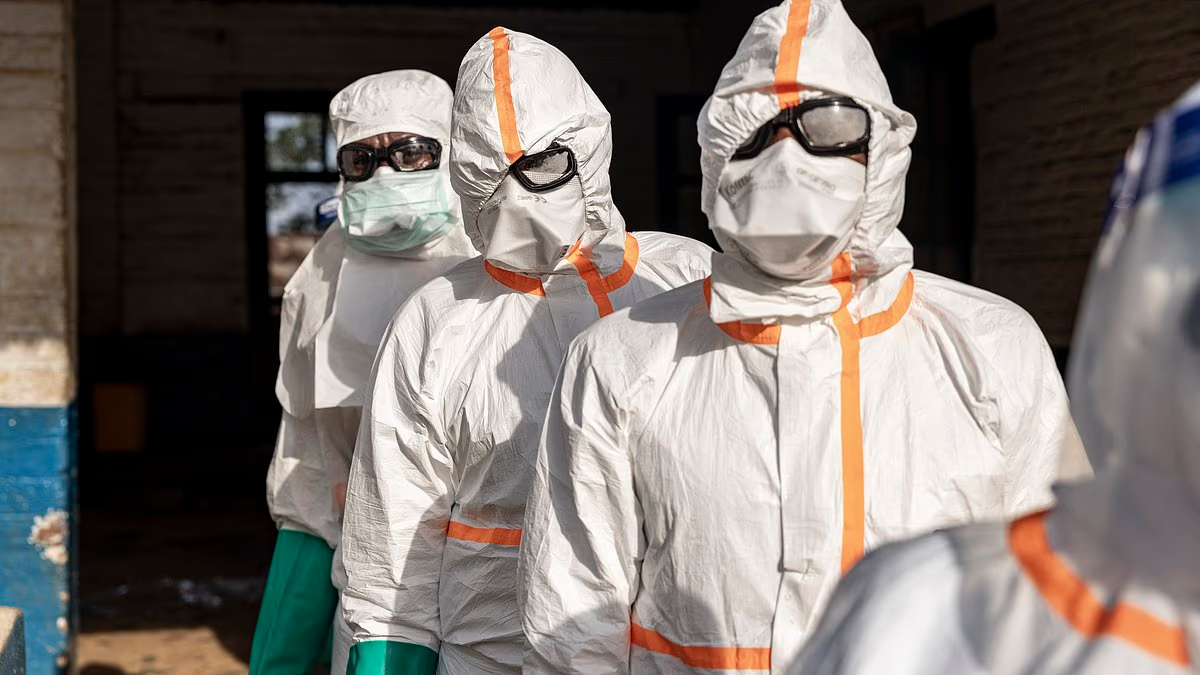
Workers line up to disinfect their protective equipment during the Ebola outbreak response in Mongbwalu, Ituri province, eastern Democratic Republic of Congo, on May 20, 2026
Recruitment is underway for volunteers aged 18 to 55, with testing expected to begin shortly.
Dr Katrina Pollock, chief investigator of the trial, told the BBC: ‘We’re doing phase one (early stage) trials of new vaccines all of the time, precisely to be ready for exactly this kind of outbreak.’
Researchers also hope to extend trials to Uganda, which borders the DRC and has reported around 20 confirmed cases.
Participants will be monitored for up to a year, although researchers expect any significant side effects or lack of effectiveness to become apparent within weeks.
The vaccine, manufactured by the Serum Institute of India, uses a harmless virus to deliver a small, lab-made piece of genetic material based on the Bundibugyo strain.
It does not contain the Ebola virus itself.
This instructs the body to make a protein which prompts the immune system to produce antibodies capable of recognising and fighting Ebola.
It was approved for use by the Medicines and Healthcare Products Regulatory Agency (MHRA) after it was tested on mice and macaque monkeys.
The technology behind the vaccine is similar to that used in the Oxford/AstraZeneca Covid-19 vaccine, which was developed in just 10 months – far faster than the typical timeline of around a decade.
But researcher Alex Sampson says despite the accelerated pace, safety standards have not been compromised.
He told the BBC: ‘We’re doing all the same tests that we would normally do, just we’re able to do them in parallel, so it means a lot of teams working in lots of different places around the clock, but we’re still doing everything that we would normally.’
While the Oxford Covid vaccine was administered to millions worldwide, rare blood clotting events were reported in approximately one in 100,000 recipients.
Dr Pollock said severe side effects are ‘very rare’ and they thought ‘very deeply’ about the implications for trials on healthy people.
She said any risk would be communicated to volunteers, adding: ‘I want to stress that the Covid AstraZeneca vaccine was given to millions of people safely.’
Meanwhile, three other vaccines targeting the Bundibugyo strain are also in development.
One is being produced by Moderna using mRNA technology, while two others -developed by the International AIDS Vaccine Initiative and Public Health Vaccines in the United States – use methods that have proven effective against other Ebola strains, though they are slower to manufacture.
Europe’s only confirmed Ebola case has been in France, where a doctor tested positive last month after returning from a humanitarian mission in the DRC.
A suspected Ebola case also prompted the precautionary shutdown of part of the Queen Elizabeth University Hospital in Glasgow a fortnight ago, before the patient tested negative.
At the beginning of this month, the Health and Social Care Committee, a cross-party group of 11 MPs, asked chief medical officer, Sir Chris Whitty, and public health minister Sharon Hodgson MP to explain ‘how prepared the Government is for a future outbreak’.
The Bundibugyo strain is not new, but it is rare. It was first recorded in 2007 and takes its name from the area of western Uganda, where it was first spotted.
It arose for a second time in the DRC in 2012. But both outbreaks were limited in size – with just over 200 cases and around 66 deaths.
The virus is thought to spread through direct contact with the blood or bodily fluids of a person who is sick or has died from Ebola, or through contact with contaminated surfaces.
Patients can carry the virus for up to 21 days before symptoms begin, which is when experts believe they become infectious.


