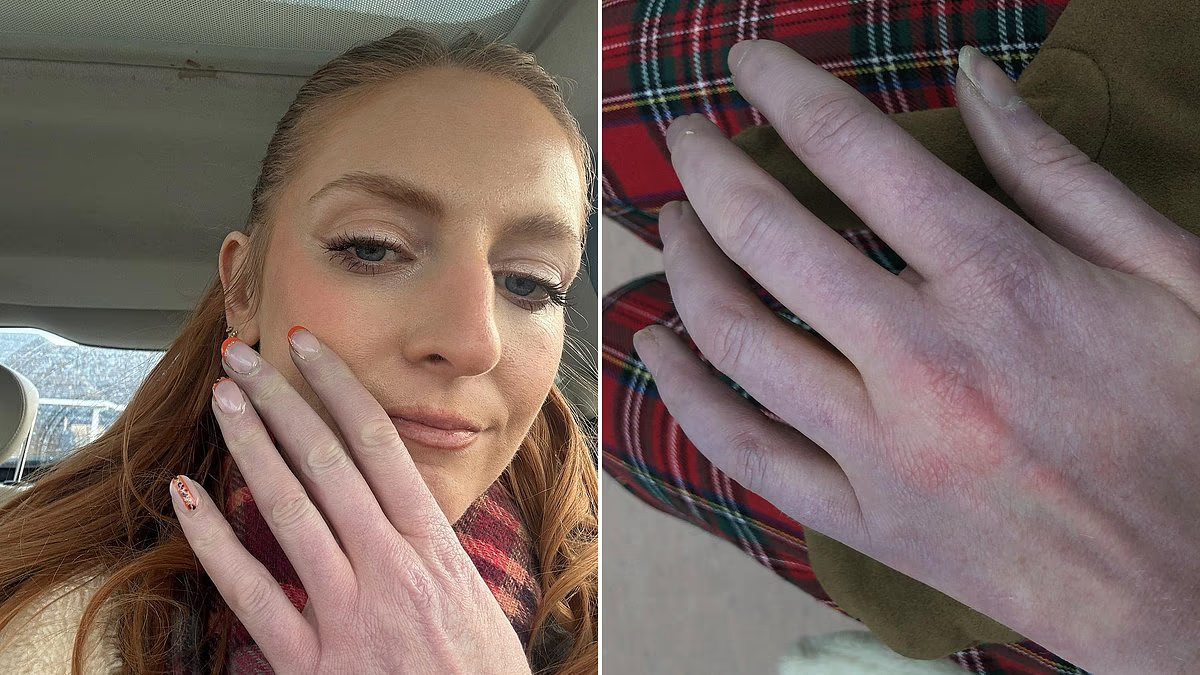

When Beth Smith was growing up, she regarded her unusually cold hands as little more than a family trait. She could lift food from the microwave without a tea towel and hold a steaming cup of tea by the cup itself, rather than the handle.
“Everyone in my family had cold hands,” says Beth, from Essex. “We used to joke that we had asbestos fingers.”
As the years passed, however, the problem became harder to dismiss. When she was about ten, her hands began turning white without warning. Beth says her GP simply advised her to stay covered up and keep warm, but the episodes gradually became worse. Her hands could look pale and drained of blood whenever she was unwell or under pressure.
Beth was eventually told she probably had Raynaud’s disease, a common condition in which tiny blood vessels in the fingers and toes suddenly narrow or spasm. This restricts circulation, leaving the extremities intensely cold and often turning the fingers white or blue.
Raynaud’s affects roughly one in six people in Britain. In most cases it is not dangerous and can be controlled by avoiding rapid temperature changes, wearing gloves and thick socks, and keeping the body warm.
Yet for some patients, Raynaud’s is an early warning sign of a more serious medical condition. Around one million people in the UK are believed to have secondary Raynaud’s, meaning their circulation problems are linked to another underlying disease.
Symptoms in these patients may be much more intense, sometimes causing permanent damage to tissue and blood vessels. In such cases, treating Raynaud’s alone is not enough; the underlying illness must also be identified and managed.
Doctors and specialists warn that secondary Raynaud’s is still being overlooked in some patients, with potentially devastating consequences.

As a child, Beth Smith dismissed her cold hands as a family quirk. She could remove dishes from the microwave without a tea towel and hold hot tea without gripping the handle

Beth was eventually told she likely had Raynaud’s, in which narrowed blood vessels reduce circulation to the fingers and toes and cause extreme coldness
Samir Patel, a consultant rheumatologist at King’s College London, says cold fingers and toes are so widespread that their possible significance is often underestimated.
“For many people, there is no obvious cause and the symptoms are not severe,” he says. “But in other cases, Raynaud’s can be the first noticeable sign of an autoimmune disease.”
Beth spent almost ten years searching for an explanation. By the time she reached 25, her Raynaud’s symptoms had become, in her words, “totally out of control”.
“My hands and feet were turning blue and grey, and the discolouration was beginning to spread towards my elbows and knees,” she recalls. Several medications had been tried without success, leaving her frightened. She had been warned that a prolonged loss of blood flow to her hands could cause such severe tissue damage that amputation might eventually be necessary.
At 26, Beth underwent further testing and finally received a diagnosis of the autoimmune disease that had been driving her symptoms for years.
She had scleroderma, a rare condition in which the body produces excessive collagen. This can cause the skin to become tight and thickened and, in more serious cases, lead to scarring in internal organs.
Certain forms of scleroderma can cause severe complications and may become life-threatening.
Diagnosis can be challenging because many symptoms resemble more common complaints, including tight or painful areas of skin, acid reflux and persistent tiredness. However, Raynaud’s is the first symptom in around 95 per cent of scleroderma cases, often appearing years before other signs develop.
In people with scleroderma, excess collagen can accumulate in the blood vessels supplying the fingers and toes. When cold temperatures or stress cause those vessels to narrow further, blood flow can be cut off entirely.

Beth’s cold hands became increasingly troubling as she grew older. At around ten, they began turning white unexpectedly and without an obvious trigger
Once diagnosed the condition can be treated with blood pressure drugs that help dilate blood vessels, as well as with immune suppressants that help slow the skin thickening and reduce internal organ damage.
The earlier treatment is begun, the more effective it can be at managing symptoms and preventing permanent tissue damage.
There are several factors that differentiate secondary Raynaud’s. ‘The red flags are people who develop it out of the blue, at an older age, and who are male,’ says Louise Parker, founder and director of The Raynaud’s Clinic in north-west London. ‘Raynaud’s is a predominantly female condition – so men developing it should be a cause for concern.’
Every six weeks Beth, 33, has drug infusions over a five-day cycle that helps open up her blood vessels to keep her scleroderma at bay – and this has massively helped with her Raynaud’s.
But she wishes she had been seen earlier by doctors who properly understood it and were able to recognise the signs of her underlying condition.
‘I was always conditioned to believe that it was my own fault my Raynaud’s was bad, because I didn’t dress warmly enough,’ she says. ‘But wearing gloves and socks and trousers never actually helped me – they actually cut off my circulation more.
‘I think that if I was put on the right medication sooner, I probably would have tolerated it better.’


