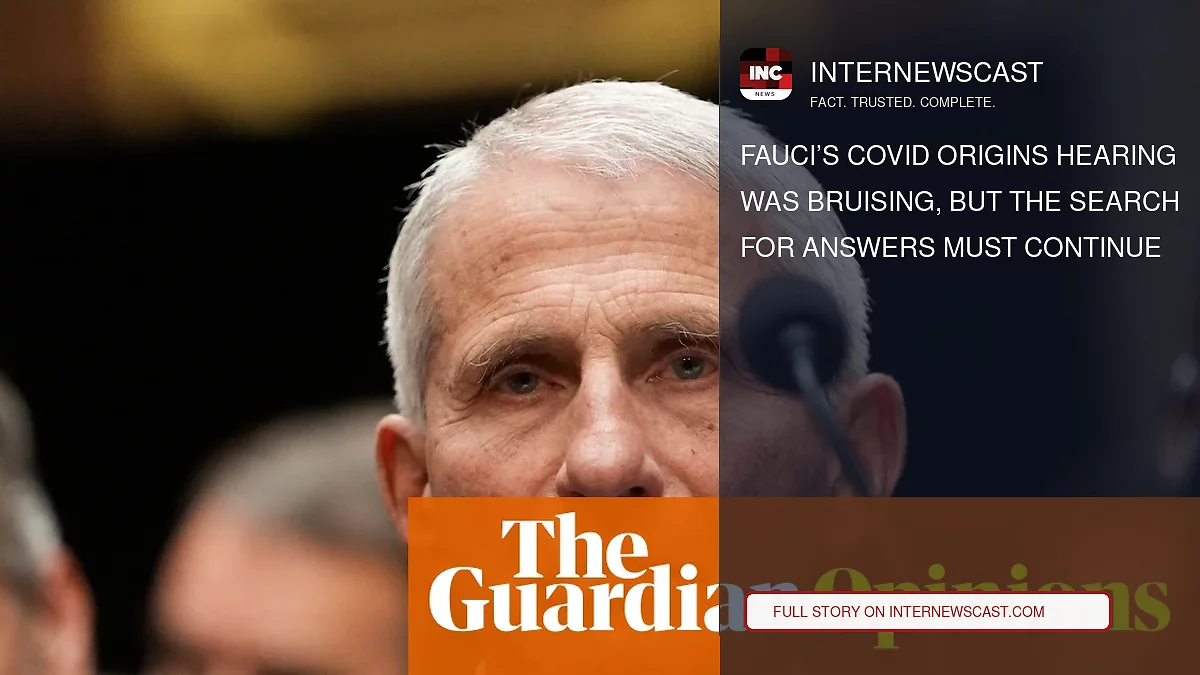

As both a microbiologist and a physician who treats infectious diseases, I have found it deeply troubling to see the public conversation around the origins of Covid-19 deteriorate so sharply. Reading Anthony Fauci’s newly public diary entries on the origins dispute has been particularly unsettling. So, too, was watching the 29 July televised confrontation staged by US senator Rand Paul, in which Fauci was subjected to a combative and often hostile line of questioning.
From the earliest days of the pandemic, many of us urged a sober, evidence-driven examination of what was known, what remained uncertain and what still needed to be investigated about the origins of Covid-19. Yet instead of moving closer to that kind of clear-eyed assessment, the debate has drifted further away, overwhelmed by political agendas, tribal loyalties and reasoning that too often collapses under scrutiny.
The consequences are not abstract. Public confidence in science, in scientists and in government institutions is on the line, as is our ability to detect, prevent and respond effectively to the next pandemic. The urgent questions now are how the debate became so distorted — and how we can begin to repair it.
In the years before Covid-19 emerged, the scientific community had already spent two decades wrestling with a difficult question: could human activity trigger a pandemic? By late 2019, there was no true consensus. Many public health experts leaned toward the view that nature remained the dominant pandemic threat, largely because history suggested that naturally emerging pathogens were far more likely.
Others, especially researchers focused on advances in biotechnology and the risks created by human behavior, believed the picture had changed. In their view, people had become entirely capable of setting off a major outbreak. When a mysterious disease suddenly surfaced in Wuhan, China, in late December 2019 and was soon linked to a coronavirus with recent relatives in bats, two explanations quickly rose to the center of the Covid origins debate: a natural spillover connected to one of Wuhan’s loosely regulated wildlife markets, echoing the 2002 Sars outbreak, or a laboratory accident in the same city that housed the world’s largest known collection of bat-related coronaviruses.
Six years on, after endless accusations and public sparring, both scenarios remain possible. Each is backed by circumstantial evidence, but neither has been proven. The virus responsible for Covid-19 has not been identified in the wild, and it has not been shown to have existed in any laboratory.
At the center of the controversy are two facts that can both be true without necessarily being connected. The first is that published scientific work shows researchers in Wuhan carried out high-risk studies on bat coronaviruses, including some projects supported by the US National Institutes of Health.
Those studies were intended to help predict future disease outbreaks. But some of the experiments looked uncomfortably like biological Russian roulette: researchers combined pieces of newly discovered bat viruses to create chimeric viruses, then examined how they behaved — work conducted under biosafety conditions that many critics consider insufficient.
Yet, this published work does not reveal a plausible Covid precursor virus. Thus, Rand Paul is correct in that risky work was funded by NIH in Wuhan. Anthony Fauci is correct in that the published work, on the face of it, did not cause Covid. Of course, as with any research program, we can assume that much remains unpublished.
My own view, for what it is worth, is that a lab accident in Wuhan is the most plausible explanation for Covid, given the kind of work pursued there, the fact that publications by Chinese researchers indicate knowledge about the Sars-CoV-2 virus before late December 2019, and the thousands of negative tests from suspect animal reservoirs. But I could be wrong.
If we are to improve our capacity for anticipating, preventing and responding to the next pandemic, several things must happen. First, everyone who insists that they know how Covid began should back off, accept ongoing uncertainty and display a bit more humility.
Second, we need an objective and transparent forensic investigation of Covid origins with broad international engagement and proper authorities and accountability.
Third, scientists must fully embrace the responsibilities that come with technical power and knowledge and accept guardrails for some kinds of experiments. Similarly, political representatives must embrace their responsibilities for ensuring an educated, balanced public discussion about the trade-offs between a healthy pursuit of public health science and the attendant risks, as well as for balanced public policy addressing risk oversight.
One thing that cannot continue to happen is a collective state of wishful thinking that this issue can be ignored or buried, or that nothing useful will result from addressing it. Continuing down the current path comes at our own peril.


