
Florida is confronting what experts believe to be the largest outbreak of mosquito-borne dengue fever in the United States in more than 80 years.
The Florida Department of Health reported 72 additional locally acquired infections last week, bringing the state’s total for the outbreak to 368.
Federal health officials said nationwide data on dengue outbreaks is limited. However, based on information available from state health departments, the Florida outbreak has surpassed every other US outbreak recorded since 1945.
The previous largest outbreak occurred in Hawaii, where official records show 264 locally acquired cases over six months in 2015 and 2016.
Dengue is often known as “breakbone fever” because it can cause a sudden high fever, severe headache, pain behind the eyes and intense aching in the muscles, joints and bones.
The United States records dengue cases every year, most commonly among people who contracted the virus while traveling abroad. In recent years, however, locally acquired infections have become more frequent.
Across the continental US, 995 dengue cases have been reported this year. That total includes 626 travel-associated infections and 369 locally acquired cases, including those in Florida and one in Virginia.
A Centers for Disease Control and Prevention report released earlier this year found that the average annual number of dengue cases in the US rose 359 percent in 2024 compared with the yearly average from 2010 through 2023.

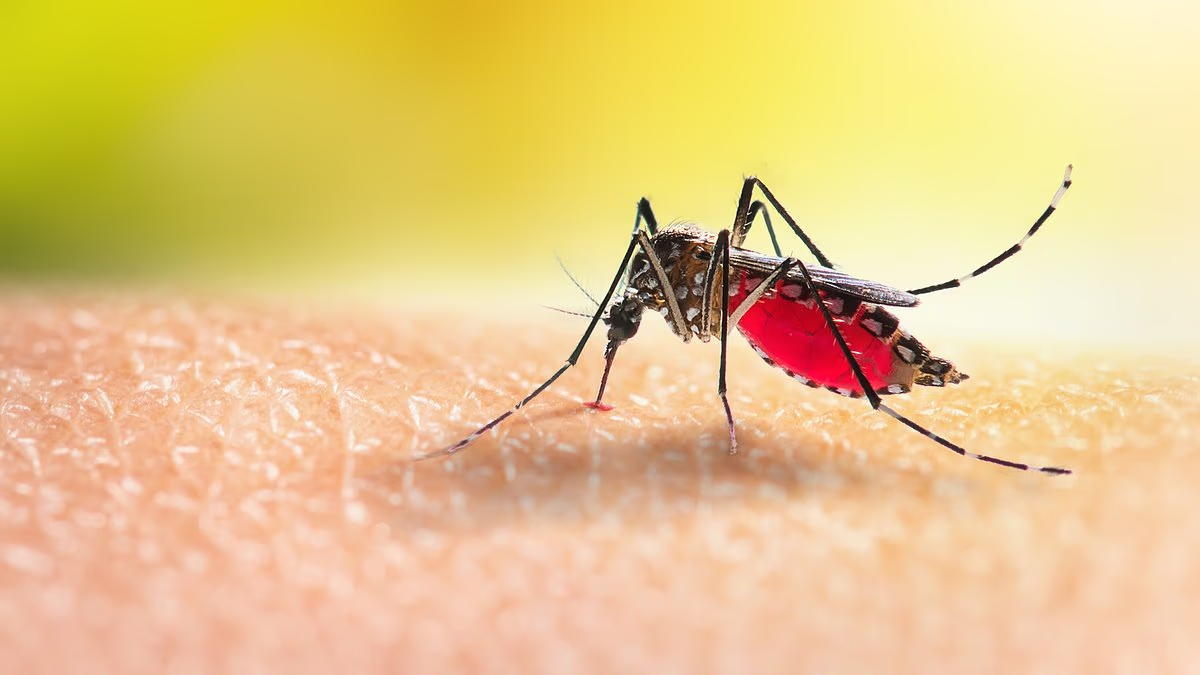
Dengue fever is transmitted by bites from infected Aedes mosquitoes, particularly Aedes aegypti, a species commonly found in Florida
Florida has reported 656 dengue cases in total this year, including 288 travel-associated infections, which account for about 40 percent of the state’s cases.
Hillsborough County, home to Tampa, is the center of Florida’s locally acquired outbreak, with 310 infections. Nearby Pinellas County, which is also part of the Tampa metropolitan area, has reported 37 cases.
Miami-Dade County has recorded nine locally acquired cases, while Orange County, including Orlando, has reported five. Pasco County, north of Tampa, has recorded four.
Polk County, located between Tampa and Orlando, along with Palm Beach County and Broward County on Florida’s east coast, has reported one case each.
It remains unclear how dengue entered Florida. One possible route is for an infected traveler to return from abroad and then be bitten by a mosquito. The mosquito can acquire the virus and spread it to another person through a subsequent bite.
Maurice Kurtz, a 73-year-old St. Petersburg resident, is among those infected during Florida’s outbreak. He said the illness left him feeling as though he had been hit by a car.
His temperature climbed to 101F, and even walking around the block left him extremely fatigued.
“I went around the block and, oh, I ached so much,” he told CIDRAP News. “This was way beyond the tightness and aching I get from the most strenuous workouts I’ve ever done.”
Over the following two days, Kurtz slept for 16 hours—highly unusual for someone who is normally an active swimmer, cyclist and runner. He also recalled noticing tiny, itchy red spots on his legs several days before he became ill.
Tests for flu and COVID were negative. When Kurtz asked doctors to test him for dengue, they initially said the disease was mostly being seen farther north, in Hillsborough County.
After Kurtz explained that he had visited Tampa the day before his symptoms began, doctors performed a blood test. The result was positive for dengue fever.
Kurtz has made a recovery, though he still struggles with fatigue and getting back to his active lifestyle.
‘I just got a mosquito bite and I’m recovering from this disease, which has a reputation of being this rare tropical thing,’ he said.
‘The likelihood of you getting it is very, very slim. But it could happen to you – and in [my] case, it did.’
Dengue fever was nearly eradicated in the US in the 1970s amid a campaign to wipe out the Aedes aegypti mosquito, identified by the white bands on its legs, which carries the virus.
After that campaign was abandoned, however, the mosquito – and dengue fever – have repeatedly triggered sporadic outbreaks, particularly in Florida.

The above map shows all countries for which the CDC has issued a level 1 travel advisory due to the spread of dengue fever
Dengue fever often causes an asymptomatic infection, but in some patients it can trigger life-threatening internal bleeding, respiratory distress and heart failure.
It can also lead to shock and organ failure, especially of the liver, brain and heart.
Health officials say about 40 to 80 percent of people infected with dengue fever do not develop any symptoms, but if symptoms do develop, they appear abruptly about five to seven days after infection.
Warning signs include a fever above 100F (38C), severe headache, pain behind the eyes, bone, joint or muscle pain, and bleeding in the gums.
Some patients also develop redness of the skin on the face within the first 24 to 48 hours of symptoms emerging.
In severe cases, patients may also suffer from severe abdominal pain, persistent vomiting and lethargy.
Patients may also develop dengue shock syndrome, a condition where severe bleeding leads to a rapid drop in blood pressure and causes the body to go into shock.
Children under five, adults over 65 and pregnant women are considered to be most at risk from the virus.
There is no specific cure for dengue fever and treatment consists of supportive care and therapies to manage symptoms and complications.
Doctors recommend patients with mild symptoms drink plenty of fluids and take Tylenol to ease pain.
In severe cases, patients may be admitted to the hospital for supportive care, an IV, blood pressure monitoring and a transfusion to replace lost blood.
To protect against dengue fever, there is a three-dose vaccine available, which is recommended for children ages nine to 16 years who have previously been confirmed to have a dengue infection. It slashes the risk of a symptomatic infection by about 80 percent.
Dengue fever can also be prevented by using insect repellent and long, protective clothing to avoid mosquito bites. Eliminating standing water by dumping it out of buckets, pet dishes and roof gutters also prevents mosquitoes from laying eggs.
Additionally, the CDC recommends using screens on windows and doors or staying in air-conditioned rooms.


