
Share this @internewscast.com
In a significant move that could potentially save countless lives, the government has announced an expansion of its newborn screening program to include tests for a rare genetic disease. This change, set to begin in October, aims to prevent painful and avoidable deaths among hundreds of thousands of children.
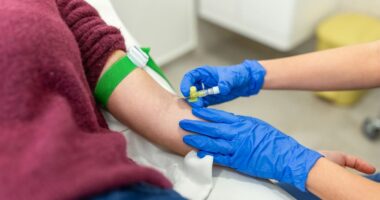
Currently, the NHS conducts ‘heel prick’ tests on infants around five days after birth to detect ten treatable conditions, such as cystic fibrosis. However, this list is about to grow, addressing a long-standing gap in early diagnosis capabilities.
The push for expanded screening gained momentum earlier this year when former Little Mix singer Jesy Nelson urged the NHS to include spinal muscular atrophy (SMA) in its testing protocol. Nelson’s advocacy is deeply personal, as her twin daughters were born with SMA, a severe muscle-wasting condition.
Tragically, due to a late diagnosis, Nelson’s daughters, Ocean and Story, face a bleak prognosis with life expectancy not extending beyond two years. This heartbreaking situation underscores the urgent need for early detection.
Despite the National Screening Committee’s decision in January to exclude another muscular disease from the program, the Health Secretary, Wes Streeting, has now announced plans to screen over 400,000 infants for SMA starting October 2026.
This decision follows persistent public pressure urging the health secretary to override the committee’s previous guidance. The expansion marks a crucial step toward making effective treatment more readily available through the NHS.
Paediatric consultant Dr Simon Jones, a leading expert in metabolic diseases at St Mary’s Hospital previously told the Mail: ‘I’ve seen children who received treatment grow up healthy – and I’ve watched others deteriorate and die because they were diagnosed just weeks too late.
‘No parent should have to bury their child because the Department of Health is still making up its mind about a test that could have saved them.

Jesy Nelson on This Morning demanding the NHS expand the heel prick testing to check for spinal muscular atrophy, which her twin seven-month old daughters have
SMA is a rare but devastating degenerative condition, affecting around one in 14,000 babies, with the majority being type 1 which affects babies less than 6 months old.
Common symptoms include muscle weakness, such as floppy or weak arms and legs, movement problems, problems with breathing or swallowing, tremors and bone and joint issues that can lead to spine curvature.
Most types of SMA are caused by inherited faulty genes and crucially can be picked up through a heel prick blood test.
Tests, including genetic blood tests, are available before, during and after pregnancy but historically have only been offered to at-risk parents and children.
This is about to change.
Wes Streeting announced today that he is bringing forward plans to screen babies in England for SMA from January 2027 to October this year – as is already the case in Scotland.
In a letter addressed to the singer and Giles Lomax, chief executive of SMA UK, Streeting said: ‘At our meeting I committed to seeing whether the in-service evaluation of SMA screening could be implemented faster and cover a wider geographical areas.
‘I am pleased to confirm that [screening] will now start in October this year rather than January 2025 as previously planned.’

Miss Nelson’s twins were born prematurely in May 2025
He continued: ‘It was great to meet you both and I really appreciated you sharing your personal experiences of raising children with SMA and applaud the work you have both done highlighting the issue and seeking earlier diagnosis.’
The pilot will see an estimated 404,000 babies tested in England.
But a further 163,000 will go untested as a control group which will be used to compare outcomes – a situation experts have branded ‘unethical’.
Whilst there is currently no cure for the condition, there are treatments available to help SMA have the best possible quality of life – with early support being vital.
In response, Streeting has said officials are still working through the ‘challenges’ related to extending the pilot to the whole of England, The Mirror has reported.
‘As you know, I’d like to see a full rollout,’ the letter continued.
The main treatments for the condition include three NHS-approved drugs that target the altered genes that cause SMA: nusinersen, risdiplam and onasemnogene abeparvovec.
The worry is that these treatments are currently administered too late to make a difference, once substantial nerve damage has occurred.
Only one condition has been added to the UK newborn screening programme since 2015.
A spokesperson for the National Institute for Health and Care Research (NIHR), which is funding the scheme, said: ‘Its potential impact will be to demonstrate whether newborn screening for SMA can be delivered effectively through the NHS, accurately and quickly identify affected babies, and pride robust evidence to inform a national decision on introducing SMA screening.’