
Share this @internewscast.com
In a troubling development for the healthcare sector, tens of thousands of patients who have been on long waiting lists for joint replacement surgeries may soon receive notices of cancellation. These surgeries, vital for improving quality of life, are being put on hold due to an unexpected global shortage of bone cement, a key component in the procedures.
The shortage was announced on Wednesday, following a critical machine failure experienced by the NHS’s primary supplier, which has disrupted the supply chain worldwide. Currently, the existing stock is expected to last just one more week, leaving the healthcare system in a precarious position as it struggles to meet the needs of approximately 850,000 patients in England awaiting joint replacement surgeries.
In response to this crisis, hospitals have been directed to prioritize only emergency procedures, leading to the cancellation of scheduled surgeries over the next two months. This decision is part of a broader strategy to manage the dwindling resources effectively.
Experts have expressed concerns that the situation might worsen, with the timeline for resolving the issue still uncertain. Some have drawn parallels to the prolonged wait times experienced during the COVID-19 pandemic, indicating the potential severity of the impact.
To help the public understand the scope of the crisis, the Daily Mail has unveiled an interactive map highlighting hospitals that are expected to be most affected. These include facilities already facing long delays for joint replacement surgeries and those nearing NHS target thresholds.
Now the Daily Mail’s interactive map can reveal the hospitals likely to be hit worse by the shortage, with existing long waits for joint replacement operations, and those closest to hitting NHS targets.
Mid and South Essex NHS Foundation Trust currently has the most patients waiting for knee and hip operations, with more than 19,100 patients waiting to start treatment.
Kettering General Hospital NHS Foundation Trust, which covers five hospitals including Isebrook Hospital and Market Harborough District Hospital, has the shortest waiting list with just over 1,860 patients waiting for a procedure.
On Tuesday, health officials led by the British Orthopaedic Directors Society and British Orthopaedic Association said the thousand emergency trauma operations per week that require cement should be prioritised.
This will see elderly patients who have suffered a hip fracture pushed to the top of the list, despite 22,000 patients having waited longer than a year for surgery.
Daily Mail analysis of figures released by the UK’s National Joint Registers (NJR) reveals that around 200,000 first time knee and hip procedures used cement in 2024 alone.
Cancellations and long waiting lists normally push procedures into the independent sector, with private hospitals typically having better margins than most other treatments.
But private sector operators have been told ‘supply should be suspended where not clinically urgent.’
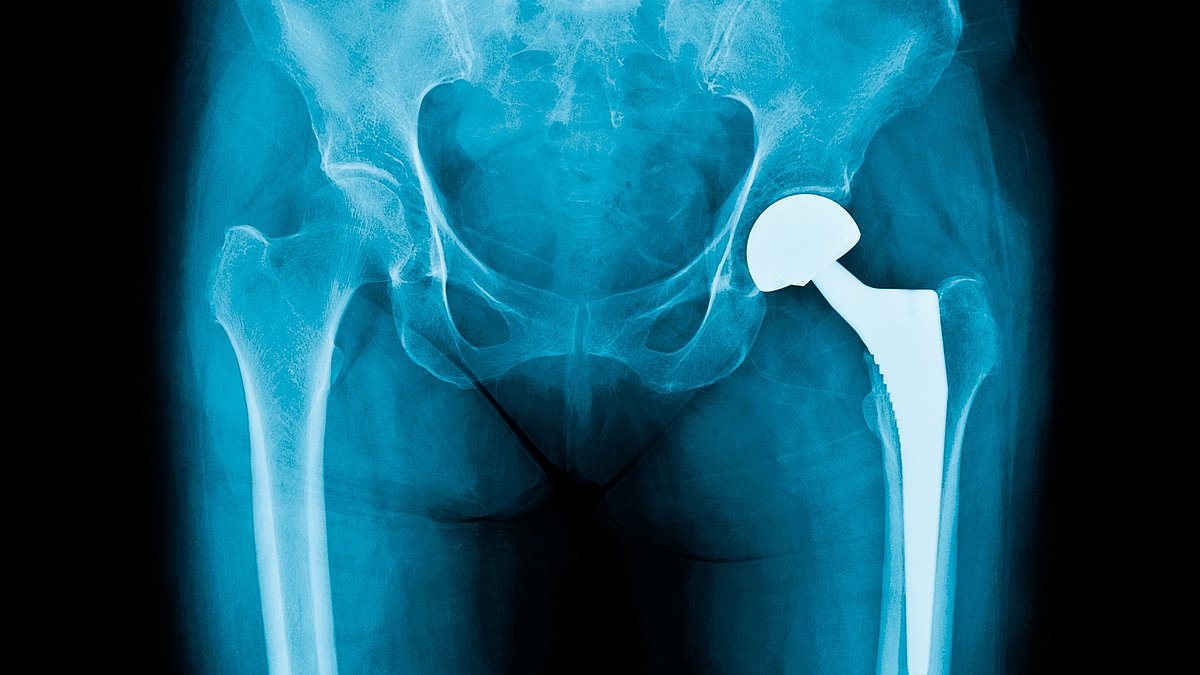
Bone cement, which is used to lock the replacement in place and get patients back to normal life quicker, is used in the majority of the 250,000 procedures carried out each year.
But Heraeus, one of the world’s major suppliers and the NHS’ preferred choice, has said there will be a ‘supply shortage for at least the next two months’, after the firm suffered a machine failure whilst trying to upgrade its systems.
It means close to a million patients waiting for joint surgery now face further delays on the NHS, with those living in areas with the shortest waiting lists likely to receive life-changing treatment sooner.

An estimated 110,000 hip replacement surgeries were performed in 2023/24
Officials have reportedly acknowledged the ‘seriousness of the shortage and the likely need to restrict activity to trauma and urgent cases’.
The crucial ingredient is thought to be used in more than 80 per cent of knee replacements and almost 60 per cent of hip replacements – which equates to around 15,000 operations every month.
But this will not be possible with the current shortage, labelled a ‘crushing blow’ by Arthritis UK.
Research spearheaded by the University of Bristol last year revealed that each knee replacement operation cancelled at short notice costs the NHS a lost tariff of between £6,500 and £11,000 – forecasted to cost the health service tens of millions a year.
According to The Telegraph, leaders added that ‘competitor cement availability is limited’, as health services struggle to get on on top of record backlogs after delays caused by the pandemic and funding cuts earlier this year.
Dr Alex Dickinson, Professor of Prosthetics Engineering, University of Southampton, said: ‘There are other manufacturers of bone cement, but there is not an alternative material that could just be substituted.
‘Implant engineering at its best is a very cautious and gradual process. Any new technology potentially carries risks to the patient, and we must go through very thorough development work to try and minimise these risks.
‘It also takes years of follow-up to see the long-term outcomes of new technologies.’

Figures released last year revealed 49,500 people were waiting for an NHS knee replacement
Fergal Monsell, the president of the BOA, added the association was working to ‘reduce the impact on patients’, but that it was ‘a situation that is beyond the control of trauma and orthopaedic surgeons and NHS organisations’.
He said: ‘NHS trusts have also been advised to utilise the released theatre time to treat orthopaedic patients where procedures do not require the use of cement.’
Dr Mark Wilkinson, a surgeon and professor of orthopaedic at the University of Sheffield, told the Daily Mail that the whole of UK can expect to face disruptions, with the shortage expected to add ‘at least two months to NHS waiting lists.’
He said: ‘There isn’t a magic wand for this problem. You can almost think of it like another Covid. The affect will be the same until the cement becomes available.
‘Every two month delay – which is a best case scenario – will add at least 10,000 hip and 20,000 knee replacements to existing waiting lists.
‘And I think that’s a best case scenario. It could be much longer. Only 18 per cent of procedures utilise other types of cement and alternative suppliers are going to struggle to keep up with the demand.
‘But we don’t have time to wait. The problem is now.’