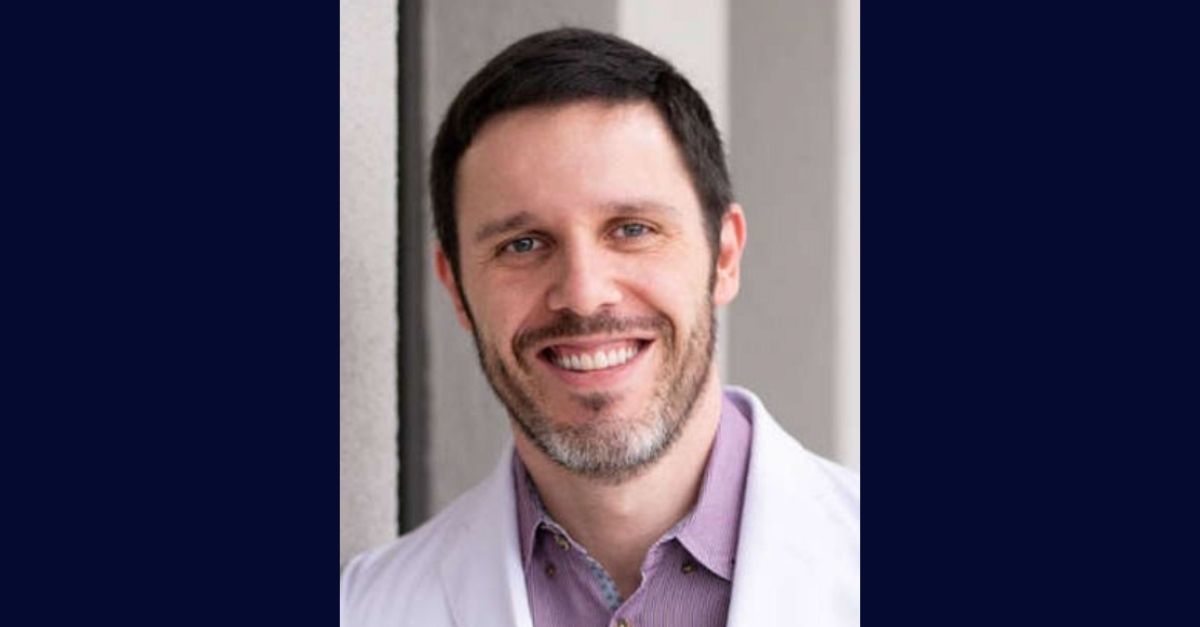
Dr. Justin Scott (Pure Dental Health).
A Georgia-based dentist is seeking the reinstatement of his professional license following a suspension due to claims of severe dental malpractice, including an incident where a patient developed bone necrosis after borrowing $20,000 for incorrectly fitted implants.
Dr. Justin Scott of Pure Dental Health in Atlanta argues that he has been unjustly treated after the Georgia Board of Dentistry issued an order suspending his license, as detailed in a legal petition filed on Monday and accessed by Law&Crime.
According to the emergency petition for a temporary restraining order, preliminary injunction, and stay of the board’s suspension, Scott’s attorney, Matthew S. Coles, claims, “The order is unlawful.”
Coles further explains, “The board was aware of all accusations by June 2025, reviewed Dr. Scott’s responses, conducted inspections at both of his practice locations on September 10, 2025, and observed the cited conditions, departing without issuing any emergency directive. No further actions were taken for six months. An agency that inspects and then delays six months before acting cannot claim an immediate danger situation.”
The accusations against Scott, which include improper implant placement and dental misalignments, do not justify an emergency suspension and should be addressed through peer review and standard procedures, the petition argues.
Additionally, the document emphasizes that the board has not presented any expert analysis of Dr. Scott’s treatments nor any expert testimony indicating that patient safety was at risk, asserting that the suspension has inflicted “permanent and irreparable” damage on him.
“Dr. Scott’s Buckhead practice is shuttered, 12 employees face unemployment, and hundreds of patients have lost access to ongoing care,” Coles says. “His practice, listed for sale at $2.1 million, has received only a $300,000 offer since the suspension — a destruction of $1.8 million in value.”
The Board of Dentistry’s order of suspension accuses Scott of multiple offenses related to “poor” orthodontic treatments he carried out on multiple patients. One patient allegedly received implants from Scott that failed and led to “bone necrosis” at two different implant sites that were “poorly placed,” according to the suspension order.
The patient, identified in the order as M.G., had to take out a $20,000 loan for the dental services, the board says. “Patient M.G. received implants from [Scott] which ultimately failed,” according to the suspension order.
Another woman identified in the order suffered from “significant root resorption” on her upper and lower teeth, and she is now “at risk of losing her front teeth,” the board says.
A third patient, who was seen by a different dentist after going to Scott, was described as having “all lower implants” in her mouth removed. “Patient is over closed, decreased VDO due to makeshift denture, no occlusal stops, therefore torquing mandibular condylar area,” the subsequent treating dentist wrote in a follow-up report, according to the board’s suspension order.
A fourth person, who was also seen by a different dentist after going to Scott, suffered from “multiple conditions that required correction as a result of poor orthodontic treatment,” the board says.
An investigation and on-site probe of Scott’s dental facilities in Dunwoody and Atlanta found “extensive and pervasive failures of sanitary practice, sterilization and infection control,” according to the board.
The failures included “improper” sterilization techniques and storage, with instrument packs being found opened in drawers and “improper” seals on sterilized packages; a failure to maintain maintenance logs; expired supplies — including anesthetic cartridges, medications, and patient supplies — found in procedure rooms, the supply closet, and the refrigerator; “improper” instrument storage, including wet instrument packs on the counter after being pulled from a sterilizer; and other issues.
“I have no teeth, I have no functional teeth,” said Tangie Larkin, one of Scott’s former patients, in an interview with local ABC affiliate WSB. “This side broke all the way off,” she said.
Patrick Archibald, another alleged former patient, told the outlet he “can barely talk” after getting work done by Scott.
“My bottoms are not done at all,” he said. “My friends will tell you there are times I just sat there and cried and cried at night. I want my mouth fixed I want what I paid for. Because five years later all this money in and instead of my dream teeth I have no teeth.”
Neither Scott’s lawyers nor the Georgia Board of Dentistry responded to Law&Crime’s requests for comment on Tuesday.