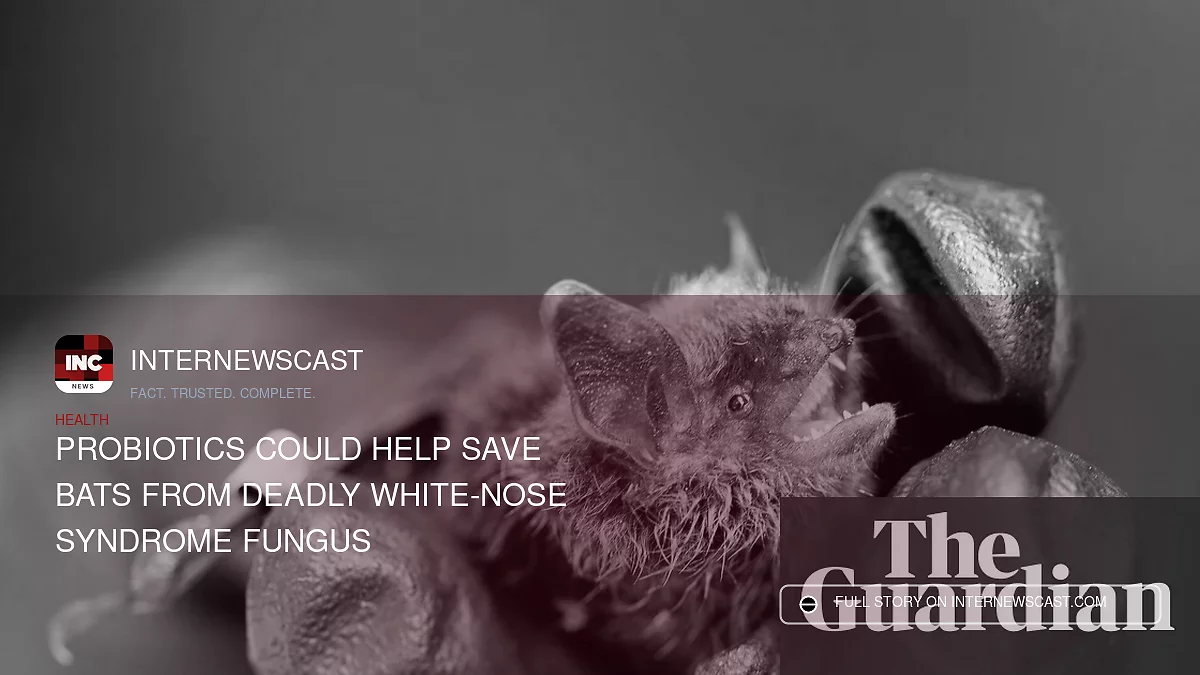

Creeping through a tight cave corridor beneath the boreal forest outside Fort Smith in Canada’s Northwest Territories this May, two biologists came upon a grim sign: a dead bat lying on a limestone shelf, its small body dusted with wispy white fungal growth.
As their headlamps swept closer, the discovery grew more troubling. A second bat, still alive, showed the same fungus on its forearms. “It hissed at us and crawled back into a crack,” recalled Jesika Reimer.
Reimer, an ecologist who studies bat populations across northern Canada and Alaska, knew what the scene almost certainly meant. For two decades, white-nose syndrome — a devastating disease caused by the fungus Pseudogymnoascus destructans, or Pd — has been moving steadily west across North America, passing between bats and through cave systems. The disease has already killed more than 6.7 million bats.
The fungus grows on bats’ faces, wings and arms during hibernation. Its irritation wakes them repeatedly, prompting grooming and activity when they should be conserving energy. As they burn through the fat reserves needed to survive the cold months, many ultimately die from dehydration or starvation. Smaller bat species, which carry less stored fat, are especially vulnerable.
Its arrival in Fort Smith, roughly 450 miles (725km) south of the Arctic Circle, marks a major northern advance. “For 20 years, we’ve been tracking the spread of white-nose syndrome across the continent,” said Joanna Wilson, Reimer’s colleague and a biologist with the Northwest Territories government. “We always knew it would eventually get here.”
Still, the timing stunned the team. Their plan had been to document healthy, stable bat colonies before the disease reached the area. White-nose syndrome had been detected in 2025 in a cave at Fort McKay, Alberta, nearly 200 miles to the south, giving researchers reason to believe they had a little more time. “We thought we’d have a year or two,” Reimer said.
With the fungus now confirmed at the northernmost known hibernaculum — the winter shelter where bats ride out the North American cold — scientists are confronting urgent questions about what white-nose syndrome could mean for bat populations in Canada’s far north and Alaska, Reimer said.
The Fort Smith-area caves were identified only in 2010, after a wildlife technician flying over the landscape spotted a telltale karst formation below. Karst terrain develops when bedrock such as limestone or dolomite dissolves over time, creating caves, sinkholes and underground chambers that can become crucial winter habitat for bats. The technician later returned on foot and confirmed the site was a hibernaculum. Two more caves were subsequently found nearby.
Until then, biologists had not known where the Northwest Territories’ hibernating bat species – including little brown bats (Myotis lucifugus), big brown bats (Eptesicus fuscus) and northern long-eared bats (Myotis septentrionalis) – were spending the winter.
They had located summer colonies, or roosts, which tipped them off that bats were sticking around through the winter months, but they did not know where or in what numbers. The 11-chambered cave shelters an estimated 3,000 bats, making it the largest hibernaculum in western Canada. It has been key to understanding the behaviour of northern bats.
In 2011, Reimer focused her postgraduate research on the cave to discover how bats survived at such an extreme northern latitude, where the summer months are cooler, shorter and the sun hardly sets. She found that northern bats had to adapt to survive, such as taking more risks than their southern counterparts, flying at dusk instead of in true darkness to forage for mosquitoes and moths, and eating more orb-weaver spiders – higher in energy content – to keep fuel levels up.
But no matter their adaptive abilities, smaller species of bats, such as little brown and northern long-eared myotis bats, are particularly susceptible to white-nose syndrome. Both are listed as species of special concern in the Northwest Territories. Since the fungus arrived in New York state in 2007 – thought to have been brought over from Europe on the shoes of a caver – it has killed 90% of little brown and 99% of northern long-eared myotis bats in the caves where it has spread.
Some little brown populations are slowly rebounding, Reimer points out. They are genetically adapting their metabolic rates to burn less fat and withstand infection.
However, there is a less hopeful prognosis for the northern long-eared myotis, a species that weighs just 6-9g, and lacks the fat and energy reserves to outlast white-nose syndrome through the winter. “If it hits them as hard as it has elsewhere in their range, we can expect them to completely disappear from the ecosystem,” Reimer says.
In May, Reimer and Wilson led research efforts to capture bats outside the cave entrance using lightweight mist nets, documenting little browns and northern long-eared myotis with white fungus “riddling the wing membranes”, Reimer says, adding that there were clear signs of necrosis, when living tissue dies. They also used a UV light to scan for orange fluorescence on their wings, which indicates Pd.
They witnessed other unusual behaviours, too, including bats flying outside the cave in daylight. “That can be a sign of bats that are sick, or trying to recover,” Wilson says.
One of their colleagues discovered an infected bat, badly dehydrated, at a nearby lake. “It couldn’t fly,” Reimer says. When they examined its wings they found they were as “brittle as tissue paper”, she says. They gave the bat food and water, though they think it probably died later.
While laboratory tests recently came back positive for white-nose syndrome, Reimer and Wilson were relieved that they did not see the same mass die-offs as documented in large caves in the south, including most recently in Alberta’s Rocky Mountains. They are not sure if it is because the fungus has only just arrived and has not yet become established, or if the cave’s sub-arctic latitude gives bats an adaptive edge.
One factor could be the temperature of caves. While the fungus thrives at 10C (50F), Reimer says, the northern caves are much cooler. “Some of the chambers drop below freezing throughout the winter,” she says.
And while Pd can still grow, it might not grow as quickly as it would in a warmer cave. That, says Wilson, gives researchers some “cautious hope”.
“We might see different outcomes,” she says.
And there is an additional reason for hope. Researchers are applying an experimental “probiotic cocktail”, developed by scientists at Ontario’s McMaster University from samples taken from the microbiomes on bats’ wings, to the surface of summer roosts. The substance gets on to their body and spreads from bat to bat in much the same way that Pd spreads.
It is thought that the probiotic – beneficial microbes that have anti-fungal properties – could improve the bats’ resilience to Pd infection by slowing its growth. Early field trials in British Columbia and Washington are yielding promising results: among Pd-infected bats, those with the highest amount of probiotic microbes had the least Pd.
“We see it as a treatment option that has a very good chance of helping and very little chance of harm,” Wilson says.
But further complicating the advance of white-nose syndrome is another big factor: wildfires. In 2023, large wildfires torched the trees surrounding the caves near Fort Smith. “It’s matchsticks. There is not a single piece of foliage to be found,” Reimer says.
The loss of habitat forces bats to fly longer distances to find food, summer roosts in old decayed trees, and mates during the autumn breeding season.
Reimer also wonders if wildfires could have played a role in the rate at which the fungus spread, forcing bats from the Northwest Territories to move south and mix with Pd-infected bats – then bringing it back to the northernmost caves.
For now, there are more questions than answers, including what mitigation measures biologists will take – and if they will choose to mitigate at all, says Reimer. While the little brown bats may be able to bounce back on their own, interventions could give the northern long-eared myotis a “fighting chance” to survive and adapt, she adds.
Nothing more will be known until next spring, when Reimer and Wilson return to the caves to see how the bats have fared – and to search for more answers.
Find more age of extinction coverage here, and follow the biodiversity reporters Rebecca Ratcliffe, Phoebe Weston and Patrick Greenfield in the Guardian app for more nature coverage.


