
Share this @internewscast.com
Our pets aren’t just companions; they live alongside us, sharing our spaces and occasionally, our health challenges. While sometimes these shared health issues are coincidental, research increasingly suggests a deeper link between the wellness of pets and their owners than previously understood.
Take the Dog Aging Project in the United States, for instance. This initiative tracks more than 50,000 dogs to explore how factors like their owner’s environment—including details as specific as flooring type—along with lifestyle and diet, influence their aging process and susceptibility to diseases. The insights gained could potentially benefit human health as well.
“Lifestyle is a crucial determinant of health,” explains Anne Crilly, an immunologist and head of the One Health program at the University of the West of Scotland, which focuses on the interplay between environment, animal, and human diseases. She notes that sedentary or overeating pet owners might unknowingly transfer these habits to their pets, leading to conditions like arthritis, cancer, and autoimmune diseases—ailments common in humans as well.
Here, six individuals share their unique experiences of being diagnosed with the same condition as their pets, and how these animals have become a source of strength and support during their journeys…
My rabbit and I share the same back problem

Leanne Dempsey and her pet rabbit Gia both have spondylitis, a chronic inflammatory condition that affects the spine
Leanne Dempsey, a 34-year-old volunteer at The Bunnyjackpot Foundation animal rescue in Northwich, recounts her story:
Upon meeting Gia, my rabbit, in August, I immediately felt a profound bond. Abandoned at eight years old, she was in a dire state, covered in maggots and her fur in disarray.
Our sanctuary takes in rabbits, guinea pigs and other small pets – but something about Gia stood out. She looked poorly and in pain, but her eyes were bright.
A few days after she’d arrived the vet did an X-ray as he was worried about her teeth – and because rabbits are small the whole body shows up on an X-ray. This revealed that Gia, like me, had spondylitis, a chronic inflammatory condition that affects the spine. This is common in rabbits, especially older ones like Gia.
I’d been diagnosed seven years ago when I was 27, after years of pain and stiffness in my lower back and joints.
Gia’s spinal condition meant she needed special care and I felt no one would better understand her needs than me – so I said I’d take her home to live as a house rabbit; I have five other rabbits.
Like me, Gia had trouble getting about some days due to her pain so I modified her feeding and sleeping areas so she could reach things easily without any climbing involved. I’m not sure someone without spondylitis would have thought to do that.
Gia and I both have anti-inflammatory pills we take twice daily. I know my condition might worsen, as might Gia’s, but we manage together. I still find it odd we have the same condition and wonder if that’s why I was so drawn to her.
I wheeze – as does my donkey

Kate Hinze and Woody the donkey have asthma and both take the same medication
Kate Hinze, 53, who runs a donkey sanctuary, lives in south Cornwall, with her husband, Phil, 57. She says:
I’ve had asthma since childhood, so when two summers ago I noticed my rescue donkey Woody wheezing I knew exactly what was wrong. His wheezing, although donkey-like, sounded just like mine.
As well as wheezing Woody, aged 20, had laboured breathing. I called the vet who gave him a liquid medication called Ventipulmin, the donkey equivalent of the human ‘blue’ Ventolin inhaler [which dilates airways] which normally keeps my asthma well controlled. But that didn’t help.
So Woody was prescribed a steroid medication – the same one as I use – that I hid in pieces of carrot, and it eased off. But last summer Woody was wheezing again and the vet said it now looked like seasonal asthma, caused by an allergen – possibly triggered by local haymaking or straw.
We put him on 18 anti-histamines a day – hidden in pieces of apple and carrot – to help try to control his reaction.
I’ve had asthma since I was about ten, so I really sympathise with Woody, especially as we seem to get flare-ups at the same time. Now we take our medications together each morning in the summer and when one of us starts wheezing, the other is never far behind.
My dog and I have failing hearts

Samantha Norman and Blu have heart problems so they go for gentle slow walks together
Samantha Norman, 59, lives in South Wales. She says:
On days I feel bad, my bulldog Blu comes over and snoozes at my feet, as if to say ‘I understand’. Because he does. We both have problems with our hearts. At 38 I had a heart attack, which was terrifying.
I have dermatomyositis, an autoimmune disease that affects skin and muscles – including the heart – which is what had put me at risk.
I got my Blu as a puppy four years ago to help get me out and about. I had never worked due to being disabled. Then, when Blu was one, I was walking him when he stopped suddenly and couldn’t breathe properly.
The vet diagnosed pulmonary hypertension, very high blood pressure in the artery that carries blood from the heart to the lungs – and said it could put him at risk of heart attacks.
It wasn’t treatable – all I could do was avoid him getting excited and to only go on slow walks, which suited me.
Last August, my cardiologist said I have heart failure so like Blu I can’t overdo it, so we go for gentle slow walks together. I think we understand what each other can and can’t do.
Arthritic hips just like my cat

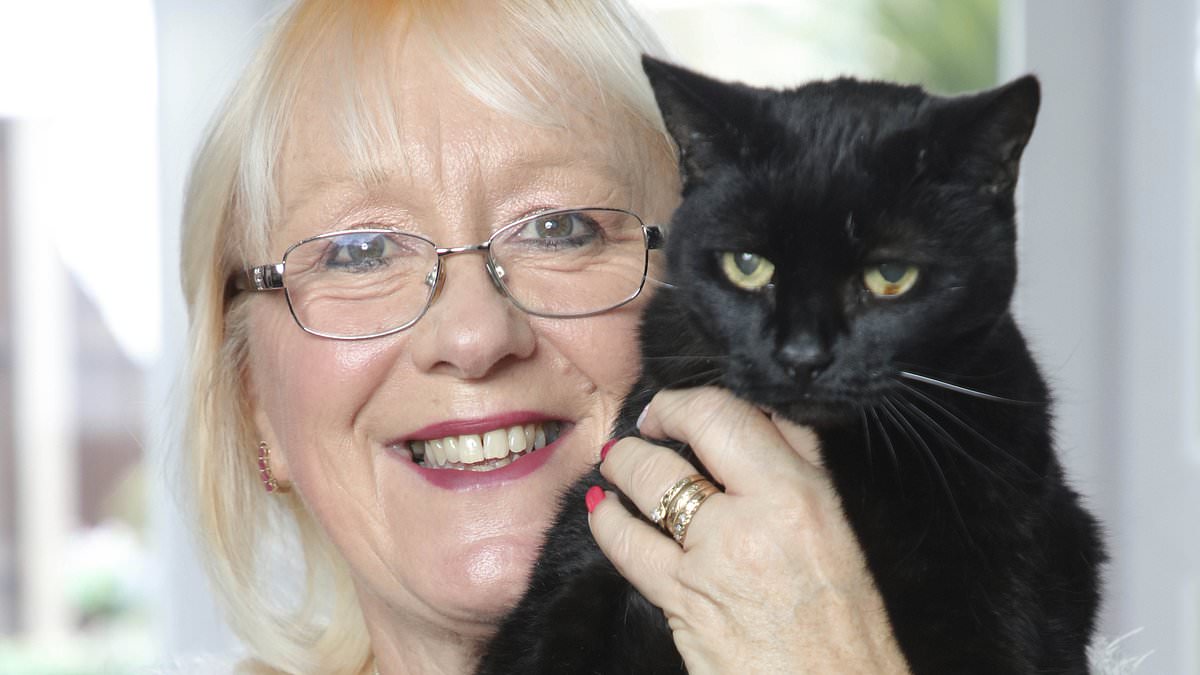
Sandra Riddle with Jeepster who both have arthritis in their hips
Sandra Riddle, 62, a veterinary receptionist, lives in Gosport, Hants. She says:
Three years ago, I noticed my cat Jeepster, now 17, was having difficulty jumping up on to the sofa. Before she’d have just leapt up but instead she was hesitant.
My daughter Lucy also noticed that Jeepster could only scale one stair at a time rather than dashing up as she used to.
After reading up on this at the vets where I work, and fearing Jeepster might be in pain, I made an appointment for her to be assessed. Back in 2015 my left hip became so painful that going up stairs and getting in and out of chairs became difficult.
Soon the pain was waking me up at night. Scans showed I had arthritis and needed a hip replacement, which I had in 2017. It was life-changing.
Scans of Jeepster showed she had arthritis in her hips, too. I felt so sorry for her as I knew just what it was like.
But whereas I’d had surgery, Jeepster was given liquid medication specifically for cats, Solensia, which helps with inflammation and pain.
Within a couple of weeks Jeepster was jumping up onto the sofa again and bounding up the stairs. The vet explained older cats are prone to arthritis, but the medication is highly effective. She continues to have this monthly and enjoys a good quality of life.
Earlier this year I had my other hip replaced, as painkillers did nothing to help. I was slightly envious that medication worked for Jeepster but not me. But at least we can both move around pain-free now.
My dog shares my sight problems

Mhairi Derby-Pitt and her West Highland terrier Bramble have peripheral vision problems
Mhairi Derby-Pitt, 45, a charity organiser and volunteer, lives in Berwick-upon-Tweed. She says:
Not long after I got Bramble, my West Highland terrier in May last year, I suspected he might have sight problems.
Bramble loved chasing things and bringing it back to you, but I noticed that if I wasn’t throwing it straight in front of him he couldn’t find it.
Strangely enough, back in 2023 I’d been bumping into things and injuring myself. I would even bump into displays in shops and knock things over.
An optometrist diagnosed a lack of peripheral vision, meaning I couldn’t see well out of the sides of my eyes.
Further tests revealed this was due to (functional neurological disorder – a problem with how the brain receives information.
Bramble was 11 weeks old when I took him to the vet, who confirmed he had peripheral vision problems just like me. He was unsure why – but Bramble was a rescue pup and had had a bad start in life.
Bramble’s diagnosis made me feel a bit sad at first, as I know how difficult it can make life.
But he’s such a comfort. There’s no real treatment: we both have to go on being clumsy and helping each other.
I bump into everything and Bramble does too. We go out for walks and stumble about – and Bramble can only see a ball if it comes straight at him.
We have turned out to be the perfect match.
Fermi and Livi too anxious to have a photo together

Norwegian Forest cat Fermi has anxiety
Livi Parkins, 48, a cat sitter, lives in Birkenhead with husband Ben, 47, an electronics engineer and their two children. She says:
When I’m at my most anxious, I seek out my cat Fermi. She won’t let me pet her, or even sit on my lap, but she’ll soothe me just by being in the same room. You see, I suffer from anxiety as she does.
We got her five years ago from a rescue centre. She’s a Norwegian Forest cat and had been used for breeding. When we first saw her she was hiding at the back of a pen. She was very shy, we were told, but we hoped this would pass. It didn’t. When we took her home the first thing she did was hide. She would just stand in her litter tray a lot – the vet said she’d probably always be an anxious cat.
Her anxiety mirrored my own life. Before I set up a pet setting business I worked in finance and was very stressed and would have panic attacks.
Now Fermi and I live together with our anxiety – she was too anxious to be photographed (she doesn’t like strangers). Sometimes we’ll sit in the same room, both alone but not alone, just enjoying each other’s calming company.