Share this @internewscast.com
An extensive investigation into ticks and the diseases they transmit in New York has uncovered a concerning rise in a lesser-known blood parasite.
For nearly a decade, scientists scoured the forest floors of Dutchess County, New York, anticipating the presence of Lyme disease among the black-legged tick population. However, they were taken aback when they discovered that another pathogen, often overlooked, might pose an even greater hazard.
This pathogen, Babesia microti, is a parasite that invades red blood cells, leading to babesiosis—a malaria-like illness that can be particularly dangerous or even deadly for the elderly and those with weakened immune systems. The newly published research indicates that this parasite is far more prevalent than previously understood.
From 2014 to 2022, researchers from the Cary Institute of Ecosystem Studies, in collaboration with SUNY Upstate Medical University, meticulously examined over 2,000 nymphal ticks. These ticks, at a stage most likely to bite humans, were screened for 16 different animal-borne pathogens.
While Borrelia burgdorferi, the bacteria responsible for Lyme disease, was consistently identified at every sample site and throughout each year of the study, Babesia microti emerged as the unexpected focus.
Throughout the study’s duration, Babesia microti was found in an average of 21 percent of the nymphal ticks, reaching a peak infection rate of 42 percent in 2015. This is a significant increase compared to the sub-10 percent infection rates noted in earlier research.
The findings align with rising cases of human babesiosis in the Northeast, where infection rates have increased by roughly nine percent annually between 2015 and 2022, suggesting the parasite is gaining ground even as public attention remains fixed on Lyme disease.
While many infected people never feel sick, others develop flu-like symptoms, such as fever, chills and muscle aches, one to eight weeks after a tick bite. In severe cases, babesiosis can trigger severe anemia, organ failure, respiratory distress and death, with mortality reaching 21 percent in vulnerable groups.

Over nine years trawling Dutchess County forest floors for black-legged ticks, scientists expected to find plenty of Lyme disease. Instead, they discovered another pathogen, Babesia microti, may be an even greater threat
What makes Babesia microti particularly concerning is its tendency to co-infect ticks alongside other pathogens.
The study, published in the journal Ecosphere, found that coinfection with Babesia microti and Borrelia burgdorferi occurred more often than would be expected by chance in seven of the nine study years.
This matters because previous research has shown that Lyme disease infection can help Babesia microti establish itself in tick populations.
‘Coinfection dynamics that facilitate Babesia microti host infection may explain the different prevalence profiles’ between the two pathogens, the researchers wrote, meaning that the two together can make people sicker than either would alone.
Researchers gathered over 2,000 young ticks called nymphs by dragging a cloth through the forest.
The nymphs were then taken to a lab and screened for 16 different animal pathogens using a highly sensitive RNA-based test. This allowed them to track which infectious agents were present and how common they were each year.
At the same time, researchers monitored the populations of white-footed mice and eastern chipmunks, the primary animals that infect ticks with diseases.
Using a method that involved marking them, releasing them and recapturing them, the researchers were able to estimate how many of those animals lived in each gridded area covered in the study.

Researchers collected more than 2,000 nymphal ticks by dragging cloths through the forest. In the lab, they screened each one for 16 different animal pathogens using a sensitive RNA-based test, allowing them to track which infectious agents were present each year and how common they were
When researchers trapped them, they also carefully counted the number of larval ticks feeding on each animal which told them how much contact was happening between ticks and their hosts.
They wanted to see if the number of mice and chipmunks, and how many ticks were feeding on them, could explain and predict the density of infected nymphs in the following year — the key measure of human disease risk.
They found that the number of larval ticks feeding on mice was the strongest predictor of how many infected nymphs would appear the following year.
When mouse populations surged, individual mice carried fewer ticks because the feeding demand was spread across more hosts.
Yet, paradoxically, high mouse abundance still predicted more infected nymphs the following year. More mice meant more larvae fed overall and those larvae matured into the ticks that eventually bite people.
When it came to predicting infection prevalence itself, or the percentage of nymphs carrying disease, chipmunks played an unexpectedly important role.
The probability that a nymph would be infected with Babesia microti was associated with how many larvae fed on chipmunks the previous year, especially when chipmunk populations were high.
Mice have long been considered the primary reservoir for these pathogens, but the research suggests that disease surveillance experts should widen their scope when looking for host animals.

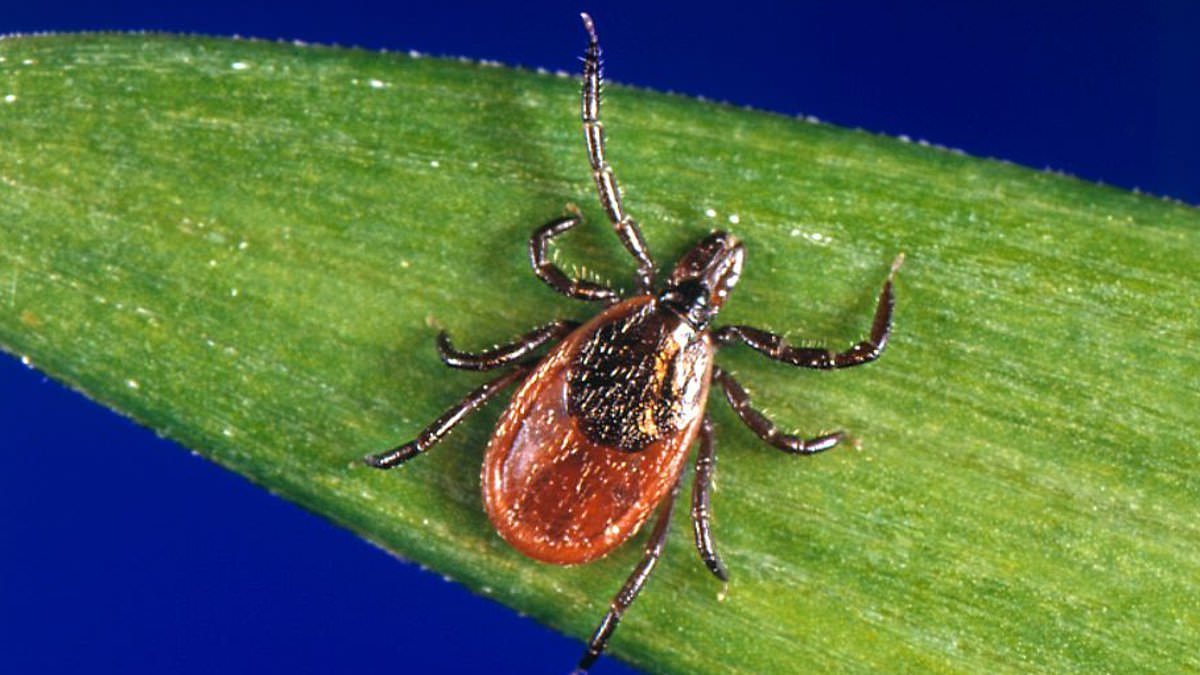
The black-legged tick is pictured. Researchers cautioned that tick-borne illness may be underestimated. Their models consistently underpredicted infection rates during peak years, meaning risk can spike higher than current data can explain

This panel shows how the percentage of infected nymphal ticks changed across the nine-year study for four key pathogens. Babesia microti stood out to researchers. It averaged 21 percent across the study, far exceeding previous regional estimates, and hit a dramatic peak of 42 percent in 2015
The study detected seven of the 16 pathogens screened for, including Powassan virus and two Rickettsia species not typically associated with blacklegged ticks.
Rickettsia rickettsii, which causes Rocky Mountain spotted fever, turned up in nine nymphs in 2016. Rickettsia parkeri was detected in 2021. Powassan virus, a rare but often severe infection, also appeared in one sample that year.
The researchers cautioned that the true scope of tick-borne illness may be underestimated.
Their models consistently underpredicted infection rates when prevalence was highest, meaning that when risk spikes, it tends to spike greater than current data can explain.
The study has important limitations, however. It was conducted entirely on one property in New York, so the findings may not apply to other regions.
The models consistently underestimated infection rates during peak years, meaning some ecological factors weren’t captured.
Climate data was not included, despite its known role in tick survival. Testing could not distinguish dangerous strains of one pathogen from harmless ones and the potential role of other animals, beyond mice and chipmunks, was not fully explored.