
Share this @internewscast.com
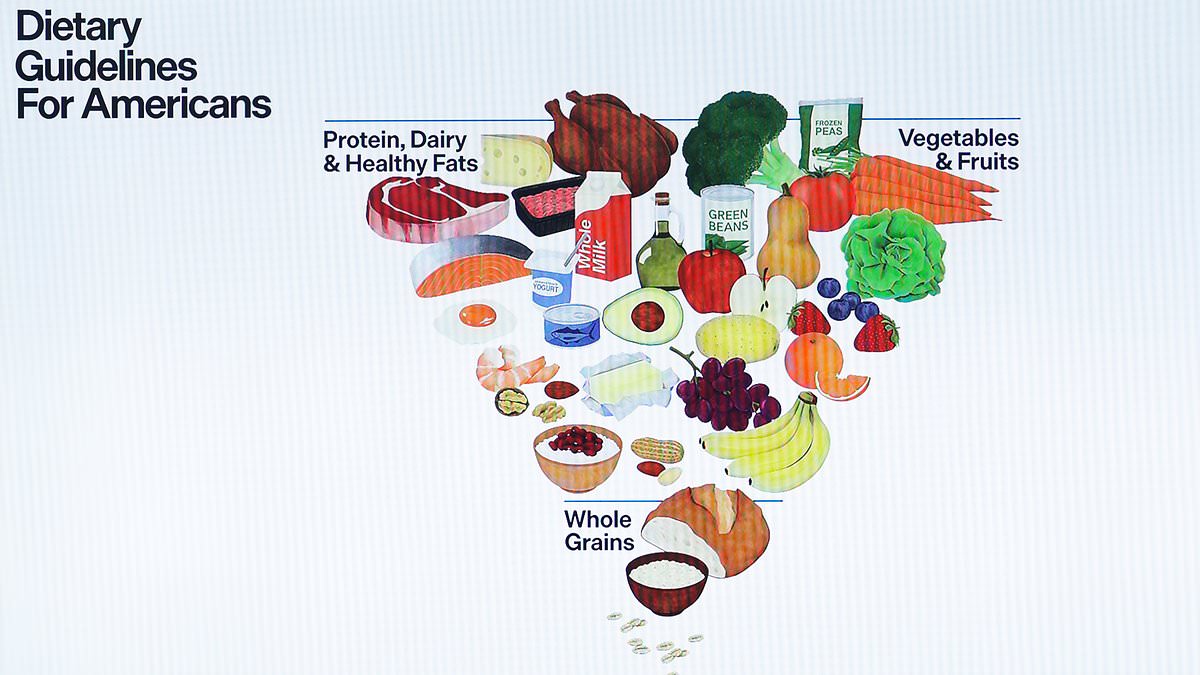
The Trump administration has introduced a significant shift in dietary guidelines, essentially inverting the traditional food pyramid to highlight the importance of protein, dairy, and fats while reducing the focus on whole grains and carbohydrates.
In this updated approach from the USDA, the emphasis is placed on consuming ‘real food,’ encouraging higher intake of protein, fruits, vegetables, and dairy products.
Notably, for the first time, the guidelines advise Americans to steer clear of highly processed and pre-packaged foods such as chips, cookies, and candies.
Refined carbohydrates, including items like white bread, along with sugar-laden beverages such as sodas, fruit juices, and energy drinks, are also discouraged.
This marks a distinct change from earlier guidelines, which permitted these foods within the constraints of daily nutrient and added sugar limits.
At a White House press conference yesterday, Health and Human Services Secretary Robert F. Kennedy Jr. introduced the guidelines, stating, “These guidelines bring us back to the essentials.”
‘American households must prioritize whole, nutrient-dense foods — protein, dairy, vegetables, fruits, healthy fats and whole grains — and dramatically reduce highly processed foods.’
He added: ‘This is how we Make America Healthy Again.’

Robert F Kennedy Jr in Wednesday’s press briefing, unveiling the new dietary guidelines
The American Medical Association was quick to back the guidelines, saying they ‘affirm that food is medicine and offer clear direction patients and physicians can use to improve health’.
But some slammed the advice. Dr Marion Nestle, a leading nutritionist at New York University, told STAT News: ‘These guidelines are about ideology, not science’, before adding they were ‘muddled, contradictory, ideological, retro’.
Below, Daily Mail reveals how to follow the new dietary guidelines:
Calorie counts
Previously, the dietary guidelines had recommended calorie targets based on activity level and age. For a moderately active woman aged 31 to 50 years old, they recommended 2,000 calories per day. For a moderately active man of the same age, they recommended 2,400 to 2,600 calories per day.
The new guidelines offer more personalized recommendations that people can calculate using their age, sex, height, weight and level of physical activity.
They also tell people to ‘pay attention to portion sizes’ and ensure they remain hydrated using still or sparkling water and unsweetened beverages.
The USDA has established a tool online that allows people to calculate the estimated number of calories they would need to consume per day to maintain their weight or to achieve a ‘healthy weight.’
Protein

Protein should come from a wide variety of sources, including animal sources such as eggs, poultry, seafood and red meat, according to the new guidelines
Americans are being urged to eat more protein and focus on a diet rich in ‘high-quality, nutrient-dense’ forms of the fuel.
Under the new dietary guidelines, adults are advised to consume about 0.5 to 0.7 grams of protein per pound of body weight per day, equivalent to about 119 grams per day for an average 199lb man and 102 grams per day for an average 171lb woman.
That protein should come from a wide variety of sources, including animal sources such as eggs, poultry, seafood and red meat, and plant sources, such as beans, peas, lentils, legumes and nuts.
The guidelines emphasized eating proteins in their whole, minimally processed form, prepared using methods such as baking, broiling, roasting, stir-frying or grilling, and flavored simply with salt, herbs and spices.
They are urged to avoid deep-fried foods. They are also urged to avoid foods that include added sugars, refined carbohydrates or starches.
Kennedy told CBS News in an interview: ‘What we’re stressing is that people should be eating protein.’
He added that protein and healthy fats were ‘wrongly discouraged in prior guidelines’, saying he was ‘ending the war on saturated fats’.
The HHS Secretary is a known fan of protein. His own daily diet reportedly includes a ribeye steak every evening and more than 100 grams of nuts.
Protein is an essential building block for cells and is vital for growth and repair processes in the body.
However, people need to take caution when consuming protein from certain sources, which can contain saturated fats.
Doctors warn that consuming too many saturated fats found in meats can cause cholesterol to build up in the arteries, raising the risk of heart disease and stroke.
Dr Jonathan Reiner, a cardiologist in Washington DC, warned on X: ‘If you have heart disease the new dietary recommendations that highlight red meat, cheese and whole milk are not right for you.’
Dairy

Americans are also been urged to consume more dairy (stock image of cheese)
The new guidelines also urge Americans to make dairy a larger part of their diet.
People are told to consume three servings of dairy per day, such as cheese, milk and yogurt, as part of a 2,000-calorie diet, and it should be full-fat dairy.
Full-fat dairy boosts gut health, can help someone feel full for longer and can be part of a diet that supports a healthy weight.
Low-fat and no-fat dairy products have been popular for their perceived greater health benefits.
With fewer calories and fat, they can aid in weight loss and lowering cholesterol levels.
However, some experts warn that they do not deliver all the benefits of their full-fat counterparts.
Vegetables and fruits:

The above shows the old food pyramid that was first recommended in 1992
In the previous guidelines, Americans were recommended to eat 1.5 to two cups of fruit and two to three cups of vegetables daily.
In the new guidelines, people are told to eat two fruits and three vegetables every day.
Officials said these should be in their original form and thoroughly washed prior to being eaten raw or cooked. Frozen, dried or canned vegetables with no or limited added sugar may also be a good option, they said.
Americans were encouraged to eat a ‘colorful, nutrient-dense’ range of fruits and vegetables to achieve a balanced diet.
Fruits and vegetables on the list included broccoli, peas, tomatoes, apples, avocados, squashes, oranges, blueberries, grapes and bananas.
Fruits and vegetables are essential to the diet for their high nutrient and fiber content, helping to avoid vitamin deficiencies and move food through the gut. They can also be an excellent source of energy.
Healthy fats

The new guidelines read: ‘When cooking with or adding fats to meals, prioritize oils with essential fatty acids, such as olive oil’
Americans are also being encouraged to consume more healthy fats, or unsaturated fats, found from plant sources and fatty fish.
The guidelines read: ‘When cooking with or adding fats to meals, prioritize oils with essential fatty acids, such as olive oil. Other options can include butter or beef tallow.’
Unsaturated fats are better for health because studies show they can help boost levels of good cholesterol and lower those of bad cholesterol, lowering someone’s risk of heart disease, stroke and death.
Unsaturated fats also have a weaker chemical structure, meaning the body finds it easier to break them down, compared to the saturated fats alternatives.
The guidelines add: ‘In general, saturated fat consumption should not exceed 10 percent of total daily calories.
‘Significantly limiting highly processed foods will help meet this goal. More high-quality research is needed to determine which types of dietary fats best support long-term health.’
Whole grains

Americans have been urged to focus on whole-grains over the alternatives
Whole grains were also included in the Trump diet guidelines, but Americans were told these should make up a smaller part of their diet.
People were told to consume two to four servings of whole grains per day and to prioritize ‘fiber-rich’ versions.
For comparison, in the previous guidelines, people were urged to eat whole grains for at least half of all grains consumed. There was no recommendation on how often to eat them per day.
Whole grains highlighted by the new guidelines include whole grain bread, oats and porridge.
Americans are also advised to avoid highly processed, refined carbohydrates, such as white bread, ready-to-eat or packaged breakfast cereals, flour tortillas and crackers.
Whole grains can also be an excellent source of vitamins, minerals and fiber, boosting heart health, digestion and weight management.
Highly processed foods, added sugars and refined carbohydrates
These were not featured on the food pyramid at all, with officials urging Americans to avoid or severely limit their consumption of these foods.
A processed food is any food that has been altered from its natural state and contains added ingredients that would not normally be found in the kitchen.
The guidelines read: ‘Avoid highly processed packaged, prepared, ready-to-eat, or other foods that are salty or sweet, such as chips, cookies, and candy that have added sugars and sodium (salt).
‘Limit foods and beverages that include artificial flavors, petroleum-based dyes, artificial preservatives and low-calorie non-nutritive sweeteners.
‘Avoid sugar-sweetened beverages such as sodas, fruit drinks and energy drinks.’
They continue: ‘While no amount of added sugars or non-nutritive sweeteners is recommended or considered part of a healthy or nutritious diet, one meal should contain no more than 10 grams of added sugars.’