
A Daily Mail interactive map has identified the US counties at the center of the country’s widening measles outbreak.
Official figures show that 46 of the 50 states have reported measles cases this year. Infections have been recorded in 337 of the nation’s roughly 3,100 counties—more than one in 10.
More than 5,700 measles cases have been reported nationwide by local health departments, marking the highest annual total in 35 years and more than twice the 2,200 cases recorded last year.
The outbreak is still accelerating, with approximately 200 new infections reported each week since the end of August.
Local health officials have connected 11 deaths to measles this year: eight in Pennsylvania, two in Wisconsin and one in New York. It is the highest nationwide death toll from the virus in at least 35 years. Three measles-related deaths were reported in 2025.
The most recent death was reported just one day after the US officially lost its measles elimination status, a designation it had held for 26 years.
International health authorities announced the decision Tuesday after determining that measles had continued spreading in the US for more than a year. A country cannot retain elimination status when transmission persists for longer than 12 months.
US health officials attributed the loss in part to declining uptake of the measles, mumps and rubella (MMR) vaccine, a trend they said began years before the second Trump administration.
Health and Human Services Secretary Robert F Kennedy Jr, formerly a vocal vaccine critic, has also encouraged Americans to get vaccinated. In a post on X, he wrote: ‘I continue to recommend MMR vaccination as the most effective way to prevent measles.’
Public health leaders described the loss of elimination status as both ‘tragic’ and ‘a stain’ on the country’s reputation.
Speaking Wednesday, Louisiana Republican Senator Bill Cassidy, who has been outspoken about the measles crisis, called on the Trump administration to declare ‘from the mountaintop, the vaccine is safe.’
He added: ‘It does not cause autism. Please be vaccinated. It protects yourself. It protects other people. They should say that over and over and over again.’
The MMR vaccine prevents measles and is 97 percent effective after two doses. Health authorities say it is safe and overwhelmingly recommend vaccination as the strongest protection against infection.
Among the measles cases reported by local US health departments, 97 percent involved people who had not received the MMR vaccine.
Thirty-one percent of patients were between five and 17 years old, while 29 percent were adults. Age information was unavailable for another 27 percent of cases.
Spartanburg County in northwestern South Carolina has reported the most measles cases in the country, with 610 infections.

Cold-like symptoms, including fever, coughing and a runny or blocked nose, are often the first signs of measles
South Carolina faced a major measles outbreak during the first four months of the year, but health officials declared it over in April. They credited increased MMR vaccination with helping bring transmission under control.
Lancaster County, roughly a 1.5-hour drive west of Philadelphia, recorded the second-highest number of cases, with 528 infections. Mifflin County in central Pennsylvania ranked third, reporting 205 cases.
Pennsylvania is now dealing with a significant measles outbreak, with many cases concentrated in Amish and Mennonite communities.
Neither religion prohibits vaccination in its scriptures, although the communities have historically recorded lower vaccination rates.
Of the nine other counties reporting more than 100 measles cases this year, three are in Utah, two are in Wisconsin, and one each is located in Minnesota, Pennsylvania, Texas and Virginia.
Only four states—Arkansas, Hawaii, Mississippi and Nevada—have not reported a measles infection so far this year.
Measles ranks among the most contagious diseases known to science. Without vaccination, nine out of 10 people exposed to the virus are expected to become infected.
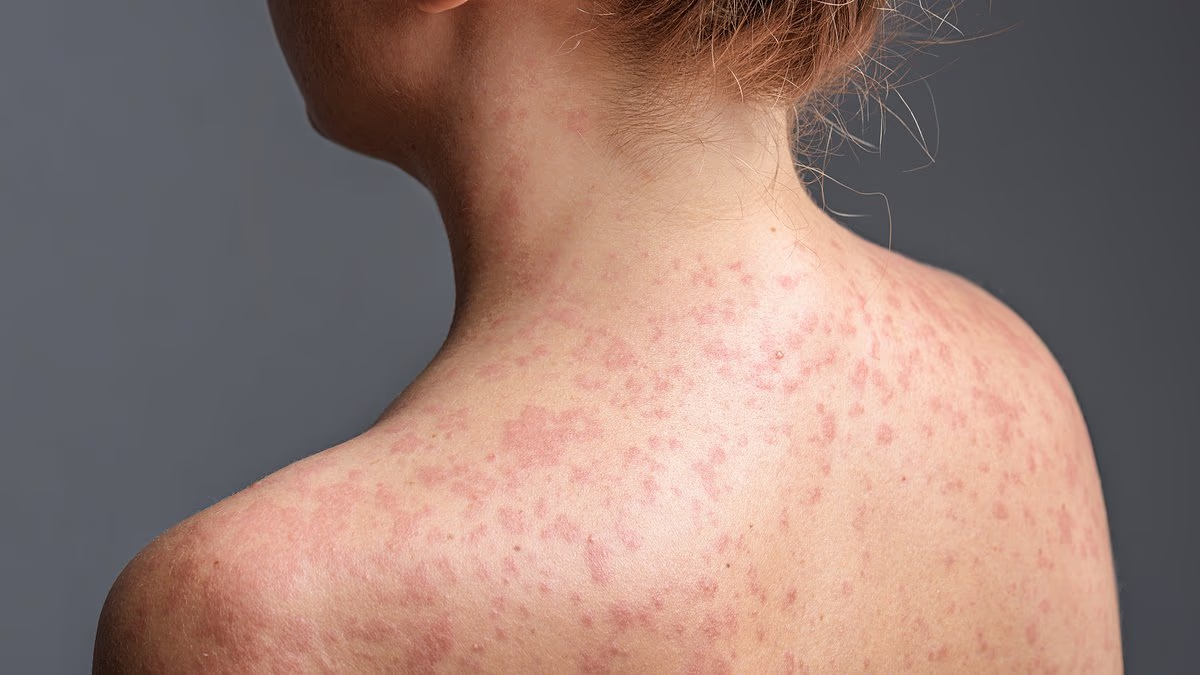
The illness commonly begins with a cough and fever, followed by a distinctive bright-red rash that usually appears on the face before spreading across the body.

The US has lost its measles elimination status after retaining it for more than 25 years. The image shows a measles rash on a woman
Children younger than five and people with weakened immune systems face the greatest risk of serious illness.
The Centers for Disease Control and Prevention says about one in five unvaccinated people who contract measles require hospitalization. Among children who become infected, one in 20 develops pneumonia, a potentially life-threatening lung infection.
About one in every 1,000 children with measles develops encephalitis, or brain swelling. The complication can trigger seizures and may result in deafness or intellectual disability.
Between one and three children per 1,000 infected with measles die from respiratory or neurological complications.
Doctors say vaccination remains the best defense against measles.
The MMR vaccine is typically given first between 12 and 15 months of age, followed by a second dose between ages four and six. According to the CDC, two doses are about 97 percent effective at preventing measles.
Before MMR vaccines became available in the 1960s, measles epidemics caused as many as 2.6 million deaths worldwide each year. By 2023, the annual death toll had fallen to approximately 107,000.
Across the US, 92.4 percent of kindergarten students are fully vaccinated against measles—below the CDC’s 95 percent threshold for community or herd immunity. Pennsylvania’s MMR vaccination rate is 94.6 percent, compared with 97.7 percent in New York.
Vaccine exemptions have also increased, reaching 4.2 percent compared with 1.6 percent just over a decade ago.


