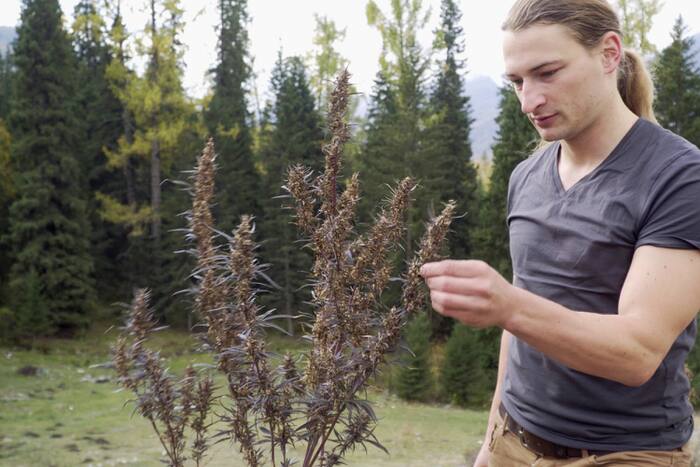


GENEVA – Cannabis may have been used to produce a high much earlier than historians previously believed — possibly as far back as 2,800 years ago, according to a new study.
Archaeologists excavating a monumental burial site in Siberia say they found what may be the earliest evidence yet of cannabis being used for its psychoactive effects.
The discovery suggests cannabis may have been consumed at least 300 years before similar evidence was documented in neighboring China.
The history of ancient drug use has fascinated researchers for generations. Greek historian Herodotus described Central Asian people inhaling cannabis around 440 B.C., while archaeologists in recent years have uncovered cannabis seeds in burial sites throughout the region’s mountainous areas.
Researchers from Germany, Russia, Sweden and Switzerland said hair recovered from the royal tomb, alongside the cannabis seeds, offers fresh insight into the plant’s place in ancient cultures.
“It’s extremely rare that we have both preserved plant parts and human soft tissue with the active compounds in it in the same context,” said study co-author Gino Caspari, an archaeologist at the University of Bern.
However, the evidence does not reveal whether the cannabis was inhaled or eaten, Caspari said.
The excavation began in 2017 at a large burial mound at the Tunnug 1 site in southern Siberia’s Uyuk Valley. The area contains one of the earliest monumental tombs associated with the Scythians, ancient nomadic peoples who moved from Central Asia into parts of southern Russia and Ukraine.
The research team worked for months in tents at a site described as being “essentially out in the middle of nowhere.” Their field season, which ran from spring through autumn, brought flooded marshes, snowstorms, freezing temperatures and clouds of mosquitoes. Wild horses moved across the surrounding grasslands.
Among the larger discoveries were burial weapons, horse equipment and animal-themed artwork. But the researchers said they were especially surprised to find tiny black fragments that proved to be cannabis seeds, along with preserved human hair.
“It’s only so often as an archaeologist that you do get to drug test a person that’s been dead for almost 3,000 years,” Caspari said.
Radiocarbon tests on some of the more than 1,000 seeds helped date the material. The seeds were deliberately placed inside the tomb rather than arriving there by chance, Caspari said, indicating that cannabis held importance for the people who created the burial site.
The study was published Thursday in the journal Science.
Still, some outside experts remain unconvinced by the conclusions.
Volker Auwaerter, head of forensic toxicology at the University Medical Center in Freiburg, Germany, said in an email that the hair analysis was “scientifically weak” and did not provide enough evidence to establish cannabis use.
“For a central part of the study, the article falls far short of what would have been possible,” said Auwaerter, who was not involved in the research. “This matters because the hair data carry the abstract’s main claims (cannabis consumption and use for its psychoactive properties).”
Modern researchers generally do not accept ancient written accounts without supporting physical evidence. Cannabis also had practical uses: its seeds could be pressed for oil, while its fibers could be turned into fabric. As a result, finding seeds alone does not prove the plant was used as a drug.
Auwaerter said the study’s findings could not rule out the possibility that the hair was exposed to cannabis from the surrounding burial environment rather than through consumption. He added that a forensic toxicology analysis conducted by a specialist laboratory would have been both appropriate and relatively easy to arrange.
___
Jenne reported from Vienna, Austria.


