
Share this @internewscast.com

As the Artemis II mission advances past the halfway point to the moon, Canada’s pride swells in recognition of their astronaut’s involvement in this unprecedented journey. On Saturday, the nation celebrated the crew’s upcoming historic lunar fly-around, a venture that will take them further into the depths of space than the famed Apollo astronauts ever ventured.
The crew, consisting of three Americans and one Canadian, is set to arrive at their celestial destination on Monday. During their mission, they will capture images of the moon’s enigmatic far side as they circle around it. This marks the first time a human crew is headed moonward in over 53 years, continuing the legacy left by NASA’s Apollo program.
Artemis II is on track to break a new record for the farthest distance humans have traveled from Earth, reaching over 252,000 miles (400,000 kilometers). This endeavor will surpass the previous record set by Apollo 13, as the spacecraft performs a dramatic U-turn behind the moon to return to Earth, without making a stop or entering lunar orbit.
From Quebec, the Canadian Space Agency expressed their enthusiasm for the mission and their astronaut Jeremy Hansen’s participation as he embarks on this lunar voyage. Hansen is making history as the first non-U.S. citizen to travel to the moon, a source of national pride and inspiration.
“Today, he is making history for Canada,” declared Lisa Campbell, President of the Canadian Space Agency. “As we witness him take this courageous leap into the unknown, let his journey serve as a reminder that Canada’s future is shaped by those who dare to dream bigger.”
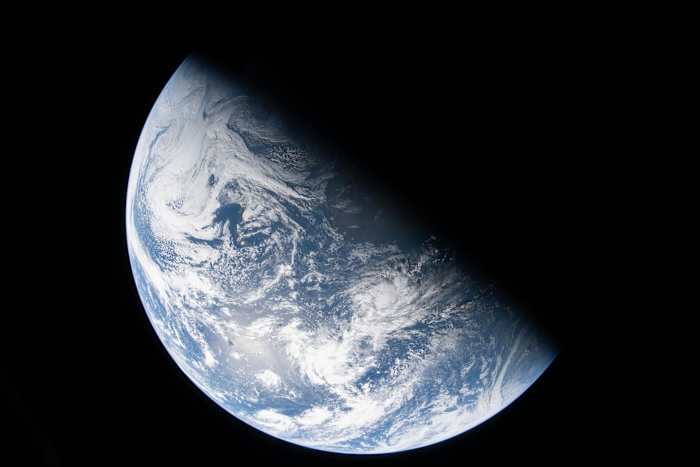
During a live broadcast linkup, Hansen shared his excitement, speaking of the “extraordinary” views he’s already experienced from NASA’s Orion capsule.
Hansen, Reid Wiseman, Victor Glover and Christina Koch are the world’s first lunar astronauts since Apollo 17’s crew of three in 1972. Koch and Glover are the first female and first Black astronauts to the moon, respectively.
Their nearly 10-day mission — ending with a Pacific splashdown on April 10 — is the first step in NASA’s bold plans for a sustainable moon base. The space agency is aiming for a moon landing by two astronauts near the lunar south pole in 2028.
___
The Associated Press Health and Science Department receives support from the Howard Hughes Medical Institute’s Department of Science Education and the Robert Wood Johnson Foundation. The AP is solely responsible for all content.
Copyright 2026 The Associated Press. All rights reserved. This material may not be published, broadcast, rewritten or redistributed without permission.