
Share this @internewscast.com

A chilling wave of arctic air is surging southward from Canada, making its presence felt in the northern United States. Meanwhile, the Pacific Northwest is on high alert for potential mudslides and levee breaches as floodwaters promise to linger.
In the wake of devastating floods, thousands have been compelled to evacuate. Among them are Eddie Wicks and his wife, who reside on a picturesque farm in Washington state, adorned with sunflowers and Christmas trees, near the Snoqualmie River. As they relocated their animals—two donkeys to safer elevations and eight goats to an outdoor kitchen—the water levels rose with unprecedented swiftness.
By Thursday afternoon, the floodwaters had completely surrounded their home. Fortunately, deputies from the King County Sheriff’s Office marine rescue dive unit intervened, rescuing the couple and their dog. They were ferried across their now lake-like field, a half-mile journey (approximately 800 meters) by boat.
Major cities such as Chicago and Minneapolis are preparing for the oncoming arctic chill.
As the Pacific Northwest grapples with the aftermath of flooding, a different weather front is ushering in perilously low wind chill values to areas of the Upper Midwest.
By midday on Saturday, Grand Forks, North Dakota, recorded temperatures of minus 12 degrees Fahrenheit (minus 24 degrees Celsius). The wind chill, however, made it feel like a bone-chilling minus 33 F (minus 36 C), according to the National Weather Service.
For big cities like Minneapolis and Chicago, the coldest temperatures were expected late Saturday night into Sunday morning. In the Minneapolis area, low temperatures were expected to drop to around minus 15 F (minus 26 C), by early Sunday morning. Lows in the Chicago area are projected to be around 1 F(minus 17 C) by early Sunday, the weather service said.
The Arctic air mass was expected to continue pushing south and east over the weekend, expanding into Southern states by Sunday.
The National Weather Service on Saturday issued cold weather advisories that stretched as far south as the Alabama state capital city of Montgomery, where temperatures late Sunday night into Monday morning were expected to plummet to around 22 F (minus 6 C). To the east, lows in Savannah, Georgia, were expected to drop to around 24 F (minus 4 C) during the same time period.
Danger of mudslides, levee failures continues in Pacific Northwest
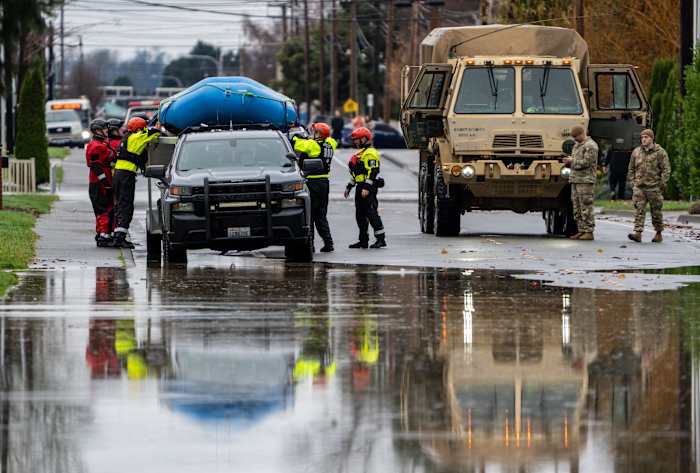
The cold weather freezing much of the country comes as residents in the Pacific Northwest endure more misery after several days of flooding. Thousands of people have been forced to evacuate towns in the region as an unusually strong atmospheric river dumped a foot (30 centimeters) or more of rain in parts of western and central Washington over several days and swelled rivers, inundating communities and prompting dramatic rescues from rooftops and vehicles.
The record floodwaters were expected to continue to slowly recede Saturday, but authorities warn that waters will remain high for days, and that there is still danger from potential levee failures or mudslides. There is also the threat of more rain forecast for Sunday. Officials have conducted dozens of water rescues as debris and mudslides have closed highways and raging torrents have washed out roads and bridges.
Copyright 2025 The Associated Press. All rights reserved. This material may not be published, broadcast, rewritten or redistributed without permission.