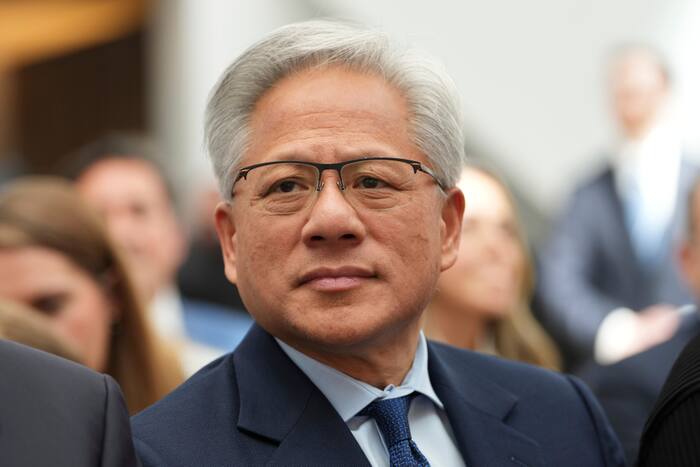

BANGKOK – China on Monday rejected allegations of an attempted spy plot involving Nvidia CEO Jensen Huang, calling the claims unsubstantiated and part of a smear campaign against Beijing.
Huang told Nvidia’s board that he had been intimate with a business executive whom U.S. intelligence agencies determined was collecting information for Beijing, The New York Times reported.
“The so-called Chinese spy allegation is unsubstantiated. It is nothing but smears against China,” Chinese Foreign Ministry spokesperson Guo Jiakun said Monday.
The Nvidia chief is at the center of a controversy over whether he helped advance sales of sophisticated computer chips to China despite U.S. technology restrictions designed to limit Beijing’s access to cutting-edge systems. Nvidia is one of the world’s most valuable publicly traded companies, alongside Apple and Microsoft.
Nvidia said Sunday that it would investigate the matter. Huang has not identified the person involved in the extramarital relationship.
China had previously denied a New York Times report alleging that Huang formed a close relationship with a Chinese citizen named Alice Huang. She ran a company that faced accusations of smuggling advanced chips into China and was described in the report as a spy for Beijing.
“The key questions are whether he was aware of any espionage activities and whether any confidential or strategically sensitive information was compromised,” said George Chen, a partner and chair of digital practice at The Asia Group, a Washington-based consultancy.
“Those questions require evidence rather than speculation,” he added in written comments.
Huang has pressed in recent years for looser restrictions on chip sales to China. He successfully lobbied U.S. President Donald Trump to permit Nvidia to sell its H200 chips this year, although it remains unclear whether Beijing would allow Chinese companies to purchase the chips in large quantities.
The H200 is not Nvidia’s most advanced model, but it remains a sophisticated chip. Huang had earlier persuaded Trump to allow sales of the less-powerful H20, which Nvidia designed for the Chinese market to comply with U.S. export controls.
Chinese media have largely emphasized Huang’s admission of the affair, while state media outlets have mostly repeated the government’s position. Some commentators said the New York Times report was intended to destabilize relations between the United States and China.
“Whenever China-US relations begin to improve, there are often those firing shots from the shadows,” the state-owned Global Times said.
___
Associated Press business writer Chan Ho-him in Hong Kong contributed to this report.


