

KOROR – China issued a warning of “consequences” for Taiwan after representatives from Beijing and Taipei took part in a ceremonial event at a Pacific leaders summit, a gathering already marked by calls for major powers to avoid turning a forum of mostly small island nations into a stage for geopolitical rivalry.
The Pacific Islands Forum opened its annual summit Monday in Koror, Palau’s largest city, bringing together 18 member states and territories. China, the United States and Taiwan are not members, but competition for influence across the region’s vast and resource-rich ocean areas, as well as its strategically important locations, once again threatened to dominate the agenda.
Diplomatic tension had been widely anticipated at this year’s summit. Palau, a western Pacific island nation near the Philippines with close ties to the United States, is one of just 11 countries, along with the Vatican, that maintain formal diplomatic relations with Taiwan. Beijing claims Taiwan as part of China.
A number of Pacific leaders were absent from this year’s meeting. Some had announced in advance that they would not attend because of health issues or domestic political matters, while analysts suggested other absences could reflect pressure from Beijing.
China and Taiwan envoys exchange criticism
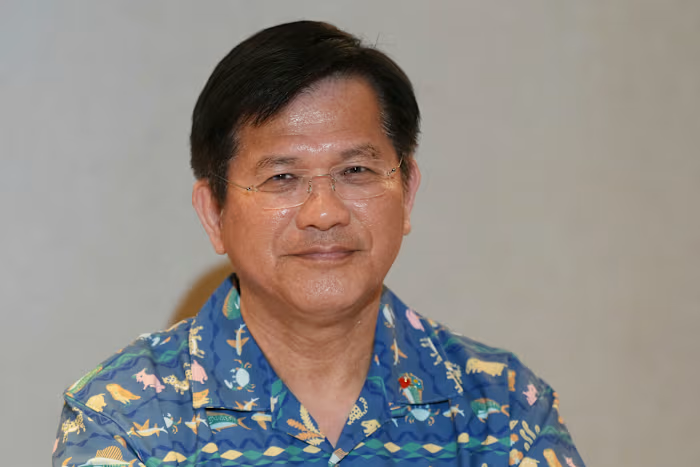
Before the summit began, Palau President Surangel Whipps Jr. hosted joint events with Taiwan’s representative, Foreign Minister Lin Chia-lung. At the opening ceremony, envoys from Beijing and Taipei were seated in the same row, though in separate sections.
Speaking to reporters in Koror after the ceremony, China’s Pacific envoy, Qian Bo, said the attendance of Taiwanese officials was “very inappropriate.” When asked whether Taiwan would face consequences, Qian replied that there would “always be consequences.”
Qian denied that his comments amounted to a threat and did not elaborate. China has for years used diplomatic pressure to push for Taiwan’s exclusion from international summits and forums.
Chinese Foreign Ministry spokesperson Guo Jiakun claimed Taiwan is not a dialogue partner or development partner of the forum and therefore is in no position to participate in the event’s activities.
Lin on Tuesday rejected the suggestion that his participation was illegitimate, accusing Beijing of dividing the region and “blaming the problems” on others.
“If we go to a party, we always follow the directions of the host,” Lin said in Koror. “However, whenever China goes to a party, it makes itself as if it’s the host and China ruins the whole atmosphere of the party.”
Summit’s host urged major powers not to interfere
China’s criticism came at the end of an event where Palau’s president urged the major powers present at the forum to leave the summit’s workings to member states.
“Our partners are welcome to sail with us but they do not choose our destination,” Whipps said in a speech. “The Pacific agenda must be driven by us and for us.”
Powerful nations interested in the Pacific have raced in recent years to shore up alliances among its leaders, intensifying a contest for influence between China and the U.S., Taiwan and forum members Australia and New Zealand. That has led to an explosion in interest in the annual Pacific leaders meeting, which has grown from a casual affair to a summit with 2,000 attendees.
Non-member countries invited to attend are called partners, with China holding so-called dialogue partner status and Taiwan registered as a development partner. Taiwan’s attendance at summits has provoked China’s ire before, with the issue resulting in partner countries being barred from attending last year’s meeting in Solomon Islands.
Divisions are echoed among members
Ahead of each summit, Pacific leaders often try to focus attention on the matters they say are most pressing to them. These include the effects of climate change on the region and the struggles related to he COVID-19 pandemic and the start of the Iran war that have befallen their national economies, with many of them reliant on foreign aid, tourism and increasingly expensive imported gasoline.
However, as conflicting major powers over the past decade have escalated their efforts to secure access to Pacific waters and ports by inking security deals and offering funding, immigration access to their countries and other sweeteners, the leaders’ ability to speak with one voice at the annual summit has come under pressure.
In a recent episode, the forum’s foreign ministers failed to reach consensus on a statement criticizing Beijing’s launch of a ballistic missile into the South Pacific Ocean in July. While most member states strongly opposed China’s actions, the refusal of two to endorse a proposed statement meant none was issued.
Some analysts say the absence of certain major politicians from the summit could be another example, although those present have downplayed suggestions that the representation of some states by senior officials instead of national leaders would undermine discussions.