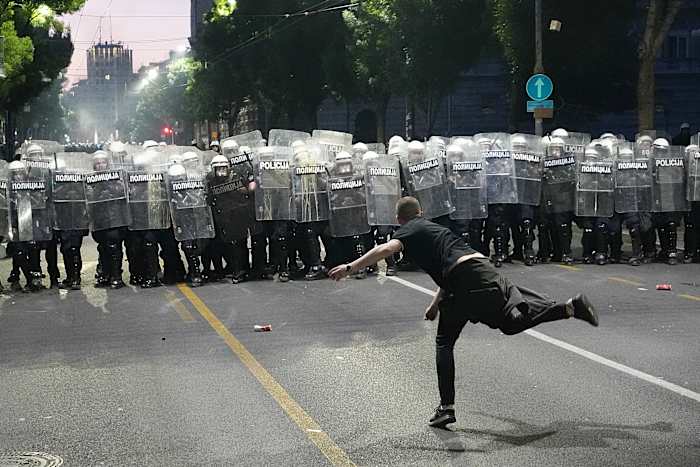

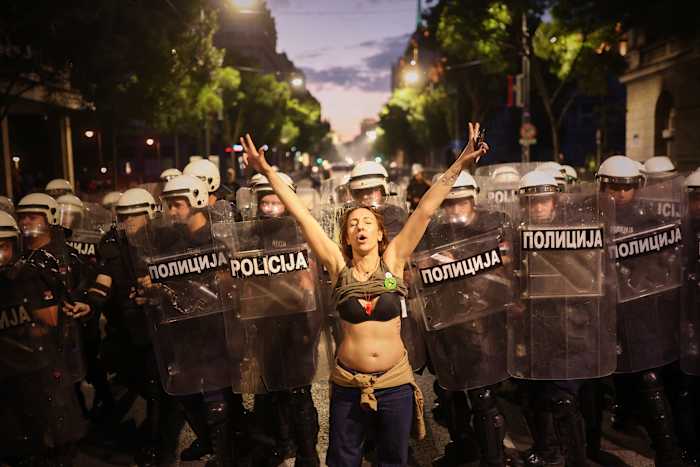
BELGRADE – Tensions flared in the heart of Serbia’s capital as protesters clashed with riot police following a massive anti-government demonstration on Saturday. The rally, which drew tens of thousands, was aimed at opposing the autocratic leadership of President Aleksandar Vucic.
Initially peaceful, the gathering in central Belgrade took a violent turn when youthful factions of demonstrators began throwing flares, rocks, and bottles at police barricades. In response, authorities used pepper spray, advancing to break up the crowds.
Some protesters, including known soccer hooligans, used trash cans as barricades against the advancing police, who attempted to encircle them. To prevent further unrest, anti-riot vehicles were strategically positioned in central Belgrade to deter the demonstrators from regrouping.
Earlier that day, throngs of protesters converged on the city, many brandishing banners and donning T-shirts emblazoned with the slogan “Students win.” Car convoys from various Serbian towns joined the influx into the capital.
Facing growing unrest, President Vucic has been working to quell these widespread demonstrations that challenge his stringent governance of the Balkan nation.
These extensive anti-corruption protests have roots in a tragic train station incident in northern Serbia in November 2024, which claimed 16 lives. The public outcry led to the resignation of then-Prime Minister Milos Vucevic, as the government subsequently cracked down on dissenters.
The students on Saturday demanded an early parliamentary election and the rule of law, accusing the government of crime and corruption.
Prosecutor Bojana Savovic told the crowd that “a state where laws are not implemented or are implemented selectively is no longer a state, it becomes a mafia organization.”
Parliament speaker Ana Brnabic downplayed the student rally, saying “it offered nothing new.” Brnabic cited a police estimate that 34,300 people came to the rally and said “democracy is flourishing.”
Clashes first erupted in the vicinity of a park camp of Vucic’s loyalists outside the Serbian presidency building that he set up ahead of another big anti-government rally last March as a human shield against protesters. Folk music blared from a fenced area surrounded by rows of riot police in full gear.
Serbia’s state railway company on Saturday canceled all trains to and from Belgrade, in an apparent bid to stop at least some people from coming from other parts of the country.
The Serbian president has faced international scrutiny for his hard-line tactics against the demonstrators. The Council of Europe Commissioner for Human Rights, Michael O’Flaherty, criticized Serbia’s government in a report this week and said he “will monitor the situation closely” on Saturday.
O’Flaherty cited “reports of police protecting unidentified and often masked attackers of journalists and protesters.” He said the overall rights situation has deteriorated since his previous visit in April 2025.
Serbia is formally seeking European Union entry but it has nourished close ties with Russia and China. The democratic backsliding under Vucic could cost the country around 1.5 billion euros ($1.8 billion) in European Union funding, the EU’s top enlargement official warned last month.
The venue on Saturday was Belgrade’s Slavija Square, the scene of a huge anti-government protest in March 2025. That rally ended in sudden disruption that experts later said — and the government denied — involved the use of a sonic weapon against peaceful demonstrators.
The youth movement’s quest for justice and rule of law has resonated widely among Serbia’s citizens, who are disillusioned with established politicians after decades of perpetual crisis.
Students now say they plan to challenge Vucic at the approaching elections that they hope will oust the right-wing populist government. Vucic said this week that the ballot could be held between September and November this year.
Vucic, government officials and the pro-government media have branded critics as foreign agents who wish to destroy the country — rhetoric that has ramped up political polarization.
Protester Maja Milas Markovic said students “managed to gather us here with their youth and wonderful energy; I really believe that we have right to live normally.”
___
Associated Press writer Dusan Stojanovic in Belgrade, Serbia, contributed to this report.


