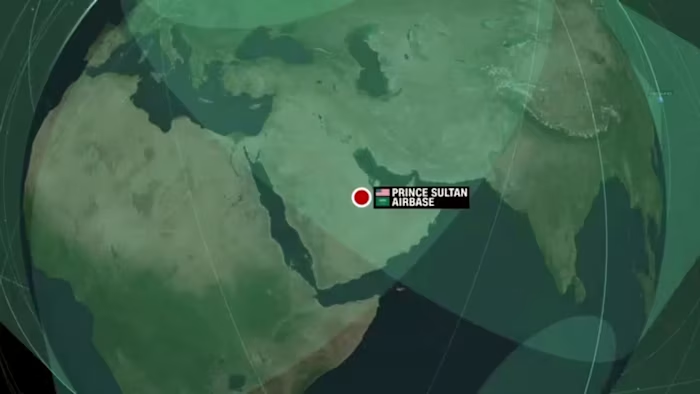


CNN – Fourteen Russian reconnaissance satellites passed over a U.S. military installation in Saudi Arabia just two days before Iran launched a devastating attack, according to a CNN investigation. U.S. officials and international intelligence sources said the satellites’ timing and coordinated coverage may have given Iran access to extensive battlefield data, helping it carry out some of its most accurate strikes against American forces.
The suspected link between Russian space-based surveillance and Iranian missile operations centered on Prince Sultan Air Base, located near Riyadh and home to a longstanding U.S. military presence.
The March 27 attack
Iran attacked the base on March 27, injuring 12 U.S. personnel and causing extensive damage across the facility. Iranian state media later published images purporting to show the destruction.
Two U.S. officials and several international intelligence sources told CNN they had evidence that Russian satellites supplied Iran with targeting information, supporting at least some of the precision attacks. The sources said the extent of the destruction and the accuracy of the strikes would have been extremely difficult to achieve without Russian geospatial intelligence.
What the satellites collected
To examine the satellites’ movements and their potential view of the base, CNN reviewed orbital data with assistance from space technology specialists at Project Aurora and Kayhan Space.
The review identified 14 Russian spy satellites, including Cosmos 2573, one of Moscow’s most advanced intelligence-collection spacecraft, passing over Prince Sultan Air Base in a pattern that could gather multiple forms of military information. CNN’s analysis found that the satellites’ order and positioning provided what experts described as broad, high-value, multisource intelligence coverage.
The spacecraft appeared to perform different surveillance roles:
Cosmos 2573 gathered highly detailed, military-grade imagery of the area
Eight signal-collection satellites monitored radio and radar transmissions, potentially revealing the positions of air defense systems
Two infrared satellites tracked heat sources, including the signatures of rocket launchers
Three synthetic aperture radar (SAR) satellites observed the ground through clouds and during darkness, detecting physical changes such as the movement of mobile equipment
One of the assets identified in the analysis was an Airborne Warning and Control System aircraft, or AWAC. Valued at hundreds of millions of dollars, the aircraft serves as a crucial airborne surveillance platform for U.S. operations in the Middle East. It had been moved from its prewar position before the March 27 assault. Iran destroyed the aircraft in the attack.
‘Russian payback with interest’
CNN’s Tamara Qiblawi reported that the strike was likely part of a broader pattern. Sources generally believe Russian satellites supplied Iran with targeting data on several other occasions during the conflict, including during an attack on a CIA facility in the Saudi capital.
Qiblawi reported that U.S. officials remain divided over the precise impact of Moscow’s assistance and how much it influenced the conflict’s outcome.
Dr. Nawaf Obaid, a senior fellow at King’s College, offered a more sweeping assessment, saying Russian intelligence support fundamentally altered the course of the war.
“We wouldn’t be in this situation today. The war wouldn’t be where it is today if it wasn’t for the unique capabilities that the Russians gave to the Iranians,” Obaid said.
Obaid framed Russia’s assistance as retaliation for U.S. intelligence sharing with Ukraine. “This is Russian payback with interest,” he said. “It’s monumental in terms of the consequences of what this has done to, not just to the US standing in the region, but to the security architecture of the region going forward.”
Russia has denied the allegations, calling the reporting fake news.