
Share this @internewscast.com

SPRING CITY, Pa. – In the race to build larger data centers that will support the burgeoning demands of artificial intelligence and cloud computing, tech companies are increasingly facing resistance from communities reluctant to welcome such massive developments into their vicinity.
Across the United States, neighborhoods are becoming more vigilant, drawing lessons from one another’s experiences to combat the growing number of data center proposals. These facilities, vital for faster processing and data storage, are often seen as unwelcome neighbors due to their substantial energy and water requirements.
Local governments are grappling with the challenge of integrating these data centers into their existing zoning laws. Some areas are considering granting waivers or drafting new ordinances to accommodate these developments, while others are starting from scratch, lacking any zoning regulations at all.
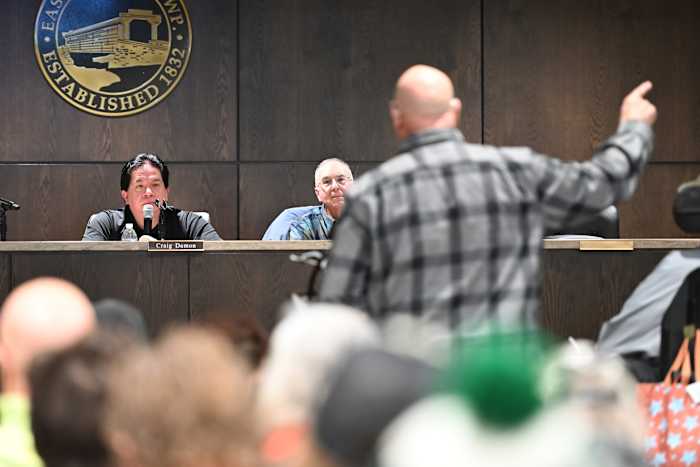
The introduction of data centers has transformed typically quiet municipal meetings into heated debates, with many residents vocally opposing the plans. These gatherings in both rural and suburban settings have become battlegrounds where community members demand that officials deny the applications.
“Would you want this built in your backyard?” queried Larry Shank during a recent meeting in East Vincent Township, Pennsylvania. “Because that’s where it’s literally going, is in my backyard.”
As data centers continue to spread, so does the opposition, with communities uniting to protect their landscapes from these industrial giants.
A growing number of proposals are going down in defeat, sounding alarms across the data center constellation of Big Tech firms, real estate developers, electric utilities, labor unions and more.
Andy Cvengros, who helps lead the data center practice at commercial real estate giant JLL, counted seven or eight deals he’d worked on in recent months that saw opponents going door-to-door, handing out shirts or putting signs in people’s yards.
“It’s becoming a huge problem,” Cvengros said.
Data Center Watch, a project of 10a Labs, an AI security consultancy, said it is seeing a sharp escalation in community, political and regulatory disruptions to data center development.
Between April and June alone, its latest reporting period, it counted 20 proposals valued at $98 billion in 11 states that were blocked or delayed amid local opposition and state-level pushback. That amounts to two-thirds of the projects it was tracking.
Some environmental and consumer advocacy groups say they’re fielding calls every day, and are working to educate communities on how to protect themselves.
“I’ve been doing this work for 16 years, worked on hundreds of campaigns I’d guess, and this by far is the biggest kind of local pushback I’ve ever seen here in Indiana,” said Bryce Gustafson of the Indianapolis-based Citizens Action Coalition.
In Indiana alone, Gustafson counted more than a dozen projects that lost rezoning petitions.
Similar concerns across different communities
For some people angry over steep increases in electric bills, their patience is thin for data centers that could bring still-higher increases.
Losing open space, farmland, forest or rural character is a big concern. So is the damage to quality of life, property values or health by on-site diesel generators kicking on or the constant hum of servers. Others worry that wells and aquifers could run dry.
Lawsuits are flying — both ways — over whether local governments violated their own rules.
Big Tech firms Microsoft, Google, Amazon and Facebook — which are collectively spending hundreds of billions of dollars on data centers across the globe — didn’t answer Associated Press questions about the effect of community pushback.
Microsoft, however, has acknowledged the difficulties. In an October securities filing, it listed its operational risks as including “community opposition, local moratoriums, and hyper-local dissent that may impede or delay infrastructure development.”
Even with high-level support from state and federal governments, the pushback is having an impact.
Maxx Kossof, vice president of investment at Chicago-based developer The Missner Group, said developers worried about losing a zoning fight are considering selling properties once they secure a power source — a highly sought-after commodity that makes a proposal far more viable and valuable.
“You might as well take chips off the table,” Kossof said. “The thing is you could have power to a site and it’s futile because you might not get the zoning. You might not get the community support.”
Some in the industry are frustrated, saying opponents are spreading falsehoods about data centers — such as polluting water and air — and are difficult to overcome.
Still, data center allies say they are urging developers to engage with the public earlier in the process, emphasize economic benefits, sow good will by supporting community initiatives and talk up efforts to conserve water and power and protect ratepayers.
“It’s definitely a discussion that the industry is having internally about, ‘Hey, how do we do a better job of community engagement?’” said Dan Diorio of the Data Center Coalition, a trade association that includes Big Tech firms and developers.
Data center opposition dominates local politics
Winning over local officials, however, hasn’t translated to winning over residents.
Developers pulled a project off an October agenda in the Charlotte suburb of Matthews, North Carolina, after Mayor John Higdon said he informed them it faced unanimous defeat.
The project would have funded half the city’s budget and developers promised environmentally friendly features. But town meetings overflowed, and emails, texts and phone calls were overwhelmingly opposed, “999 to one against,” Higdon said.
Had council approved it, “every person that voted for it would no longer be in office,” the mayor said. “That’s for sure.”
In Hermantown, a suburb of Duluth, Minnesota, a proposed data center campus several times larger than the Mall of America is on hold amid challenges over whether the city’s environmental review was adequate.
Residents found each other through social media and, from there, learned to organize, protest, door-knock and get their message out.
They say they felt betrayed and lied to when they discovered that state, county, city and utility officials knew about the proposal for an entire year before the city — responding to a public records request filed by the Minnesota Center for Environmental Advocacy — released internal emails that confirmed it.
“It’s the secrecy. The secrecy just drives people crazy,” said Jonathan Thornton, a realtor who lives across a road from the site.
Documents revealing the extent of the project emerged days before a city rezoning vote in October. Mortenson, which is developing it for a Fortune 50 company that it hasn’t named, says it is considering changes based on public feedback and that “more engagement with the community is appropriate.”
Rebecca Gramdorf found out about it from a Duluth newspaper article, and immediately worried that it would spell the end of her six-acre vegetable farm.
She found other opponents online, ordered 100 yard signs and prepared for a struggle.
“I don’t think this fight is over at all,” Gramdorf said.
___
Follow Marc Levy on X at https://x.com/timelywriter.
Copyright 2026 The Associated Press. All rights reserved. This material may not be published, broadcast, rewritten or redistributed without permission.